








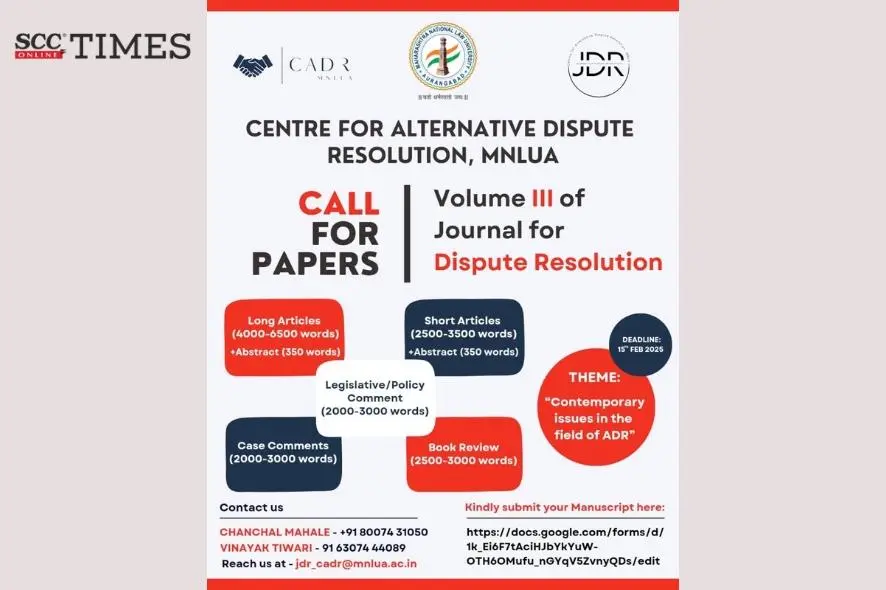
About MNLU
Maharashtra National Law University, Aurangabad (MNLU Aurangabad) is a National Law University in Aurangabad, Maharashtra, India.
About the Journal
The Journal for Dispute Resolution (JDR) is an open-access, annual, and double-blind peer-reviewed journal of MNLU-A. The journal aims to provide a platform for meaningful discourse on contemporary legal issues surrounding ADR in India and international jurisdictions. The Journal primarily seeks to promote interest, research and academic writing among academia, practitioners, students and research scholars alike.
With utmost pleasure, the JDR released its First Volume namely Journal for Dispute Resolution-Volume I in July 2023 and Volume II in May 2024 dedicated to the field of ADR. As the Centre celebrates this achievement, we look forward to continuing this journey of knowledge dissemination and academic excellence through calling for submissions for its Third Volume.
Sub-themes
The Journal Welcomes submission on any of the following sub-themes:
- Arbitration in Intellectual Property Disputes: Arbitrability of Infringement dispute over the Internet
- Extension of curative jurisdiction over arbitral awards: Effects on Indian arbitration regime
- Public Policy of India and International Commercial Arbitration
-
Generative AI and Arbitration
Note: The above sub-themes are only suggestive. The journal welcomes submissions on any contemporary topic related to domestic and international arbitration and other contemporary topics on Alternative Dispute Resolution mechanisms.
Submission Categories
- Long Articles (4000-6500 words): The article must be a comprehensive and in-depth analysis of a contemporary issue in the ADR field and should include references to a range of sources and contributions in the form of alternatives and suggestions.
- Short Articles (2500-3500 words): The article must be an analysis of a contemporary issue in ADR field and should include a reference to a range of sources and contributions in the form of alternatives and suggestions
- Case Comments (2000-3000 words): The comment must be an analysis of a recent judgment, bringing out its relevance in light of the development of ADR laws, views expressed in the judgment and the opinion(s) of the author.
- Book Review (2000-3000 words): The review must be a crisp account of a recently published book on any form of ADR Laws, including the issues explored and related arguments of the author.
-
Legislative/Policy Comment (2000-3000 words): The comment must be a critical analysis and evaluation of contemporary legislative/policy developments in the field of ADR.
Submission Guidelines
- Co-authorship is permissible only up to a maximum of two authors.
- Submissions are accepted in ENGLISH language only.
- All Articles must be accompanied by an abstract not exceeding 350 words excluding Case Comments & Book Reviews.
- The author must highlight the legal or socio-economic relevance of the topic chosen in the current scenario in the manuscript.
- The body of the document must be in Times New Roman, Font size of 12 and line Spacing of 1.5 with justified alignment.
- All the footnotes must mandatorily conform to The Bluebook (20th Edition): A Uniform System of Citation.
- All submissions are required to be mailed in MS Word (.doc) format only.
- The word limit is exclusive of footnotes and abstract. The prescribed word limit may be relaxed up to 10%, at the discretion of the Editorial Board.
- The permitted level of Similarity is 15% excluding references or footnotes.
- All submissions shall be screened for AI written content/paper. The Journal adopts a zero-tolerance policy towards the same.
-
Every authorship or co-authorship is limited to a maximum of one submission.
How to Submit?
Interested candidates can submit entries via the link given at the end of the post.
Deadline
The Submissions must be sent by 11:59 pm, 15th February 2025.
Contact
In case of any queries, kindly email at jdr_cadr@mnlu.ac.in.






0 replies