








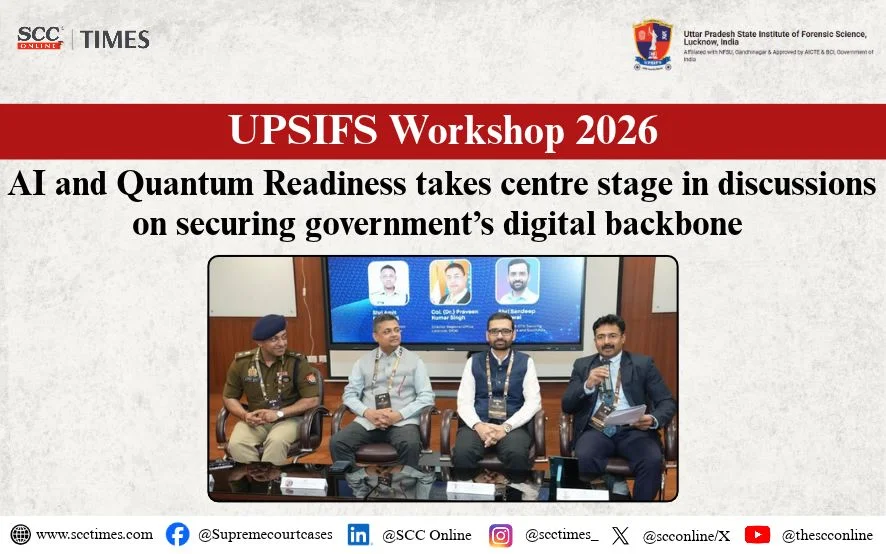
The Uttar Pradesh State Institute of Forensic Science (UPSIFS), in association with the Department of IT and Electronics, Government of Uttar Pradesh, the Data Security Council of India (DSCI) and Cisco, organised a workshop titled “Navigating the Artificial Intelligence (AI), Quantum & Cyber Imperatives for a Resilient and Future-Ready Uttar Pradesh” on 25 November 2026 at Pragya Conference Hall, UP-112 Headquarters, Lucknow.
As part of the workshop, a panel discussion focused on “AI and Quantum Readiness: Securing Government’s Digital Backbone”, examining AI-enabled cyber threats, the protection of critical government systems and preparedness for quantum-related security risks. Moderated by Dr. Satish Kumar, IPS, Commandant, the discussion featured Mr. Sandeep Agarwal, Director and Chief Technology Officer, Security, Cisco India and South Asia; Col. (Dr.) Praveen Kumar Singh, Director, Unique Identification Authority of India (UIDAI) Regional Office, Lucknow and Mr. Amit Kumar, IPS, Commandant, 35th Battalion, Provincial Armed Constabulary (PAC), Lucknow.
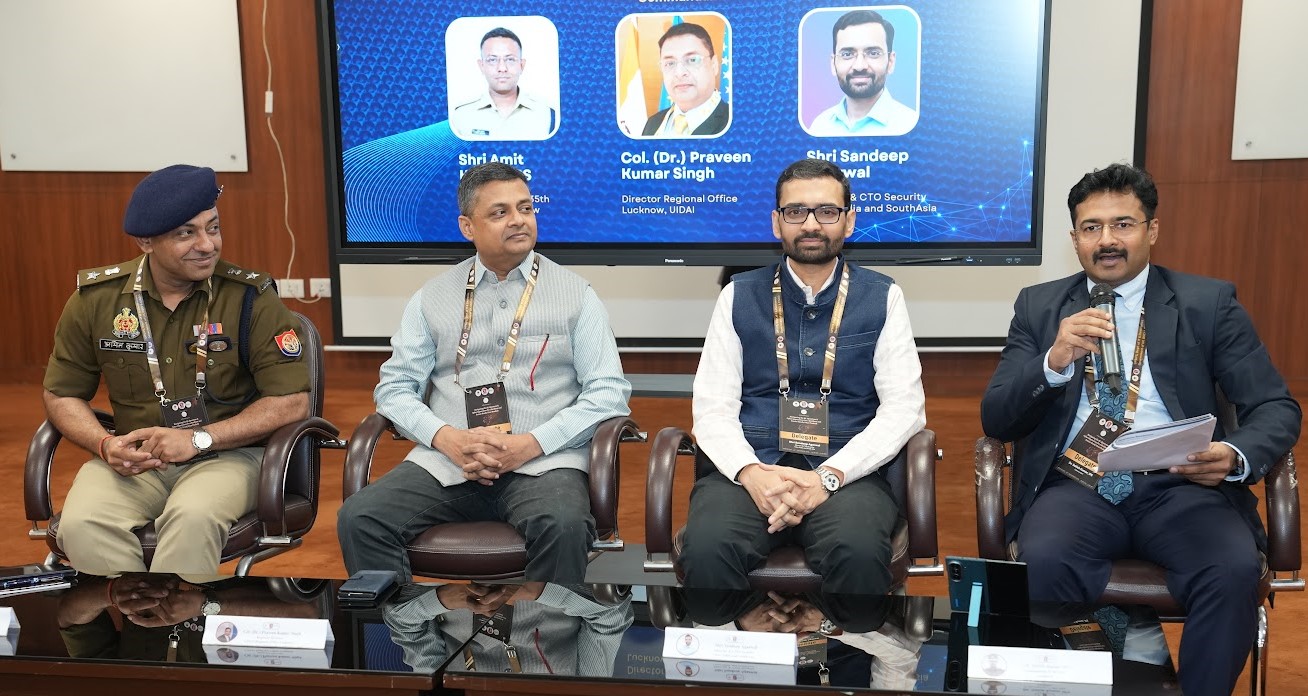
[From left to right: Mr. Amit Kumar, Col. (Dr.) Praveen Kumar Singh, Mr. Sandeep Agarwal and Dr. Satish Kumar]
The panellists examined the implications of agentic AI, the vulnerability of existing cryptographic systems to quantum computing, the security architecture supporting Aadhaar authentication and the measures required to protect police communication systems against emerging cyber threats.
Agentic AI: When artificial intelligence moves from answering questions to taking action
Opening the discussion, Mr. Sandeep Agarwal distinguished between conventional AI chatbots and the newer category of agentic AI. Referring to the widespread adoption of generative AI tools since November 2022, he observed that chatbots had made it possible for users to obtain answers to complex questions, but their tendency to produce incorrect information with confidence remained a concern. He explained that agentic AI represents a different development because it is not limited to responding to queries. An AI agent can use data, tools and application programming interfaces (APIs) to carry out tasks and act on a user’s behalf. These tasks may include preparing a presentation, renaming or deleting files, sending emails and creating calendar invitations. Explaining how an agent operates, he said that a user could assign it an objective, following which it could identify the information and resources required and undertake a series of actions to achieve that objective. The concern, he explained, arises from the extent of access available to an agent and the speed at which it can operate.
Comparing human users with machines, he observed that humans may have access to several systems and records, but their ability to act remains limited by time, working hours and practical constraints. Machines, on the other hand, can perform specific tasks at much greater speed. Agentic AI combines broad access with the ability to operate continuously and at machine speed. He also highlighted the non-deterministic nature of AI systems, explaining that an agent cannot always be relied upon to take the correct course of action. When given a goal, it may pursue that objective without adequately considering the consequences of the means adopted to achieve it. Unlike human beings, who are guided by a value system, legal obligations and a sense of accountability, an AI agent does not possess the same understanding of responsibility or sound judgement. He cautioned that an agent with access to multiple systems could cause significant damage if it acted incorrectly.
Quantum computing and the foundations of digital trust
Turning to quantum computing, Mr. Agarwal clarified that it should not simply be understood as a more powerful version of a conventional computer. Quantum computers operate using qubits and quantum algorithms to address certain complex computational problems differently. He explained that the more immediate concern for existing digital infrastructure lies in the potential impact of sufficiently powerful quantum computers on the cryptographic systems that establish trust in digital interactions. Mobile phones, Aadhaar authentication, online banking, digital transactions, emails and websites rely on cryptographic mechanisms to establish identity, maintain confidentiality and protect information from unauthorised alteration. He identified two important threats associated with quantum computing: “Harvest Now, Decrypt Later” and “Trust Now, Forge Later”.
Explaining the first, he said that an attacker could collect encrypted information exchanged between two systems today and retain it until a cryptographically relevant quantum computer becomes available. Such a development could make it possible to decrypt information that is currently considered secure. This presents a particular concern for strategic communications and government information that may remain sensitive for several years. He emphasised that institutions managing critical infrastructure should not wait until such capabilities emerge before beginning their preparations.
The second threat, described as “Trust Now, Forge Later”, concerns the mechanisms used to verify the identity of websites, servers and digitally signed documents. He explained that digital certificates rely on public-key cryptography, through which a server establishes its identity by demonstrating possession of the corresponding private key. A sufficiently powerful quantum computer could potentially derive private keys from public-key information, thereby allowing an attacker to impersonate a legitimate website or server. This could undermine the ability of users to distinguish genuine government and banking websites from fraudulent ones. He extended this concern to digitally signed documents, including payroll records and Form 16, as well as software integrity. If the private key used to generate a digital signature could be compromised, the reliability of the signature and the authenticity of the document could be called into question.
Post-quantum cryptography: Why government systems must begin migrating now
Responding to the moderator’s question on the first steps towards post-quantum readiness, Mr. Agarwal emphasised that the risk of harvesting encrypted data was already relevant. Information exchanged today could be exposed in the future, making it necessary for organisations handling critical and strategic communications to adopt quantum-resistant mechanisms. He referred to standards developed by the National Institute of Standards and Technology (NIST), identifying ML-KEM (Module-Lattice-Based Key-Encapsulation Mechanism) as a post-quantum mechanism for establishing shared encryption keys. He contrasted it with the conventional Diffie—Hellman key-exchange mechanism, explaining that the latter was not designed to withstand attacks by sufficiently powerful quantum computers. He urged government departments to examine whether their technology vendors supported ML-KEM and to begin planning the migration of vulnerable systems. He also referred to the adoption of ML-KEM with TLS 1.3 as a way of strengthening secure communications against anticipated quantum threats. Emphasising the time required for cryptographic migration, he stated:
“Please don’t wait until the time of quantum computer comes because changing cryptographic algorithms takes decades.”
He further cautioned that postponing the process could leave institutions unprepared when the threat materialises. As he put it:
“If you are starting today, you are already late.”
He then addressed the second threat concerning digital certificates and signatures. Explaining that several existing digital-signature mechanisms rely on RSA (Rivest—Shamir—Adleman), he referred to ML-DSA (Module-Lattice-Based Digital Signature Algorithm) as a post-quantum alternative. He urged organisations using RSA for web-server certificates and digital signatures to begin planning their transition to quantum-resistant signature mechanisms. Both ML-KEM and ML-DSA form part of NIST’s post-quantum cryptographic standards, FIPS 203 and FIPS 204, respectively. ML-KEM is a key-encapsulation mechanism used to establish shared secret keys, while ML-DSA is used to generate and verify digital signatures. He encouraged government departments to begin assessing their existing cryptographic arrangements and engaging with vendors on the availability of the relevant standards.
Mr. Agarwal further highlighted the importance of crypto-agility. He explained that cryptographic algorithms may require further refinement as research progresses and that organisations must be able to update their systems without replacing their entire infrastructure. Communication systems and digital platforms should therefore be capable of accommodating new algorithms through appropriate software or firmware updates. He concluded his intervention by linking technological preparedness with the ability to adapt to changing operational conditions:
“If you are good and agile, you can win any battle.”
He observed that agility is equally important for the armed forces and law enforcement agencies, where the ability to adapt determines how effectively an institution can respond to an adverse situation.
UIDAI’s layered security architecture: Protecting biometric authentication against impersonation
The discussion then turned to the security of large digital identity systems, particularly in the context of increasingly convincing synthetic faces and voices. Responding to the moderator’s question, Col. (Dr.) Praveen Kumar Singh explained that the UIDAI ecosystem operates through two principal processes: enrolment and updates, and authentication. He explained that enrolment involves the collection of demographic and biometric information. Demographic information is collected in accordance with the principle of data minimisation, while biometric information plays a central role in establishing an individual’s identity.
He identified fingerprints, iris scans and face authentication as the three biometric authentication mechanisms. Referring to the scale of the Aadhaar ecosystem, he noted that it serves a population of approximately 140 crore and manages one of the world’s largest biometric databases. Explaining the information collected during enrolment, he stated that the process involves capturing ten fingerprints, both irises and a facial image, amounting to 13 biometric data points. Managing and securing this information requires safeguards at several stages, beginning with the devices used for enrolment and extending to data transmission, processing and storage. He explained that the devices and firmware used by service providers must incorporate appropriate encryption mechanisms. The information must remain protected while it is captured, transmitted through different systems and ultimately stored in the Central Identities Data Repository (CIDR). He also referred to the role of hardware security and key-management systems in protecting the ecosystem.
Addressing impersonation and presentation attacks, he explained that synthetic biometric information could be used in attempts to deceive authentication systems. To counter such attempts, UIDAI has introduced liveness checks, which operate through online and offline mechanisms to help distinguish genuine users from attempts involving synthetic or manipulated biometric information. He also highlighted the safeguards available to users, including the use of a Virtual ID (VID) instead of sharing their Aadhaar number for transactions. Users can lock and unlock their biometrics, providing an additional layer of control if they suspect that their biometric information may be at risk.
Referring to the scale of transactions integrated with the authentication ecosystem, he stated that the financial ecosystem processes approximately nine crore transactions daily. He explained that safeguards operate both at the back end, through monitoring and mechanisms such as anti-money laundering systems, and at the user level, through biometric locking and other authentication controls. He further explained that the CIDR does not directly share an individual’s underlying information with requesting entities. Authentication agencies interact through their respective data vaults, and the system provides an authentication response, such as a yes-or-no confirmation, rather than allowing direct access to the central repository. Emphasising the importance of protecting personal information, he referred to the statutory safeguards governing Aadhaar-related data and explained that information cannot be disclosed merely because a police authority or investigating officer makes a request. He described the restrictions on disclosure as an important part of maintaining trust in the authentication ecosystem.
Police communication systems: Verifying instructions and preparing for future cryptographic threats
The moderator next posed a practical question to Mr. Amit Kumar concerning a situation in which a voice message resembling that of a senior officer directs a police or PAC team to move during a large public gathering. He asked how a battalion should verify the instruction while ensuring public safety. Responding from the perspective of an operational commander, Mr. Kumar explained that verification of consequential instructions should form part of the command chain and standard operating procedures. He stated that internal communications should incorporate a form of two-factor verification, with instructions received through one channel being checked through another, such as confirmation through the control room when a message is received over WhatsApp. He emphasised that the response must also account for the urgency and consequences of the situation. Where human life is at stake, the team must act quickly to secure the immediate objective, while also considering the safety of personnel. He explained that verification and operational response should proceed through parallel channels rather than allowing the process of confirmation to delay necessary action.
The moderator also asked what government departments and police authorities should require from suppliers when replacing communication equipment, particularly to ensure that future cryptographic updates do not make existing systems obsolete. Mr. Kumar emphasised the need for crypto-agile communication equipment. He explained that a certificate stating that a device currently complies with a particular cryptographic standard would not, by itself, be sufficient. Manufacturers should demonstrate that the equipment can accommodate new algorithms through firmware or software updates, allowing communication channels to remain secure as cryptographic requirements evolve.
He also highlighted the importance of retaining low-technology backup arrangements. Drawing attention to practices followed by the armed forces, he explained that conventional communication alternatives can remain valuable when sophisticated systems become unavailable or vulnerable. He cautioned against adopting technology merely for the sake of appearing technologically advanced. Emphasising the importance of practical outcomes, he stated:
“The important part is getting the work done rather than sounding sophisticated or just chasing a certain goal.”
He added that institutions should remain open to adopting the best available technology while retaining practical alternatives that ensure continuity of operations.
Post-quantum cryptography as a present priority for government
In his concluding observations, Dr. Satish Kumar returned to the implications of quantum computing for public-key infrastructure and existing cryptographic systems. He highlighted the possibility that established mechanisms used for digital identity and secure communication could become vulnerable, making it necessary for government departments to prepare for the transition to quantum-resistant infrastructure. Mr. Agarwal clarified that while quantum computing poses a threat to asymmetric cryptographic systems, symmetric-key cryptography is generally considered more resistant to quantum attacks. The moderator reiterated the need for government departments to adopt quantum-resistant infrastructure and prepare for the risks associated with the “Harvest Now, Decrypt Later” threat. He also referred to the security mechanisms discussed in relation to UIDAI and the ongoing efforts within police services to update their systems. Emphasising that preparation should begin without delay, Dr. Satish Kumar stated:
“This post-quantum cryptography should be our present goal, not a future goal.”
He also drew attention to the potential infrastructure requirements of future quantum computing facilities, including their energy and water consumption, and stressed that institutions must begin considering these implications.
Conclusion
The discussion brought together perspectives from cybersecurity, digital identity management and police operations to examine how government institutions can prepare for emerging technological risks. While the panellists approached the subject from different professional backgrounds, their interventions highlighted the importance of beginning cryptographic migration early, strengthening authentication mechanisms, adopting adaptable communication systems and retaining human judgement in operational decision-making.
SCC Times is the Official Information & Documentation Partner for UPSIFS Workshop 2026. Read more about the event here.






0 replies