








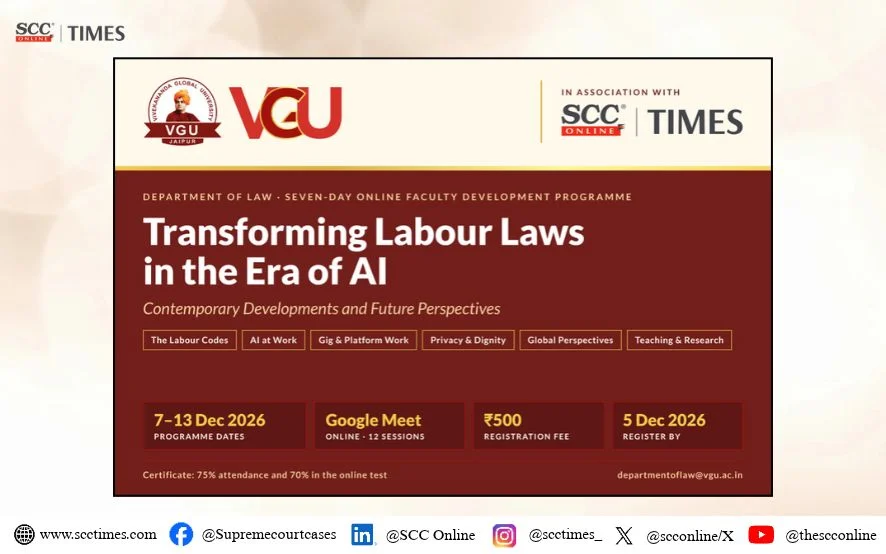
The Department of Law, Vivekananda Global University (VGU), Jaipur, in association with SCC Online Times, is organising a seven-day Online Faculty Development Programme on “Transforming Labour Laws in the Era of AI: Contemporary Developments and Future Perspectives” from 7 to 13 December 2026 on Google Meet.
Indian labour law has just been through its largest restructuring since Independence. On 21 November 2025, the four Labour Codes on wages, industrial relations, social security and occupational safety came into force and replaced 29 central labour statutes. The Central Rules followed in May 2026, and the States continue to frame their own. At the same time, work itself is changing: algorithms now screen applicants, allocate shifts, set pay and rate performance, and gig and platform workers have been recognised in the Code on Social Security, 2020 for the first time.
The programme examines both shifts together. Across twelve learning sessions, eminent academicians, policy makers, legal practitioners and industry experts will take participants through the new statutory framework, the legal questions raised by artificial intelligence at work, comparative developments abroad, and what all of this means for teaching and research.
Programme at a glance
Organiser |
Department of Law, Vivekananda Global University, Jaipur |
In association with |
SCC Online Times |
Dates |
7 to 13 December 2026 |
Mode |
Online, on Google Meet |
Sessions |
12 learning sessions, 10:00 to 11:00 AM and 2:00 to 3:00 PM IST |
Online test |
13 December 2026 |
Registration fee |
₹500 per participant (non-refundable and non-transferable) |
Last date to register |
5 December 2026 |
Certificate |
Issued to participants who attend at least 75% of the sessions and score at least 70% in the online test |
Themes
-
The Labour Codes in Operation: wages, industrial relations, social security and occupational safety under the four Codes; Central and State rules.
-
AI and the Employment Relationship: algorithmic management in hiring, scheduling, appraisal and termination, and where responsibility lies when a system decides.
-
Gig and Platform Work: worker status, and social security for gig and platform workers under the Code on Social Security, 2020.
-
Equality, Privacy and Dignity at Work: bias in automated decisions, workplace surveillance, and employee data under the Digital Personal Data Protection Act, 2023.
-
Collective Voice and Dispute Resolution: trade unions and collective bargaining in a digital economy, and adjudication under the Industrial Relations Code.
-
Safety, Skills and the Future of Work: occupational safety and health in automated workplaces, job displacement and reskilling.
-
Comparative and International Perspectives: ILO standards on decent work, the EU AI Act and Platform Work Directive, and lessons for India.
-
Teaching and Researching Labour Law: curriculum redesign after the Codes, classroom methods and research.
Objectives
-
To give participants a working command of the four Labour Codes, the rules under them and their early implementation.
-
To examine how artificial intelligence and platform work are changing the employment relationship and the rights that depend on it.
-
To place Indian developments beside international labour standards and regulatory responses in other jurisdictions.
-
To help teachers revise curricula, course material and classroom methods for labour and employment law.
-
To identify research questions and encourage interdisciplinary, publishable work in the field.
Who can attend
-
Faculty members of law, management, commerce and the social sciences
-
Research scholars and doctoral candidates
-
Advocates and legal practitioners
-
HR and industrial relations professionals
-
Postgraduate students with an interest in labour law
How to register
-
Fill in the registration form: Click here to register
-
Pay the registration fee of ₹500 through the UPI QR code provided in the programme brochure, and upload the payment receipt in the registration form.
-
A confirmation, the Google Meet link and the day-wise schedule will be sent to the registered email address.
Registration closes on 5 December 2026. The fee is non-refundable and non-transferable.
About Vivekananda Global University, Jaipur
Vivekananda Global University is a multidisciplinary State Private University established under Act 11 of 2012 of the Government of Rajasthan. Sponsored by the Bagaria Education Trust and inspired by Swami Vivekananda’s philosophy of holistic development, it is accredited NAAC A+ and offers over 200 programmes across 15 faculties to more than 33,800 students. In the QS Asia University Rankings 2026, the University was placed 95th in India, and it was ranked in the 151—200 band of the NIRF India Rankings 2025.
About the Department of Law
The Department of Law at VGU focuses on developing interdisciplinary legal education and scholarship, and its programmes are approved by the Bar Council of India. It offers the B.A. LL.B., B.B.A. LL.B., LL.B. and LL.M. programmes, and organises national events including the VGU Ranka Moot Court Competition and the VGU R.K. Rastogi Memorial Negotiation Competition. The Department runs a Moot Court Society, an Alternative Dispute Resolution Cell and a Legal Aid Cell, “Aapno Saathi”.
Organising committee
-
Convenor: Prof. (Dr.) Shilpa Rao Rastogi, Professor and HOD (Law)
-
Co-Convenors: Mr. Rahul Bishnoi and Ms. Daminee Sharma
-
Faculty Coordinators: Ms. Nitya Sharma and Mr. Ravindra Deora
Contact
For any queries, please contact:
-
Ms. Nitya Sharma: +91 97726 22148
-
Mr. Ravindra Deora: +91 94628 31156
-
Email: departmentoflaw@vgu.ac.in






0 replies