








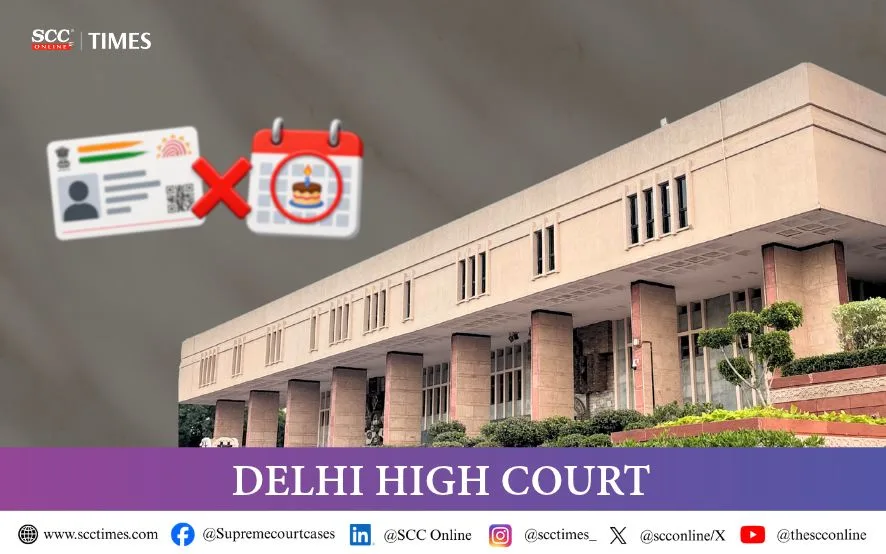
Delhi High Court: While considering a writ petition challenging the Labour Court’s award holding the termination of a workwoman’s services illegal for non-compliance with Section 25-F, Industrial Disputes Act, 1947 (ID Act), a Single Judge Bench of Manoj Kumar Ohri, J., dismissed the petition, holding that the management had failed to establish that the workwoman had attained the age of superannuation of 58 years. The Court observed that an Aadhaar card, by itself, could not be treated as conclusive proof of date of birth and upheld the Labour Court’s reliance on the Employees’ State Insurance Corporation (ESIC) records, which recorded the workwoman’s date of birth as 20 May 1960, as furnished by the management itself. The Court further reiterated that the scope of interference under Articles 226 and 227 of the Constitution is limited, and that a plausible finding based on the evidence on record cannot be interfered with merely because another view is possible. Accordingly, the Court held that the termination, effected without complying with the mandatory requirements of Section 25-F, ID Act, was illegal.
Background
The petitioner/management filed the present writ petition under Article 226 of the Constitution of India, assailing the award passed by the Labour Court-IX, Rouse Avenue Courts Complex, New Delhi, in LID No. 78/2018, whereby the respondent/workwoman was held to have been illegally retrenched and awarded full back wages from 20 May 2017 to 20 May 2018, along with consequential benefits and interest at the rate 6 per cent per annum.
The workwoman claimed that she had been employed with the management as a “Finishing Man” since 1 December 1981, drawing last wages of ₹10,500 per month. She alleged that upon demanding payment of revised minimum wages pursuant to the notification dated 3 March 2017 issued by the Government of NCT of Delhi, the management became annoyed with her and, on 20 May 2017, terminated her services when she demanded her earned wages for April 2017, in violation of Sections 25-F and 25-G, ID Act. Upon failure of conciliation proceedings, she instituted a claim before the Labour Court under Section 2-A(2), ID Act, seeking reinstatement with full back wages.
The management, however, contended that the workwoman had attained the age of superannuation, i.e., 58 years, on 20 May 2017, her date of birth being 20 May 1959, as recorded in her Aadhaar card. It further contended that following her cataract surgery, she had expressed her inability to continue working and had voluntarily resigned, which was accepted by the management. The management also disputed the applicability of Sections 25-F and 25-G, ID Act, asserting that it employed fewer than 10 workers.
The Labour Court rejected the management’s plea of superannuation, resignation and voluntary retirement, holding that the management had failed to establish the workwoman’s date of birth as 20 May 1959 or prove that she had voluntarily relinquished her services. Relying upon the date of birth furnished by the management to the ESIC, i.e., 20 May 1960, and drawing an adverse inference against the management for withholding the relevant records, the Labour Court held that the workwoman had been illegally and unjustifiably terminated. Accordingly, it awarded full back wages at the rate of ₹14,698 per month from 20 May 2017 till 20 May 2018, along with consequential benefits and interest at the rate 6 per cent per annum from the date of publication of the award till realisation.
Aggrieved by the impugned award, the management approached the Delhi High Court by way of the present writ petition.
Analysis
The Court observed that the scope of interference under Articles 226/227 of the Constitution of India is limited and that a writ court does not exercise appellate jurisdiction over the findings of the Labour Court. Interference is warranted only where the impugned order has been passed without jurisdiction, is perverse or violates the principles of natural justice.
The Court noted that the age of superannuation in the management’s establishment was 58 years and that the controversy revolved around the workwoman’s date of birth. If her date of birth was 20 May 1959, she would have attained the age of superannuation on 20 May 2017, and Section 25-F, ID Act would not be attracted. However, if her date of birth was 20 May 1960, the termination of her services would amount to retrenchment and, in the absence of compliance with Section 25-F, ID Act, would be illegal.
The Court observed that the burden of proving the workwoman’s date of birth as 20 May 1959 was upon the management, which had raised the plea of superannuation. However, the management relied solely upon the Aadhaar card (Ext. WW-1/7) to establish her date of birth. Relying upon the Unique Identification Authority of India (UIDAI) Office Memorandum dated 20 December 2018 and the Supreme Court’s decision in Saroj v. Iffco-Tokio General Insurance Co., 2024 SCC OnLine SC 3038, the Court reiterated that an Aadhaar card is not, by itself, proof of date of birth, as the date is recorded on the basis of documents or self-declaration furnished by the card holder.
The Court further noted that the ESIC record, which had been summoned by the Labour Court, reflected the workwoman’s date of birth as 20 May 1960, as furnished by the management itself at the time of her registration on 26 June 2010. Significantly, the said entry had been made several years before the dispute arose, when neither party had any apparent reason to dispute her age. The management neither cross-examined the ESIC official nor produced the documents on the basis of which the date of birth had been furnished to the ESIC. Accordingly, the Labour Court had rightly drawn an adverse inference against the management for withholding the relevant records.
The Court held that the Labour Court had rightly preferred the ESIC record over the Aadhaar card, particularly when the latter was received by the management only in March 2017, barely 2 months before the workwoman’s services were brought to an end. It observed that having recorded her date of birth as 20 May 1960 before the ESIC, the management could not subsequently rely upon a different date of birth reflected in the Aadhaar card to end her services a year earlier. The Court further held that the finding of the Labour Court was a plausible view based on the evidence on record and could not be termed perverse so as to warrant interference in writ jurisdiction.
With regard to the legality of termination, the Court held that once the workwoman was found not to have attained the age of superannuation and the management had failed to prove her resignation or voluntary retirement, the termination of her services without complying with Section 25-F, ID Act was rightly held to be illegal.
Decision
Accordingly, finding no merit in the writ petition, the Court dismissed the same. It further directed that the amount deposited with the Registrar General of the Court, along with accrued interest, be released to the workwoman and that the remaining amount, if any, be paid by the management within 4 weeks.
Also Read: Motor Accident Claim: Aadhar not per-se proof of date of birth
[J.J. Electronics v. Rosamma Joy, 2026 SCC OnLine Del 8708, decided on 13-11-2026]
Advocates who appeared in this case:
For the Petitioner: Renu, Kamlesh Kumar Mishra, Piyush, and Mansi, Advocates
For the Respondent: Aarlin Moncy and Sruti Mehrotra, Advocates








0 replies