








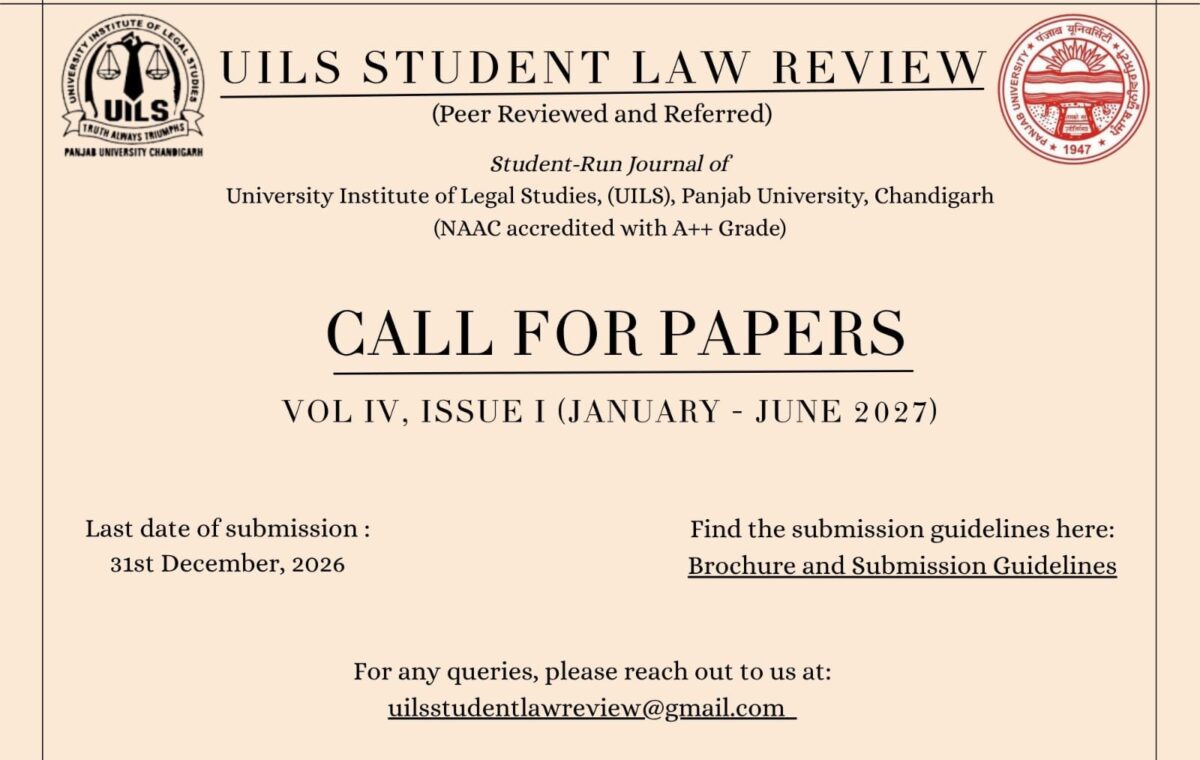
The Editorial Board of the UILS Student Law Review (USLR) invites original, unpublished and well-researched manuscripts from law students and research scholars across recognised institutions for publication in Volume IV, Issue I (January—June 2027).
USLR is a biannual, student-run academic journal of the University Institute of Legal Studies, Panjab University, Chandigarh. Committed to fostering rigorous legal scholarship and critical academic inquiry, the Review seeks to provide an inclusive platform for engaging with contemporary legal developments and emerging questions at the intersection of law, social, and policy-oriented questions.
The Review welcomes submissions engaging with contemporary legal issues across all branches of law. Contributions may adopt doctrinal, comparative, interdisciplinary or critical approaches, provided they demonstrate academic rigour, originality and a meaningful contribution to existing legal discourse.
The editorial team expresses its sincere appreciation to our Patron-in-Chief, Prof. (Dr.) Meenakshi Goyal, Hon’ble Vice-Chancellor, Panjab University (Chandigarh), our Patron, Prof. (Dr.) Shruti Bedi, Director, University Institute of Legal Studies and our Faculty Coordinator, Prof. (Dr.) Bharat. At the helm of the Editorial team is Suhani Salwan (5th Year) as Editor, supported by Co-Editors Jasmine Dhakarwal (4th Year) and Prasha Bhatia (4th Year). The team is further strengthened by its members, including Taranjot Kaur (5th Year), Aryaman Setia (4th Year), Prini Datta (4th Year), Vanya Monga (3th Year), Harkirat Singh (3rd Year), Mehak Marodia (3rdYear).
CATEGORIES OF SUBMISSIONS
The Review invites manuscripts under the following categories:
-
Articles (3,000 – 5,000 words)
Comprehensive research contributions undertaking an in-depth examination of contemporary legal issues, supported by relevant legal authorities and scholarly analysis.
-
Case Comments (1,500 – 3,000 words)
Critical and concise analyses of recent judicial pronouncements or landmark decisions, examining their reasoning, implications and contribution to the development of law.
-
Legislative Comments (1,500 – 3,000 words)
Detailed examination and critical scrutiny of proposed Bills, enacted legislation or legislative developments, with particular emphasis on their legal and practical implications.
-
Book Reviews (1,500 – 3,000 words)
Critical assessments of books concerning law and allied disciplines, evaluating their central arguments, scholarly contribution and relevance to contemporary legal discourse.
All word limits are exclusive of footnotes. The Editorial Board reserves the discretion to relax the prescribed limits depending upon the quality of the submission.
ELIGIBILITY
Submissions are invited from:
-
Students enrolled in five-year integrated law programmes;
-
Students enrolled in three-year LL.B. programmes;
-
LL.M. students; and
-
Research Scholars from recognised law schools and institutions across the globe.
Working professionals are not eligible to submit manuscripts, either as primary authors or co-authors.
Co-authorship of a maximum of two authors is permitted.
GENERAL SUBMISSION GUIDELINES
-
All submissions must be original, unpublished and not under consideration for publication elsewhere.
-
Every manuscript must be accompanied by an abstract not exceeding 250 words, written in italics, and five relevant keywords.
-
The manuscript must not contain any information disclosing the identity of the author(s), in accordance with the journal’s anonymity requirements.
-
The Review follows a one-author, one-submission policy. In cases of multiple submissions, the latest submission shall be considered, subject to any indication to the contrary by the author(s).
-
Submissions exceeding the prescribed plagiarism threshold of 15% shall be summarily rejected.
-
The accuracy of quotations, authorities, citations, names, dates, tables, footnotes and other references remains the responsibility of the author(s).
-
The Editorial Board reserves the right to accept, reject or seek revisions to any submission. Its decision shall be final.
-
All submissions must be made exclusively through the prescribed Google form. Submissions sent via email or any other mode shall not be entertained.
FORMATTING AND CITATION REQUIREMENTS
-
Citation Style: Indian Law Institute (ILI) Citation Style.
-
Title — Times New Roman, 14 points, 1.5 line spacing, Bold, All Caps, Centre Aligned.
-
Main Text: Times New Roman, 12-point font, 1.5 line spacing, justified alignment, 1cm indent on both sides.
-
Heading Level 1 —Times New Roman, 14 points, 1.5 line spacing, Bold, Capitalize each word and Small Caps, Centre Aligned, Numbering should be: I, II, III, …
-
Heading Level 2 —Times New Roman, 12 points, 1.5 line spacing, Italics, Sentence case, Centre Aligned, Numbering should be: A, B, C, …
-
Heading Level 3 —Times New Roman, 12 points, 1.5 line spacing, Italics and Underlined, Sentence case, Left Aligned, Numbering should be: a), b), c), …
-
Heading Level 4 —Times New Roman, 12 points, 1.5 line spacing, Italics, Sentence case, left-aligned, Numbering should be: i., ii., iii., …
-
Footnotes: Times New Roman, 10-point font, single line spacing, justified alignment.
-
Abstract: Times New Roman, 12-point font, italics, 1.15 line spacing.
-
Manuscript Structure: Papers must be organised under appropriate headings and subheadings rather than divided into chapters.
-
Acronyms and short forms on first instance should be spelt out in parentheses. These acronyms or short forms should be followed at all further instances in the manuscript.
-
Names of cases, publications, books, emphasised words, and uncommon foreign words should be italicised.
-
Numbers should be written in words, and percentages should be denoted by the ‘%’ symbol.
Authors must adhere to the detailed formatting and style requirements prescribed in the USLR Submission Guidelines.
MODE OF SUBMISSION
All manuscripts shall be submitted exclusively through the prescribed Google Form. Submissions made through email or any other mode shall not be entertained.
Submission Link: https://forms.gle/gVjPcVjEVJaopkhF9
Detailed Submission Guidelines: https://drive.google.com/file/d/1f-dUe13H0a0QTzq_lhgLBEH8Xg2lEppc/view?usp=sharing
Last Date for Submission: 31 December 2026
CONNECT WITH US
For queries and further information:
Contact Details:
Editor: Suhani Salwan — +91 85270 09695
Co-Editors: Jasmine Dhakarwal — +91 93508 79414
Prasha Bhatia — +91 6283 899683
We look forward to receiving original and thought-provoking contributions that enrich contemporary legal scholarship and advance meaningful academic discourse.
Please refer to the brochure for further details.
EDITORIAL BOARD
UILS Student Law Review
University Institute of Legal Studies
Panjab University, Chandigarh
Patron-in-Chief: Prof. (Dr.) Meenakshi Goyal, Hon’ble Vice-Chancellor, Panjab University
Patron: Prof. (Dr.) Shruti Bedi, Director, UILS
Faculty Coordinator: Prof. (Dr.) Bharat





0 replies