








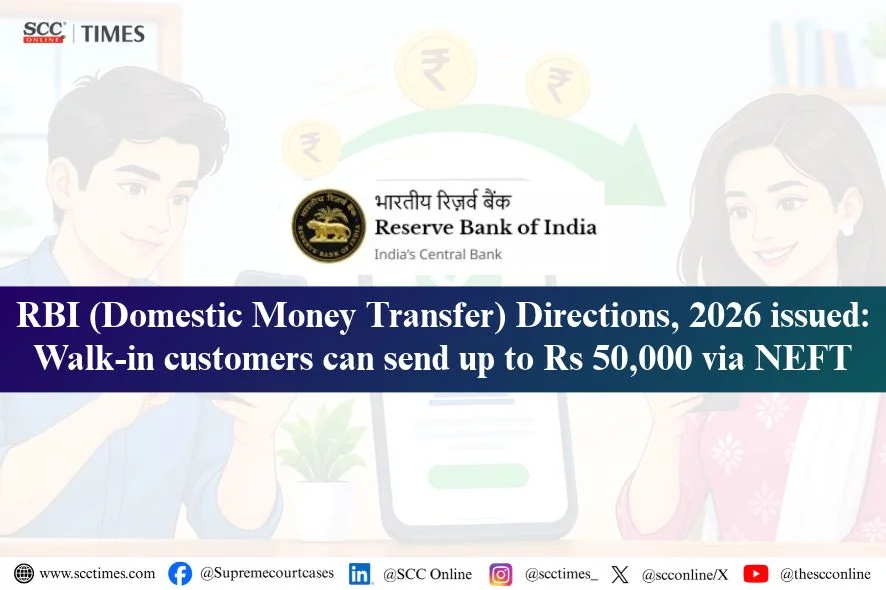
On 11 November 2026, the Reserve Bank of India (RBI) issued the Reserve Bank of India (Domestic Money Transfer) Directions, 2026, to consolidate the existing instructions pertaining to Domestic Money Transfer (DMT) services.
The Domestic Money Transfer framework was introduced to facilitate small-value fund transfers through formal banking channels, particularly for individuals, including migrant workers, who may lack access to such facilities in the absence of valid proof of identity or address. The framework prescribes transaction limits, monthly ceilings, monitoring requirements, and other safeguards to ensure the secure and regulated conduct of such transfers.
These Directions are issued under Section 18 read with Section 10(2) of the Payment and Settlement Systems Act, 2007 and shall be effective immediately.
Key Points:
1. Applicability
The Directions apply to:
⮚ Scheduled Commercial Banks
⮚ Regional Rural Banks (RRBs)
⮚ Urban Cooperative Banks
⮚ State and District Central Cooperative Banks
⮚ Authorised Payment System Operators and System Participants (banks and non-banks)
Card-to-card transfers are excluded from the purview of these Directions and continue to be governed by the separate payment instrument guidelines/approvals.
2. Payment of amounts transferred from a bank account (Cash Pay-out Service)
Banks can facilitate transfers from a customer’s bank account for cash withdrawal by beneficiaries without bank accounts through:
⮚ ATMs
⮚ Business Correspondents
⮚ Any other authorised payment channels
Key limits are:
⮚ Maximum amount of Rs 10,000 per transaction
⮚ Monthly ceiling of Rs 25,000 per beneficiary
3. Payment of amounts to be credited to bank accounts (Cash Pay-in Service)
⮚ Walk-in customers can remit funds up to Rs 50,000 to a beneficiary’s bank account through NEFT at a bank branch.
⮚ Banks are also permitted to allow such customers to transfer funds to a beneficiary’s bank account through Business Correspondents, ATMs, etc., up to a maximum amount of Rs 5,000 per transaction with a monthly cap of Rs 25,000 per remitter.
4. Strengthened KYC and Authentication
For cash-to-account remittances:
⮚ Registration requires a verified cell phone number and a self-certified Officially Valid Document (OVD) in line with the RBI (Commercial Banks — Know Your Customer) Directions, 2025, as amended from time to time.
⮚ Every transaction must be authenticated using an Additional Factor of Authentication (AFA).
5. Operational Safeguards and Monitoring
Banks and non-banks shall put in place a robust system of safeguards including:
⮚ Velocity checks
⮚ Customer alerts
⮚ Monitoring of unusual spikes in credit volumes
⮚ Investigation of suspicious transactions
⮚ Reporting of suspicious transactions to appropriate authorities
6. Real-Time Processing
⮚ DMT transactions are expected to be completed on a real-time or near-real-time basis.
7. Settlement Through Approved Systems Only
⮚ Inter-bank settlement under DMT shall occur only through RBI-approved payment systems.
8. Charges
⮚ Banks and non-banks may levy reasonable charges for DMT services to popularise and encourage wider adoption of the facility.
9. Customer Grievance Redressal
⮚ Banks and non-banks, as applicable, may set up grievance redressal mechanisms. Complaints will be covered under the Reserve Bank Integrated Ombudsman Scheme, 2026, as amended from time to time.
With the issuance of these Directions, the Domestic Money Transfer — Relaxations (dated 5 October, 2011) and the Domestic Money Transfer — Review of Framework (dated 24 July, 2024) stand subsumed and repealed.






0 replies