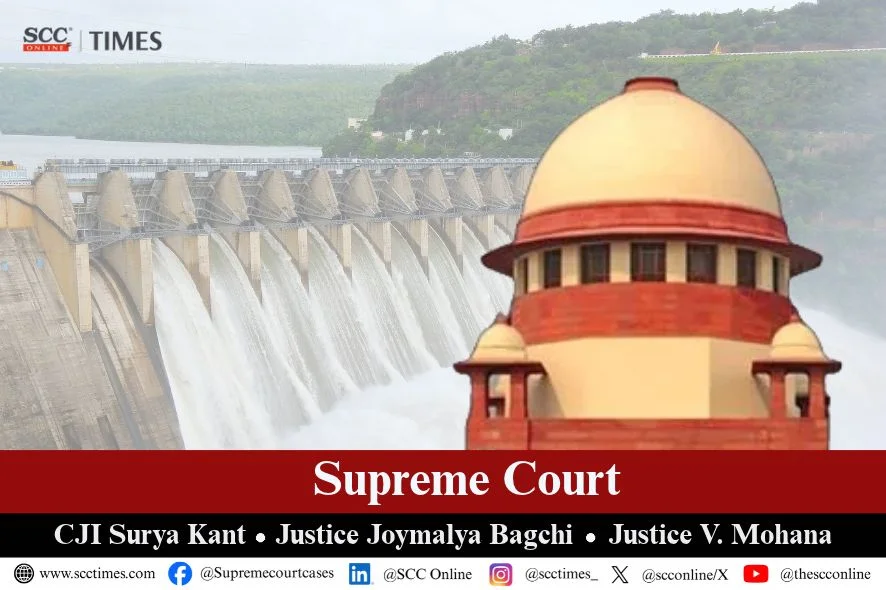
Supreme Court: While adjudicating the long-standing dispute between the State of Himachal Pradesh and the States of Punjab and Haryana concerning the allocation of power generated from the Bhakra-Nangal and Beas Hydro-Electric Projects, a three-Judge Bench of Surya Kant, CJ* with Joymalya Bagchi and V. Mohana, JJ., directed Punjab and Haryana to supply 13,066 million units of energy arrears to Himachal Pradesh over 20 lean seasons, after adjusting the latter’s capital-cost liability of ₹420.77 crores against the arrears. The Court held that the present proceedings were in the nature of execution proceedings and could not be used to reopen issues conclusively determined by its judgment dated 27 September 2011. Accordingly, the Court directed that the remaining 11,973 million units be supplied over 20 years on a cashless basis and disposed of the suit along with all pending applications.
Background
The dispute arose out of the competing claims of the State of Himachal Pradesh (Plaintiff-State) and the successor States of Punjab and Haryana, along with the Union of India, Rajasthan and the Union Territory of Chandigarh, concerning the allocation of power generated from the Bhakra-Nangal and Beas Hydro-Electric Projects (Hydel Projects). The Projects were conceived when the erstwhile State of Punjab existed as a composite entity and were substantially constructed on the territory of the erstwhile State of Bilaspur and within Kangra district, both of which now form part of Himachal Pradesh. The construction of the Projects resulted in the submergence of approximately 27,869 acres of land in Bilaspur and over 65,050 acres in Kangra district, while the power generated therefrom continued to be enjoyed principally by the composite State of Punjab and, subsequently, its successor States.
Following the reorganisation of the composite State of Punjab with effect from 1 November 1966, under the Punjab Reorganisation Act, 1966, certain territories were transferred to Himachal Pradesh, while the States of Punjab and Haryana and the Union Territory of Chandigarh came into existence. Section 78, Punjab Reorganisation Act, 1966 provided for the apportionment of rights and liabilities in respect of the Hydel Projects between the successor States. However, no final apportionment was undertaken, and the power generated from the Projects continued to be distributed amongst the States concerned on an ad hoc basis. While the Defendant-States maintained that the respective rights had been settled through the arrangements dated 17 April 1967 and 30 March 1978, Himachal Pradesh consistently contended that the said arrangements were merely tentative and did not constitute a final determination of the respective entitlements.
In 1969, Himachal Pradesh asserted its entitlement to 7.19 per cent of the total benefits arising from the Hydel Projects, on the basis of the proportion of the population of composite Punjab transferred to the State upon reorganisation. After the Central Government rejected its claim in 1994 and a tripartite meeting convened in 1995 failed to resolve the dispute, Himachal Pradesh instituted a suit before the Supreme Court in 1996 under Article 131 of the Constitution. The Plaintiff-State sought, inter alia, 12 per cent of the net power generated from the Projects, free of cost, on the basis of the “Home State” principle, or alternatively, 7.19 per cent of the power generated from the Projects, along with compensation of ₹2199.77 crores and interest for the alleged failure to supply its entitled share.
By judgment dated 27 September 2011, the Court decreed the suit in part and declared Himachal Pradesh entitled to 7.19 per cent of the power attributable to composite Punjab, corresponding to 6.095 per cent of the total power generated from the Bhakra-Nangal Project, 5.752 per cent of the total power generated from Beas Unit I and 2.984 per cent of the total power generated from Beas Unit II. The Court rejected the claim for 12 per cent free power under the “Home State” principle and held that the Plaintiff-State’s legal entitlement flowed from Section 78(1), Punjab Reorganisation Act, 1966. The Court further directed the Union of India to compute the amounts payable to Himachal Pradesh in accordance with the declared entitlements and place the computation before the Court.
Pursuant thereto, the Ministry of Power constituted a three-member Committee to determine the energy shortfall for the period commencing 1 November 1966, or the respective dates of commencement of production of the Beas Units, until October 2011. The Union of India, in its affidavit dated 5 July 2013, quantified the total energy entitlement of Himachal Pradesh at 13,066 million units and proposed compensation of ₹1497.39 crores, with simple interest at 6 per cent, or ₹1525.62 crores, with compound interest at 6 per cent, payable by Punjab and Haryana in the ratio of 58:42. The Plaintiff-State accepted the computation of energy entitlement but disputes arose between the parties concerning the applicable tariff rate, the monetary value of the shortfall and the liabilities towards capital costs, renovation, modernisation, uprating and operation and maintenance expenditure.
Despite successive attempts at settlement under the aegis of the Attorney General for India, the dispute remained unresolved. The matter thereafter witnessed further proceedings, including the filing of additional affidavits and written submissions by the States concerned and the Union of India. Following the latest round of settlement efforts initiated in September 2024, and subsequent directions passed by the Supreme Court in March 2026, the parties placed their respective notes, statements and written submissions on record. The present proceedings, therefore, concern the effective implementation of the 2011 declaratory decree, particularly the computation of the monetary amounts payable to Himachal Pradesh and the determination of the corresponding liabilities of Punjab and Haryana.
ISSUES
1. What is the quantum of energy arrears due to the Plaintiff-State from the Bhakra-Nangal and Beas Projects, and at what rate is that quantum to be valued?
2. Whether, and to what extent, the Plaintiff-State is liable to contribute towards the capital cost of the 2 Projects in proportion to its 7.19 per cent entitlement?
3. Whether the liability found due to the Plaintiff-State is to be discharged in cash or in kind, and if in kind, on what terms and schedule?
4. Whether the Plaintiff-State’s capital-cost liability may be set off against its energy-arrears entitlement, and if so, at what rate and to what extent?
5. What consequential directions are necessary to give final effect to the decree dated 27 September 2011?
Analysis
The Court observed that the present proceedings arose in continuation of its decree dated 27 September 2011, which had conclusively determined the substantive rights of the parties and left it to the Union of India to compute the amounts payable to Himachal Pradesh and work out the manner of implementation of the decree. The Court clarified that the present exercise was in the nature of execution proceedings and was not intended to reopen matters already conclusively decided or afford the parties an opportunity to reagitate settled issues. Noting that successive efforts undertaken by the Union of India to facilitate a settlement had failed, the Court held that the responsibility had ultimately devolved upon it to settle the matter finally and conclusively.
The Court noted that the latest computation note dated 19 March 2026, submitted by the Attorney General for India, had been substantially accepted by all stakeholders, except for certain reservations raised by Punjab. However, the Court was not persuaded to accept Punjab’s objections, observing that the contentions were vague and superficial and amounted to an attempt to relitigate issues already settled by the 2011 decree. It further observed that the supply of 1.2 lakh units per day had already been considered and accounted for in the capital-cost liability worked out under the proposed framework. The Court also rejected Punjab’s attempt to compute the capital-cost liability at the prevailing operation and maintenance rate, holding that arrears pertaining to an earlier period could not be computed at a rate prevailing in the present.
With regard to the period for disbursement of energy arrears, the Court noted that while the Union of India had proposed a period of 15 years, Punjab sought an extension to 30 years, relying on an earlier written submission of the Union of India. Taking into consideration the quantum of arrears and with a view to easing the burden on the Defendant-States and bringing the long-standing dispute to a close, the Court considered it appropriate to extend the period of disbursement from 15 years to 20 years. It also took note of the fact that Haryana had accepted the proposed methodology and raised no objection to the period of 15 years.
Decision
1. Payment of energy arrears: The energy arrears due to Himachal Pradesh were determined at 13,066 million units (MU), to be supplied by Punjab and Haryana at the rate of 653 MU per annum over 20 lean seasons (October to March), in the inter se ratio of 58:42 for the Bhakra-Nangal Project and 60:40 for the Beas Projects.
2. Payment of energy charges: Himachal Pradesh shall pay the charges determined by the Bhakra Beas Management Board (BBMB) for the year in which each tranche of energy is received.
3. Capital-cost liability: Himachal Pradesh’s liability towards its 7.19 per cent share of the capital cost of the Bhakra-Nangal and Beas Projects was determined at ₹420.77 crores, comprising:
(a) ₹249.23 crores attributable to Punjab.
(b) ₹171.55 crores attributable to Haryana.
4. Adjustment of capital-cost liability: The capital-cost liability of ₹420.77 crores shall be adjusted against the energy arrears by valuing the energy at ₹3.85 per unit, resulting in an adjustment of approximately 1093 MU.
5. Supply of balance energy arrears: After the aforesaid adjustment, the balance energy arrears payable to Himachal Pradesh shall stand at approximately 11,973 MU, to be supplied by Punjab and Haryana at the rate of approximately 598 MU per annum over 20 lean seasons, in the prescribed inter se ratios of 58:42 for the Bhakra-Nangal Project and 60:40 for the Beas Projects.
6. Cashless settlement: The settlement shall be implemented on a cashless basis, with the capital-cost liability adjusted against the energy arrears and the remaining energy supplied in accordance with the prescribed schedule.
The Court further emphasised that its directions were binding on all stakeholders concerned and were required to be implemented without reservation and in their true letter and spirit. The Court placed on record its appreciation for the sustained efforts of the Attorney General for India over the years in facilitating mediation between the parties and formulating a settlement framework to bring the long-standing dispute to a conclusion. The Court further observed that a decree which had remained pending for several decades could not be rendered fruitless by the unwillingness or recalcitrance of a judgment debtor. Accordingly, the suit was disposed of, along with all pending applications.
[State of H.P. v. Union of India, 2026 SCC OnLine SC 2369, decided on 6-11-2026]
*Judgment authored by: Chief Justice Surya Kant