The increasing use of artificial intelligence (AI) in legal practice has brought into focus a critical question: can lawyers and their clients compromise legal professional privilege by uploading confidential legal advice and client documents onto publicly accessible AI platforms? The issue assumed particular significance during the panel discussion titled “AI on Trial: The Next Frontier for International Arbitration”, held as part of Dubai Arbitration Week 2026. The discussion examined how AI is transforming dispute resolution, while highlighting the legal, ethical and professional risks associated with its adoption.
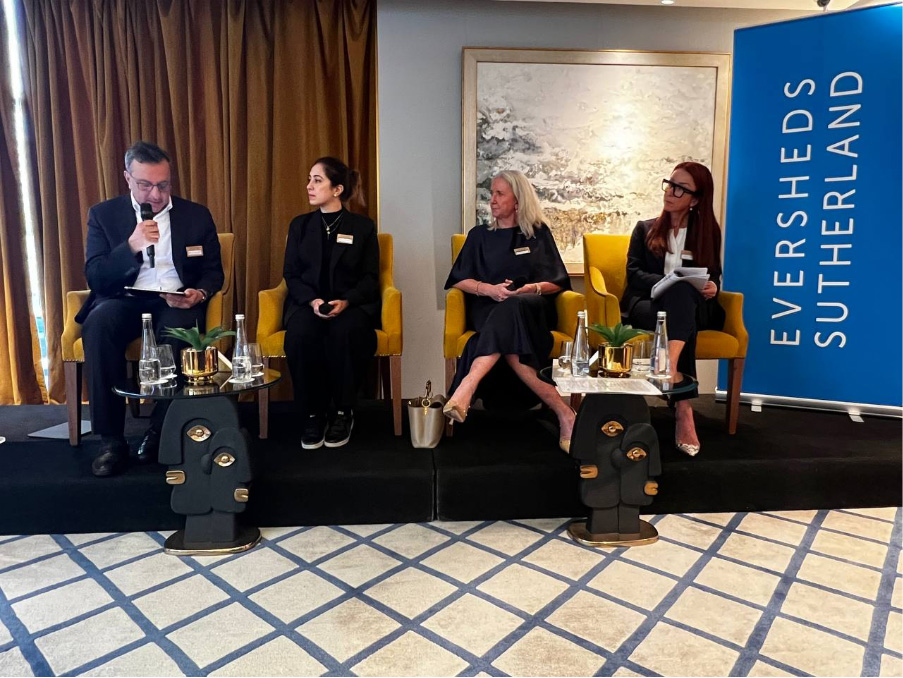
[In Picture (left to right): Nasser Ali Khasawneh, Middle East Chairman and Global Head of AI and Technology and Media & Telecommunications (TMT) at Eversheds Sutherland; Nisreen Al-Shaker, General Counsel and Head of Legal at du; Linda Fitz-Alan, Registrar and Chief Executive of the Abu Dhabi Global Market (ADGM) Courts; Rebecca Copley, Middle East Head of Litigation and Dispute Resolution at Eversheds Sutherland]
A particularly significant aspect of the discussion concerned the potential loss of legal professional privilege when confidential information is submitted to public AI platforms such as ChatGPT and Claude. The issue was discussed against the backdrop of R (Munir) v Secretary of State for the Home Department (AI hallucinations; supervision; Hamid) [2026] UKUT 81 (IAC)1, in which the Upper Tribunal (Immigration and Asylum Chamber) observed that uploading confidential client documents to an open-source AI tool such as ChatGPT would place the information in the public domain, breach client confidentiality and waive legal privilege.
The panel was moderated by Nasser Ali Khasawneh, Middle East Chairman and Global Head of AI and Technology and Media & Telecommunications (TMT) at Eversheds Sutherland. The panellists included Rebecca Copley, Middle East Head of Litigation and Dispute Resolution at Eversheds Sutherland; Linda Fitz-Alan, Registrar and Chief Executive of the Abu Dhabi Global Market (ADGM) Courts; and Nisreen Al-Shaker, General Counsel and Head of Legal at du.

[In Picture: Nasser Ali Khasawneh]
AI-assisted advocacy: The emergence of the supercharged lawyer
Opening the discussion on AI-assisted dispute resolution, Rebecca Copley observed that AI had significantly transformed litigation practice, particularly over the preceding six months. AI tools were increasingly embedded in everyday workflows, assisting with drafting documents, preparing chronologies, identifying issues, generating flowcharts and tables, and summarising voluminous records.

[In Picture: Rebecca Copley]
She identified evidence analysis as one of the areas where AI had made the most substantial difference. Previously, technology-assisted document review and e-discovery were predominantly used in high-value disputes involving substantial document volumes. AI was now enabling practitioners to examine much larger datasets even in relatively modest matters, identify potentially decisive or adverse documents at an early stage, and incorporate those findings into litigation strategy.
Describing this development as the emergence of the ‘supercharged lawyer’, Rebecca explained that effective AI adoption required practitioners to treat AI as a sparring partner rather than an authoritative source. Lawyers should challenge and probe initial responses, cross-check outputs using other AI tools and independently verify citations and sources.
She nevertheless cautioned against allowing technological assistance to displace independent legal reasoning. Practitioners must first understand the causes of action, evidentiary strengths and weaknesses, and desired litigation outcomes before introducing AI into their workflows. Otherwise, excessive dependence on AI could result in cognitive impairment and an erosion of fundamental legal skills.
In-house legal teams: Governance, integration and responsible adoption
Drawing on her experience in legal operations and in-house legal leadership, Nisreen Al-Shaker identified three interconnected dimensions of AI adoption: the tools deployed by legal teams, the expectations of the business and the role of external law firms.

[In Picture: Nisreen Al-Shaker]
She observed that businesses increasingly expect legal departments to deliver faster, more cost-effective and high-quality advice, often assuming that AI can simply be applied to any legal problem to produce an immediate answer. However, not all AI tools are designed for legal applications, and general-purpose tools cannot necessarily substitute specialised legal technology.
She emphasised the need for legal teams to identify specific use cases, determine the parameters governing the data fed into AI systems, establish access controls and safeguards for AI agents, and develop mechanisms for validating and communicating outputs.
Nisreen also highlighted the importance of collaboration between legal and technology teams. Effective AI integration requires a properly developed business requirements document (BRD), identifying the problem to be addressed, relevant datasets, technical requirements, security measures and appropriate technological solutions. AI adoption, therefore, cannot be reduced to a plug-and-play exercise.
She further identified operational applications, including invoice reviews, law-firm reporting and administrative workflows, as particularly valuable areas for in-house teams. Automating such tasks could allow lawyers to redirect their attention towards strategic and substantive legal work.
The courts’ approach: Efficiency without compromising judicial responsibility
Addressing the judicial perspective, Linda Fitz-Alan described the ADGM Courts’ approach to AI as ‘cautious but ambitious and driven’. She clarified that AI was not used to draft judicial judgments, which remained the exclusive product of judges. While technology assisted registry operations and the preparation of document summaries for judicial consideration, all such material was subjected to careful human verification.

[In Picture: Linda Fitz-Alan]
Linda explained that the ADGM Courts were preparing an AI Practice Direction, having deliberately adopted a measured approach to allow the technology and its applications to mature before introducing prescriptive requirements. The proposed approach would be permissive towards AI adoption, while establishing appropriate safeguards to protect litigants and the administration of justice.
She also outlined the Court’s use of AI for summarising judgments and documents, as well as an impending document-triage project designed to examine filings before they reached registry staff. The system would identify missing or defective documents and flag deficiencies for correction, without itself exercising the procedural power to reject a filing.
Highlighting the operational necessity of such tools, Linda noted that the ADGM Courts had received approximately 540 cases in the preceding year and were projecting a caseload of 1,100—1,200 cases, with a registry team of eight. In her view, courts must actively engage with AI, monitor its deployment and remain accountable for ensuring that technological efficiencies do not compromise the administration of justice.
Confidentiality, legal professional privilege and disclosure: The risks of public AI
The implications of AI use for legal professional privilege and disclosure obligations formed one of the most significant parts of the discussion.
Rebecca explained that lawyers handling investigations and litigation must consider the applicable privilege rules across relevant jurisdictions and establish appropriate privilege protocols at the outset. She cautioned against placing confidential legal advice and sensitive litigation documents into publicly accessible AI platforms without first assessing the consequences for privilege and confidentiality.
Referring specifically to ChatGPT and Claude, she warned that clients increasingly upload sensitive information into such platforms without appreciating the potential consequences. She emphasised that where legal advice or confidential litigation documents are submitted to a public AI platform, any privilege that otherwise attached to the material could be lost, depending on the circumstances and applicable law.
She drew attention to the English Tribunal’s observations in R (Munir) v Secretary of State for the Home Department [2026] UKUT 81 (IAC)2, while also questioning the technical characterisation of ChatGPT as an open-source tool. She noted that the distinction between open-source software and publicly accessible AI services was important, and that the technical architecture and data-handling arrangements of the platform required closer judicial consideration.
Rebecca further explained that the risk was not confined to documents uploaded to AI systems. Prompts entered into these platforms and the material generated in response could also become relevant to subsequent disclosure proceedings.
Referring to a US litigation example involving prompts used to develop a proposed corporate transaction strategy, she noted that such prompts had been found to be disclosable. She therefore urged practitioners to examine clients’ internal AI policies and educate them about the risks of uploading sensitive material into public AI tools.
On disclosure in arbitration, Rebecca advocated a proportionate distinction between routine or private AI assistance, such as document summarisation and witness-question preparation, and AI-generated material that could affect the integrity of evidence or the substantive case presented. She suggested that these issues should be addressed with opposing counsel and, where appropriate, the tribunal at an early procedural stage.
Nisreen reinforced the importance of ensuring that businesses understand the wider implications of AI adoption. Unregulated use could compromise not only privilege and confidentiality but also commercial strategy, internal positions and the organisation’s ability to control sensitive information.
English Tribunal’s observations on AI and legal professional privilege
In R (Munir) v Secretary of State for the Home Department (AI hallucinations; supervision; Hamid) [2026] UKUT 81 (IAC)3, the Upper Tribunal considered concerns arising from the use of AI-generated material in legal proceedings, particularly the submission of fabricated case citations and authorities.
At para 21, the Tribunal observed:
“To put client letters and decision letters from the Home Office into an open source AI tool, such as ChatGPT, is to place this information on the internet in the public domain, and thus to breach client confidentiality and waive legal privilege.”
The Tribunal further indicated that such conduct by regulated legal professionals or firms could warrant referral to the relevant professional regulator and should, in any event, be brought to the attention of the Information Commissioner’s Office.
The Tribunal distinguished publicly accessible AI platforms from closed-source AI tools, referring to Microsoft Copilot as an example of a system that could be used for document summarisation without the same risks. However, this distinction should not be understood as establishing that every paid-for or enterprise AI platform is automatically secure or preserves privilege.
The observations were subsequently reflected in the Solicitors Regulation Authority’s (SRA) Warning Notice on Misuse of AI. The SRA cautioned that both free and paid AI systems could present confidentiality risks, depending on their contractual terms, settings and technical architecture. It further observed that uploading confidential information into such systems could result in a breach of client confidentiality and potentially irreversible waiver of legal professional privilege.
The Law Society of England and Wales, in its practice note Using Artificial Intelligence in Legal Practice4, also addressed the implications of AI use for confidentiality and privilege. It acknowledged that there is not yet a substantive judgment comprehensively determining the impact of AI use on legal professional privilege.
Institutional safeguards and professional consequences
Discussing the measures being developed by the ADGM Courts, Linda confirmed that the forthcoming Practice Direction would provide practical guidance to the profession on appropriate AI use. She also referred to substantial costs orders imposed in cases involving misuse of AI and explained that existing conduct rules could be invoked to address irresponsible practices.
She emphasised judicial training as a central component of the Court’s approach, with dedicated AI training for judges intended to be continuous rather than a one-off exercise.
Rebecca added that existing professional conduct obligations and arbitral rules already provide mechanisms for addressing misconduct, including reprimands and referrals to professional regulators. In serious cases, contempt of court consequences could also arise.
Linda, however, cautioned against weaponising allegations of AI misuse as an aggressive litigation strategy. Concerns should be raised proportionately and addressed through an orderly, principled approach, rather than being used as a tactical device against opposing counsel.
AI-related disputes: The next frontier for arbitration
In the concluding part of the discussion, Nasser shifted attention from the use of AI in dispute resolution to disputes arising from AI itself. He identified several emerging areas of contention, including copyright infringement, the use of data by large language models, AI implementation projects and disputes involving data centres.
Referring to the litigation involving The New York Times, Microsoft and OpenAI, he highlighted the significant copyright questions surrounding the development and deployment of large language models. He also anticipated a substantial increase in disputes concerning data centres, particularly given their intersection with commercial and construction-related issues.
The discussion thus extended beyond the procedural and ethical implications of AI in arbitration to the growing body of substantive disputes likely to emerge from AI procurement, deployment, data governance and technology-related contractual arrangements.
Concluding the session, Nisreen emphasised the need for a fundamental shift in lawyers’ approach towards AI: practitioners must neither fear the technology nor adopt it uncritically. Instead, AI should be embraced with caution and accountability, while lawyers remain actively engaged in their own professional and cognitive development.
The panel ultimately highlighted that the future of international arbitration will not be defined merely by the extent to which AI is adopted, but by the ability of practitioners, institutions and courts to integrate it responsibly. The preservation of legal professional privilege, client confidentiality and professional accountability must remain central to that transition.
1. R (Munir) v Secretary of State for the Home Department (AI hallucinations; supervision; Hamid) [2026] UKUT 81 (IAC), para 21.
2. Supra Note 1
3. Supra Note 2
4. Published on 21 October 2026