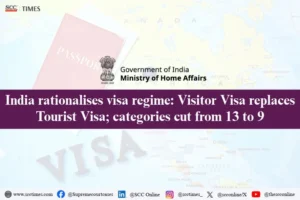
On 11 November 2026, the Ministry of Home Affairs announced a major rationalisation of India’s visa regime aimed at making it more compact, coherent and user-friendly.
Under the revised framework, the number of main visa categories has been reduced from 13 to 9, while sub-categories have been brought down from 49 to 23. The Government stated that the reforms were undertaken after studying international best practices and visa systems in developed countries. The revised structure follows an earlier rationalisation in October 2025, which had reduced the main categories from 22 to 13 and the sub-categories from 63 to 49.
Key Takeaways:
-
The number of main visa categories has been reduced from 13 to 9, while sub-categories have been reduced from 49 to 23.
-
Visa application forms across all 23 visa categories and sub-categories have been simplified, reducing the number of information fields by 65%-70%.
-
The e-Visa facility is available to nationals of 172 countries and is processed under 13 sub-categories.
-
The existing Tourist Visa has been renamed Visitor Visa, reflecting a wider range of permissible activities beyond tourism.
-
The Visitor Visa category has been divided into:
-
V-1 Visa: For short-term visits, including business meetings, medical consultations, wellness retreats, short-duration medical treatment and short-term courses in Indian languages, music, art and craft. It is granted for 30 days with multiple entries.
-
V-2 Visa: For longer-duration visits, with validity of 1, 5 or 10 years, as specified. It also covers mountaineering, for which a six-month multiple-entry visa is provided.
-
-
The Medical Visa structure has been streamlined:
-
M-1 Visa for medical treatment other than AYUSH treatment;
-
M-3 Visa for AYUSH treatment;
-
M-2 and M-4 Visas for accompanying attendants.
-
-
Medical visas will generally be issued for one year with multiple entries, supporting follow-up consultations and long-term treatment plans.
-
The Student Visa category has been consolidated into:
-
S-1 Visa for school, graduate and post-graduate studies; and
-
S-2 For PhD and research scholars, visiting faculty, foreign research students, scientific and anthropological expeditions, internships and exchange students, among other specified academic activities.
-
-
Foreign students enrolled in Indian educational institutions through the Study in India portal may receive an e-S1 Visa valid for up to five years or the duration of the course, whichever is shorter, with multiple entries.
-
The Business Visa category has been reorganised into:
-
B-1 Visa for long-term business and investment activities; and
-
B-2 Visa for short-term contractual, conference, sports, film and production-related activities.
-
-
A specific provision has been introduced under B-2 for foreign subject-matter specialists, engineers and technical personnel engaged in activities such as installation, commissioning, maintenance, training, technology transfer and production support. They may be granted a Production Investment Business Visa through the e-Visa platform. This was earlier granted under the e-B4 visa nomenclature.
-
The Ministry has clarified that the revised framework will be implemented after necessary updates to visa processing IT systems.
The revised framework comprises the following nine broad categories:
|
Category |
Purpose |
|
Business Visa |
Long-term business activities including establishing an industrial/business venture; short- term business activities like participation in sports & cultural/commercial performances, production investment business, attending conferences, shooting of films including documentaries & advertisement films. |
|
Diplomatic Visa |
Diplomats including UN Diplomats assigned to India or visiting India and their dependents |
|
Work Visa |
Long-term employment with Indian companies/organizations, working in NGOs and missionary activities |
|
Journalist Visa |
Journalists accredited in India |
|
Medical Visa |
Foreigners visiting India to undergo intensive/indoor medical treatment including treatment under Ayush systems and their attendants |
|
Official Visa |
Non-diplomatic officials including UN non-diplomatic officials assigned to India or on a visit to India and their dependents |
|
Student Visa |
School/graduate/post-graduate education, studies in Yoga, Vedic Culture & Indian Music/Dance, Buddhist studies, studies of Indian Languages & Indian knowledge systems, research, internship and exchange students |
|
Visitor Visa |
Tourism, short-term activities including business meetings, medical consultations & Wellness retreats, transit and mountaineering |
|
Miscellaneous Visa |
Persons of Indian Origin & their spouses/children, those coming to join various specified institutions like Auroville Foundation, dependents of foreign nationals coming on various long duration visas, stay visa for Afghanistan nationals, Long Term Visa for certain categories of nationals from neighbouring countries and other miscellaneous purposes not covered by any other visa category. |
The rationalisation seeks to simplify India’s visa framework by consolidating similar travel purposes and reducing overlap between categories. The revised structure provides clearer visa classifications for visitors, patients, students, researchers, investors and business professionals.
The reduction in application-form fields is also expected to make the application process simpler and less time-consuming for foreign nationals, while helping authorities focus on essential information required for visa assessment and processing.
Also Read: E-Passports Launched in India: Features, Cities, and Everything You Need to Know