Supreme Court: In a case concerning the regulation of manufacture, storage, sale and bursting of firecrackers in the Delhi-NCR region, in view of their adverse impact on air quality and public health, a Division Bench of M.M. Sundresh and Prasanna B. Varale, JJ., permitted the temporary manufacture, sale and bursting of certified Green Crackers on 7 November 2026 and 8 November 2026, subject to strict regulatory conditions. Emphasising that the right to practice, profess and propagate religion under Article 25(1) of the Constitution is subject to public order, morality, health and other provisions of Part III of the Constitution, the Court observed that the right to engage in a particular practice having a religious colour is only a qualified one and cannot go beyond constitutional restrictions. The Court reiterated that the right to life under Article 21 includes the right to a healthy, safe and pollution-free environment.
The Court further observed that the complete ban on firecrackers had not yielded the desired results, owing to ineffective implementation, and that conventional firecrackers continued to be sold under the guise of Green Crackers. Holding that there was inadequate data to determine whether a complete ban would be the most effective solution, the Court adopted a balanced approach and directed strict regulation of Green Crackers, including mandatory certification, product-specific QR codes, designated sale locations and monitoring of Air Quality Index (AQI) levels. The Court further directed that the complete ban on firecrackers shall stand restored with effect from 9 November 2026 and called upon the State authorities to furnish compliance reports, failing which strict action for contempt would be taken against the responsible officials.
Background
The present proceedings arise out of the issue of regulation of manufacture, storage, sale and bursting of firecrackers, particularly in the Delhi-NCR region, in view of the adverse impact on air quality and public health. The Supreme Court has, from time to time, issued directions regulating the use of firecrackers, balancing the competing interests of religious practices and environmental protection. In Arjun Gopal v. Union of India, (2019) 13 SCC 523, the Court permitted the manufacture and sale of firecrackers with reduced emissions (improved crackers) and Green Crackers. The said directions continued to hold the field until 2024.
Thereafter, pursuant to the directions issued in M.C. Mehta v. Union of India, 2024 SCC OnLine SC 3366, the Government of NCT of Delhi, on 19 December 2024, imposed a complete perpetual ban on the manufacture, storage, sale and bursting of all kinds of firecrackers throughout the year, with effect from 1 January 2025. Similar directions were issued to the States of Uttar Pradesh and Haryana in respect of the areas falling within the National Capital Region. The said ban was subsequently extended by the Court on 17 January 2025.
The Court, on 3 April 2025, observed that reconsideration of the complete ban to permit the use of so-called Green Crackers would not be undertaken unless supported by scientific evidence demonstrating that the pollution caused by them was bare minimum. Subsequently, on 26 September 2025, taking note of the lack of effective implementation of the ban, the Court observed that a balanced approach would be required and permitted manufacturers possessing valid certification for Green Crackers to manufacture the same, subject to filing an undertaking before the Court. Thereafter, by order dated 15 October 2025, the Court decided to follow the approach adopted in 2018 and granted temporary relaxation as a trial measure for a specified period.
The present matter, thus, concerns the regulation of firecrackers in the Delhi-NCR region, having regard to the competing considerations of religious practices, environmental protection and the adverse impact of firecracker emissions on air quality and public health.
Analysis
The Supreme Court observed that the right to practice, profess and propagate religion under Article 25(1) of the Constitution is subject to public order, morality, health and other provisions of Part III of the Constitution. The Court reiterated that the right to life under Article 21 includes the right to a healthy, safe and pollution-free environment. Therefore, the right of an individual to engage in a particular practice having a religious colour is only a qualified 1 and cannot go beyond constitutional restrictions.
The Court noted that bursting of firecrackers certainly causes pollution and that the measures undertaken by the authorities have not yielded the desired results, primarily on account of ineffective implementation. It emphasised the need for better coordination amongst all relevant stakeholders and observed that regulation, implementation and monitoring must continue not only during the festive season but also thereafter. The Court further stressed upon periodic assessment of AQI levels, collection of health-related data from hospitals and healthcare centres, and deliberations amongst public health officials and other stakeholders.
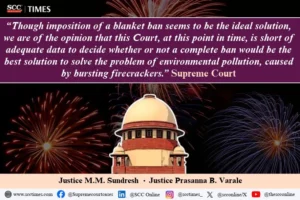
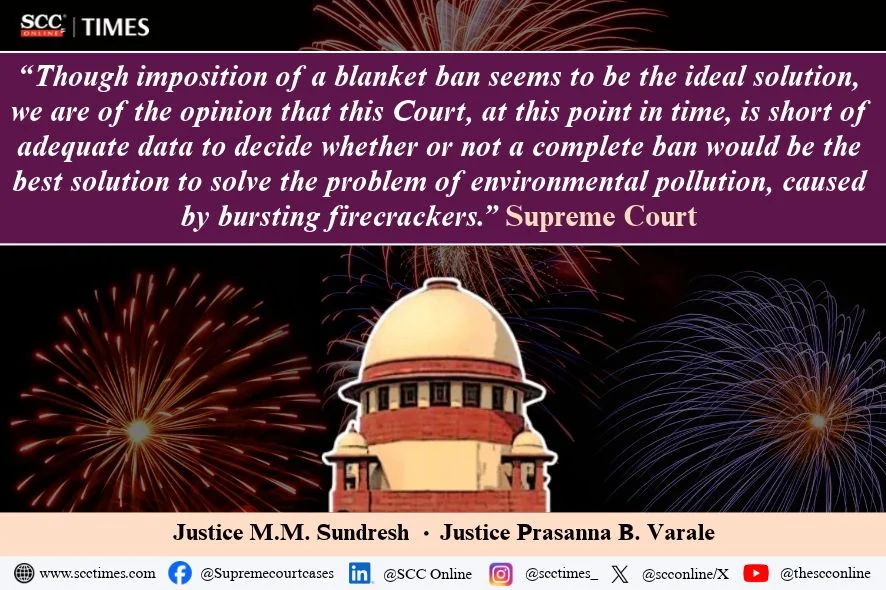
The Court observed that although a complete ban on firecrackers may appear to be the ideal solution, there was inadequate data to determine whether such a ban would be the most effective measure to address environmental pollution. It further noted that the complete ban imposed in 2024 had not resulted in any significant improvement in AQI readings. The Court also took note of the failure of the States to comply with its directions dated 15 October 2025, which had permitted temporary relaxation to assess the environmental and health impact of Green Crackers.
The Court further observed that despite the resumption of the complete ban, there was a significant spike in AQI levels on the day of Dussehra and the following day. It was also found that conventional firecrackers continued to be sold under the guise of Green Crackers. The Court noted that the complete ban was not only facilitating the illegal sale of firecrackers but was also preventing people from purchasing legitimate Green Crackers and Next-Generation Joined Green Crackers, which had been tested at established facilities.
In view of the recurring problem of non-implementation and flouting of its directions, the Court held that it was inclined to regulate the manufacture, storage, sale and bursting of Green Crackers, instead of maintaining the complete ban, for a temporary period. Accordingly, taking note of the balanced approach adopted in Arjun Gopal and M.C. Mehta, the Court issued the following directions:
Directions
General Directives
-
Bursting of firecrackers was permitted only during the stipulated time slots of 6.00 a.m. to 7.00 a.m. and 8.00 p.m. to 10.00 p.m. on 7 November 2026 and 8 November 2026.
-
No firecrackers shall be burst within a 300-metre radius of hospitals, nursing homes, primary and district health centres, old-age homes, educational institutions and notified silence zones. Such areas shall be declared as “No-Cracker Zones”, marked on the ground and published.
Qua Manufacturers and Traders
-
Only manufacturers possessing valid CSIR-NEERI and PESO certification shall be permitted to manufacture Green Crackers uploaded on the CSIR-NEERI website between 2 November 2026 and 6 November 2026.
-
Boxes containing Green Crackers shall be completely sealed to prevent their mixing with unauthorised or conventional firecrackers.
-
Manufacture and sale of firecrackers joined in series (‘ladis’) and garlands shall not be permitted. Firecrackers containing Barium or those not approved by CSIR-NEERI shall also remain prohibited.
-
Every box shall carry a product-specific, non-transferable QR code containing details of the manufacturer, NEERI registration, PESO/DM licence, formulation and test certificate.
-
Licences of traders whose licences had been cancelled shall be restored temporarily from 4 November 2026 to 6 November 2026 to facilitate the sale of approved Green Crackers. Any violation shall result in immediate cancellation of such licences.
Qua State Machinery
-
The concerned authorities shall mandate manufacturers and traders to furnish monetary security, which shall stand forfeited in case of violation of the directions.
-
District Collectors/Commissioners, in consultation with the concerned District Superintendents of Police, shall designate locations across Delhi-NCR for the sale of Green Crackers. Sale at any other location, including through online platforms, shall remain prohibited.
-
Authorities shall take necessary steps to prevent the entry of illegal and conventional firecrackers and inspect vehicles entering Delhi-NCR.
-
Banners shall be displayed at designated locations informing the public about identification of approved Green Crackers, QR codes, permitted dates and timings, complaint mechanisms and consequences of violations. Shopkeepers and traders shall also affix copies of the Court’s directions at conspicuous places.
-
Police authorities, in coordination with the District administration, shall constitute patrolling teams to keep vigil at designated sale locations.
-
Such teams shall conduct regular inspections, confiscate illegal or conventional firecrackers, initiate prosecutions against offending manufacturers and traders and undertake random verification of QR codes.
-
CPCB, in consultation with the State Pollution Control Boards, shall monitor AQI readings and prepare:
-
Pre-Diwali reports for 2 November 2026 to 6 November 2026.
-
Diwali reports for 7 November 2026 and 8 November 2026.
-
Post-Diwali reports for 9 November 2026 to 30 November 2026.
-
Samples of sand and water shall also be collected for comparative analysis.
-
-
Non-functional AQI monitoring stations shall be inspected and any defects rectified immediately.
-
Appropriate measures shall be undertaken for clearing and disposing of solid waste after the festival. The most polluted areas shall also be cleansed using water sprinklers and other necessary measures.
-
State authorities shall notify and publish the Winter Action Plan 2026, Air Pollution Mitigation Plan 2026 and CAQM Annual Action Plan, amongst others, along with relevant advisories.
-
Education Departments of the States falling within Delhi-NCR shall sensitise schoolchildren regarding the impact of pollution, particularly during festivals.
-
Directions and awareness material concerning the harmful effects of firecrackers shall be published through official websites, social media handles, leading newspapers and news channels. Delhi Metro Rail Corporation shall also use its audio systems for the said purpose.
-
The complete ban on firecrackers, as imposed earlier, shall stand restored with effect from 9 November 2026.
Compliance Reports to be Furnished
To ensure strict compliance with its directions, the Court directed the State machineries falling within Delhi-NCR to:
-
File an affidavit indicating the precise steps taken towards compliance with the direction concerning monetary security.
-
File an affidavit indicating compliance with the directions concerning designated sale locations, prevention of illegal firecrackers, public awareness and constitution of patrolling teams.
-
File a detailed report, supported by an affidavit, indicating actions taken and prosecutions initiated against offenders.
-
File reports, supported by affidavits, containing the AQI data collected during the pre-Diwali, Diwali and post-Diwali periods.
-
File an affidavit indicating the impact of bursting firecrackers, categorically specifying the exact extent of increase in patient admissions till 30 November 2026 in hospitals and health centres across Delhi-NCR.
The Court directed that all the aforesaid reports, supported by affidavits, be filed on or before 14 December 2026, failing which strict action for contempt would be taken against the responsible officials.
The Court made it clear that it would monitor the progress of implementation through periodic hearings of the writ petitions. It emphasised the need for a holistic change in public perception and urged everyone to embrace the Precautionary Principle by being proactive in preventing environmental degradation rather than merely reacting after its occurrence.
The Court also appealed to members of the Bar, prominent personalities, celebrities and sportspersons to voluntarily participate in public-awareness campaigns and use their influence to encourage citizens to celebrate festivals in a safe, responsible and environmentally conscious manner.
Accordingly, the Court directed that the interlocutory applications be listed for further compliance on 16 December 2026.
Also Read: SC Approves Enhanced ECC Rates to Curb Vehicular Pollution in Delhi | SCC Times
[Arjun Gopal v Union of India, Writ Petition (Civil) No. 728 of 2015, decided on 29-10-2026]
Advocates who appeared in this case:
Amicus Curiae: Uttara Babbar
For the Writ Petitioners: Gopal Sankaranarayanan, Senior Counsel
For the intervening applicant(s): J. Sai Deepak, Senior Counsel
For the Respondents: Aishwarya Bhati, Additional Solicitor General of India (‘ASG’) for Union of India, Government of NCT of Delhi (GNCTD) and the Commission for Air Quality Management in National Capital Region and Adjoining Areas (CAQM)