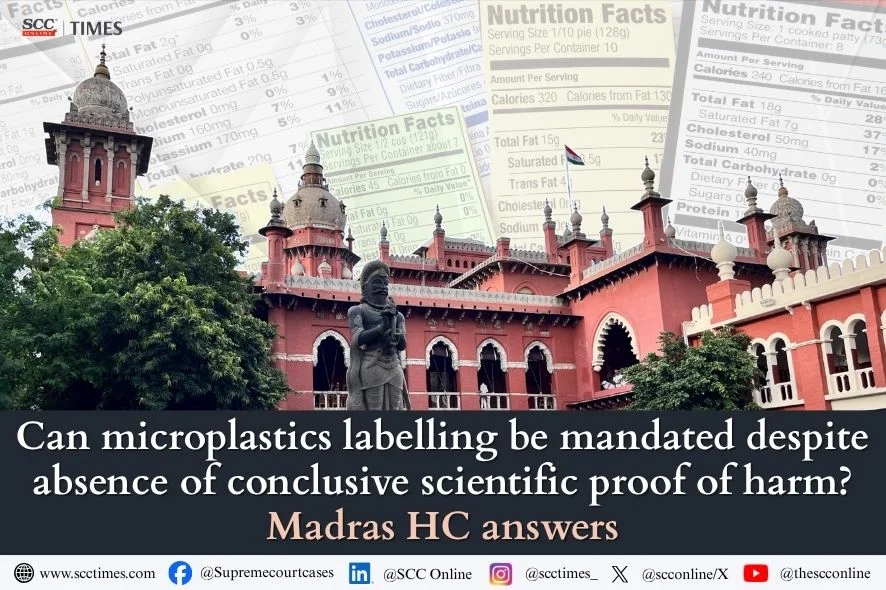
Madras High Court: While considering the validity of directions requiring packaged drinking water, sugar and salt sold in plastic packaging to carry labels stating that they may contain micro/nano plastics, the Division Bench of N. Sathish Kumar and D. Bharatha Chakravarthy, JJ., held that consumers have a right to informed choice and that scientific uncertainty cannot be a ground to withhold disclosure of potential health risks. The Court, relying on the principles of risk communication and public health protection embodied in the Food Safety and Standards Act, 2006, dismissed the review petition filed by Food Safety and Standards Authority of India (FSSAI) and the recall petitions filed by industry associations.
Background
The High Court, while considering the report filed by FSSAI, noted that analyses of commercially available bottled drinking water collected from various States had confirmed the presence of microplastics. The report further indicated that sugar and salt packed in plastic or polythene packaging contained higher levels of microplastics. FSSAI submitted that further studies were required to conclusively establish the harmful effects of microplastics on human health and to determine the level of human tolerance to such particles.
Taking note of the available studies and the ongoing scientific inquiry, the Court, by an interim order dated 6 February 2026, directed that drinking water sold in plastic/PET bottles should carry a declaration stating that it may contain micro/nano plastics. Similar directions were issued in respect of sugar and salt sold in plastic packaging. The Court further directed FSSAI to issue appropriate notifications to manufacturers and ensure compliance with the labelling requirement.
Aggrieved by the said directions, the PET Packaging Association for Clean Environment (PACE) and the Federation of All India Packaged Drinking Water Manufacturers Association (FPDWMA) filed applications seeking recall of the order, while FSSAI filed a review petition. Since the matter was being monitored by the Court as a continuing mandamus, the review and recall petitions were heard together on merits.
Contentions
The review and recall applicants contended that the labelling directions were premature and disproportionate, as there was no conclusive scientific evidence demonstrating that micro/nano plastics cause harmful effects on the human body. They argued that the available studies had not determined the extent of human tolerance to such particles and that no other country had introduced a similar mandatory labelling requirement. According to them, such warnings could create unnecessary public panic, adversely affect businesses, and mislead consumers to other options, such as glass bottles, which may contain even more particles or other materials that may be dangerous to health. The applicants also contended that the manufacturers were fully compliant with the packaging standards prescribed by the Bureau of Indian Standards
The applicants argued that it is possible that the water sources from which the water bottle is packaged may also contain microplastics. Therefore, projecting that PET bottles alone contain microplastics would only send incorrect information to the public and would be contrary to the objectives of the Food Safety and Standards Act, 2006. The applicants also referred to Section 3(1)(zz), Food Safety and Standards Act, 2006, and submitted that packaged drinking water could not be classified as “unsafe food”. According to them, in the absence of conclusive evidence establishing harmful effects on human health, the impugned labelling directions were unwarranted and unsustainable.
Analysis, Findings and Decision
The Court, while addressing the issue of “unsafe food”, held that its earlier order did not declare packaged drinking water, sugar, or salt to be unsafe food. It only directed to disclose the presence of micro/nano plastics through labelling which was necessary to enable consumers to make an informed choice It clarified that the question of unsafe food may only upon completion of further studies, conducted to ascertain the tolerance level of micro/nano plastics in the human body.
The Court further examined the definition of “hazard” under Section 3(1)(u), Food Safety and Standards Act, 2006 and held that micro/nano plastics, being physical agents, have the potential to cause adverse health effects and therefore fall within the ambit of a hazard. The Court observed that there could be no dispute regarding the existence of a plausible biological mechanism, as scientific studies indicate that these bio-non-degradable particles, once inside the body, pass through body barriers into the bloodstream and, as a contaminant, move through blood vessels into other organs. Even placental samples and breast milk contained these particles. The Court further noted that the available scientific literature points to potential digestive, gastrointestinal, cardiovascular, reproductive, neurological and other health effects arising from exposure to micro/nano plastics. While further studies may be required in respect of definitive epidemiological proof to determine the precise extent of the harm caused, the potential risk to human health is already evident.
The Court further referred to the definition of “risk” under Section 3(1)(zm), Food Safety and Standards Act, 2006 and observed that “probability of an adverse effect” on the health of the consumers is considered to be at risk. The Court, thereafter, examined the concept of risk assessment, risk communication and risk management under the Act and observed that hazard has been identified and that risk communication is considered even during the risk analysis process. The Court observed that since FSSAI has not mandated the disclosure of information on the label, despite repeated directions of this Court, the contentions that the labelling were premature and disproportionate cannot be countenanced.
The Court considered Section 18, Food Safety and Standards Act, 2006 and observed that in cases where scientific uncertainty persists regarding a potential health risk, provisional risk-management measures are necessary to ensure an appropriate level of health protection. The Court also observed that the Act mandates informing the general public of the nature of the risk and safeguards consumers’ right to make an informed choice. Thus, the labelling directions cannot be termed as disproportionate.
The Court observed that the argument that microplastics may be present in the very sources of the water are totally without merit. It held that, irrespective of the source, if micro/nano plastics are found in the water inside the bottle, the consumer should be informed of their presence.
The Court rejected the contention that the developed countries do not mandate similar labelling. It held that this issue of micro/nano plastics constitutes a grave and important concern for our country, and no comparison can be made with other countries. The Court noted that India consumed about 1.9 million tonnes of PET in 2024—2025, of which bottles were 92 per cent — up from 1.10 million tonnes in 2020—2021, reflecting an annual growth of 12—14 per cent a year. Therefore, in view of the widespread use of PET bottles and the unique consumption patterns in India, such an argument is untenable, and the labelling directions are essential for the health of the consumers.
The Court held that its order dated 6 February 2026 merely directed the barest essential minimum disclosure, namely, informing consumers that the products concerned may contain micro/nano plastics. It observed that the direction neither caused any aspersion on the safety of the products nor caused undue alarm,but was intended to enable consumers to make an informed choice. Accordingly, the Court dismissed the review petition and the miscellaneous petitions to recall the order.
Also read: Label to Liability: How India’s Food Giants are Slipping into FSSAI Penalty Zones
[FSSAI v. G. Subramania Koushik, Review Application No. 253 of 2026, W.M.P. No. 32965 of 2026 in W.P. No. 15120 of 2019, W.M.P. No. 42413 of 2026 in W.P. No. 15120 of 2019, decided on 28-9-2026]
Advocates who appeared in this case:
For the Applicants/Petitioners: AR.L. Sundaresan, ASGI for V. Chandrasekaran, SPC assisted by Mr. K. Aadhishankaran, Sathish Parasaran, Senior Counsel and Harishankar
Amici Curiae: C. Mohan, Advocate, T. Mohan, Senior Advocate, M. Santhanaraman, Advocate and Rahul Balaji, Advocate