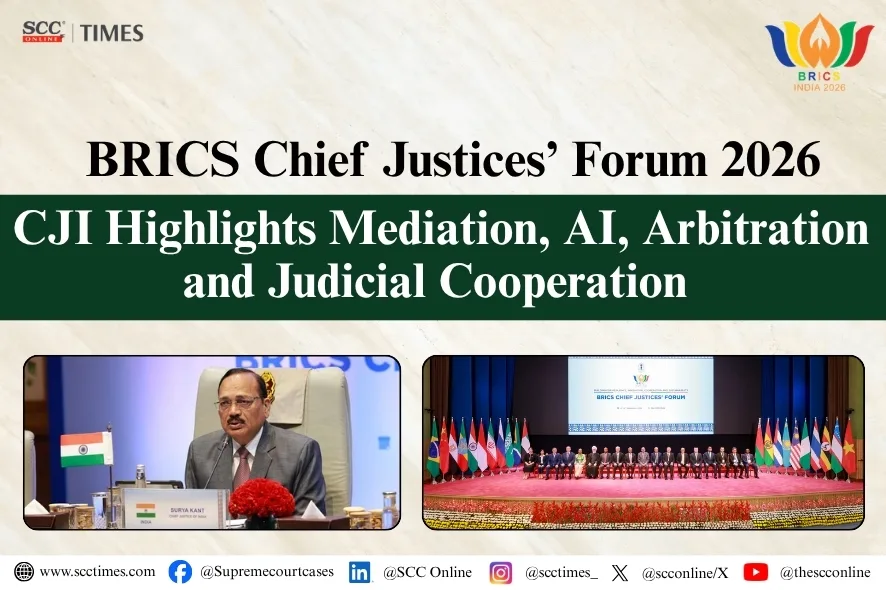
In his Welcome Address at the BRICS Chief Justices’ Forum on 5 September 2026 at the Supreme Court, the Chief Justice welcomed the Chief Justices, Presidents of the Highest Courts and Senior Judges of the BRICS Members and Partner Countries to India, describing the Forum as a “fellowship of judicial minds, bound together by the shared belief that the enduring values of justice can meet the dynamic challenges of our time”.
Reflecting upon the heritage of ancient Bharat, the Chief Justice referred to Nalanda University as a beacon of intellectual inquiry and a sanctuary where intellectuals from distant lands convened to debate, exchange and refine ideas that transcended the boundaries of geography and culture. What made Nalanda University truly unique, it was observed, was that it never asked its scholars to first agree upon a Common System of Law or philosophy, but offered “a healthy and hos pitable space for disagreement and deliberation”. The Chief Justice observed that this was the truest precedent for what the BRICS Forum now seeks to do, bringing together different schools of thought to engage with each other directly.
Justice as the Load-Bearing Wall
The Chief Justice then emphasised that Economic Progress, Technology, Dispute Resolution and Sustainable Energy are not four separate engines running in parallel, but rest upon “a single foundation”, namely, the timely and predictable delivery of justice. The role of judicial systems was compared to that of a “load-bearing wall” wthin a building, one that may not be photographed for the brochure, yet “no building stands without it”. The Chief Justice observed that when a foreign investor cannot be sure how swiftly or how fairly a dispute will be resolved in a given jurisdiction, such uncertainty directly burdens the contract in the form of higher risk premiums, added securities and stringent exit clauses. It becomes, in every practical sense, “an unwritten punitive cost of doing business”, one that no legislature ever imposed, yet every investor ends up paying. Courts that deliver judgments swiftly, consistently, and in language the world can rely upon, however, are capable of removing that hidden cost altogether.
The Sessions That Will Be Deliberated
The Chief Justice thereafter outlined the four sessions for deliberation at the Forum.
The first session concerns Mediation, treated not as some lesser substitute for litigation, but as
“a calculated strategy for resolving international commercial disputes with a speed, a confidentiality, and a measure of goodwill that formal adjudication rarely affords”.
The second session concerns the cross-border enforcement of foreign arbitral awards, where the promise of a single global standard still confronts the reality of differing national practice, with discussions focusing on the obstacles that persist and the prospects for procedural harmonisation.
The third session takes up Artificial Intelligence and Digital Innovation in the Administration of Justice, including AI-assisted case listing and triage and the use of predictive analytics in court management, while examining where the line must be drawn to keep human judgment at the heart of every judicial decision.
The fourth and final session turns to judicial leadership in Ecological Governance, examining the crucial role of Courts as nations transition towards solar, wind and other sustainable energy systems, often through disputes that pit renewable infrastructure against the forests, wildlife and water bodies it is built to preserve.
Concluding, the Chief Justice described the BRICS Chief Justices’ Forum as “a modern fabric woven with traditional threads”. The discussions, it was observed, are rooted in a shared quest “to seek solutions that serve humanity and to envision a world where law can be the gentle yet unyielding current that guides the river of development towards the ocean of shared prosperity”. Recalling India’s old and rich heritage of welcoming seekers with “open arms and open minds”, the Chief Justice invited the participants to discuss with candour, reflect with humility and build bridges of understanding, entering the deliberations with an ethos that is “open, rigorous and inspired by the pursuit of a higher good”.
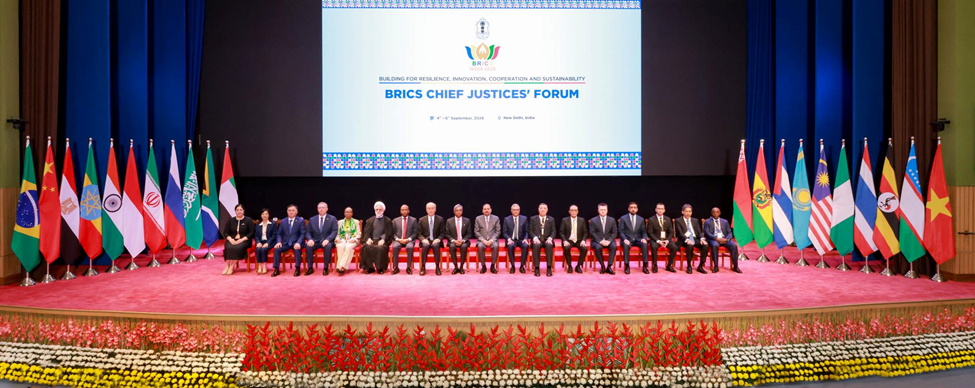
Today’s gathering was also addressed by:
-
H.E. Mr. Andrei Shved, Chairman, Supreme Court of the Republic of Belarus;
-
H.E. Dr. Romer Saucedo Gomez, President, Supreme Court of Bolivia;
-
H.E. Mr. Aslambek Mergaliyev, Chairman, Supreme Court of the Republic of Kazakhstan;
-
H.E. Datuk Seri Abu Bakar Bin Jais, President, Court of Appeal, Malaysia;
-
H.E. Muntharee Ujjin, President, Court of Appeal, Thailand;
-
H.E. Dr Flavian Zeija, Chief Justice, Republic of Uganda;
-
H.E. Malikakhon Kalandarova, Deputy Chairperson, Supreme Court of the Republic of Uzbekistan.
-
H.E. Luiz Edson Fachin, President, Supreme Federal Court of Brazil (via video recording) called for multipolarity and greater international collaboration. He has also emphasised that international law is of critical importance in the current period of global instability and transition and stressed upon the need to uphold the rule of law in the international order.
-
H.E. Zhang Jun, Chief Justice, People’s Republic of China highlighted judicial cooperation as a valuable contribution to member nations and called for solidarity and cooperation among BRICS member and partner states. He also emphasised the promotion of rule-based international trade and commerce in the current times of industrial transformation. He said that the judiciary plays a significant role in promoting social equity and justice. He also spoke about the growing role of Artificial Intelligence in judicial functioning and identified the judiciary’s expanding role in resolving cross-border commercial disputes. He called for the promotion of cooperation among legal systems and contribute to the formation of a world judicial civilisation.
-
H.E. Boulos Fahmy Iskander Boulos, Chief Justice, Supreme Constitutional Court of Egypt spoke about a free and fair legal system with a common global voice.
-
H.E. Tewodros Meheret Kebede, President, Federal Supreme Court of Ethiopia, focused on Alternative Dispute Resolution mechanisms and discussed the interlinkage between the rule of law and economic development.
-
H.E. Sunarto, Chief Justice, Supreme Court of Indonesia called for the exchange of best practices and a durable platform for judicial dialogue among member nations.
-
H.E. Ayatollah Gholam Hossein Mohseni-Eje’I, Chief Justice, Islamic Republic of Iran highlighted that BRICS is shaping economic and political developments, and raised concerns over widespread violations of human rights, sovereignty, and territorial integrity, the humanitarian crisis and displacement of civilians.
-
H.E. Igor Krasnov, Chief Justice, Supreme Court of the Russian Federation said that BRICS has a key role in ensuring co-operation and a multi-polar world.
-
H.E. Mahube Betty Molemela, President, Supreme Court of Appeal of South Africa asked for co-operation on international issues. He spoke about the role of judicial leadership in ecological governance.
-
H.E. Mohammed Hamad Al Badi Al Dhaheri, President, UAE Federal Supreme Court said that arbitration and mediation are integral to the modern economy. He pointed out that while digital technology and AI are advancing justice delivery systems, it should not eliminate the human element from the process. He also emphasised environmental law as essential to protecting the rights of future generations.
MEDIATION AS A STRATEGIC MECHANISM FOR RESOLVING INTERNATIONAL COMMERCIAL DISPUTES
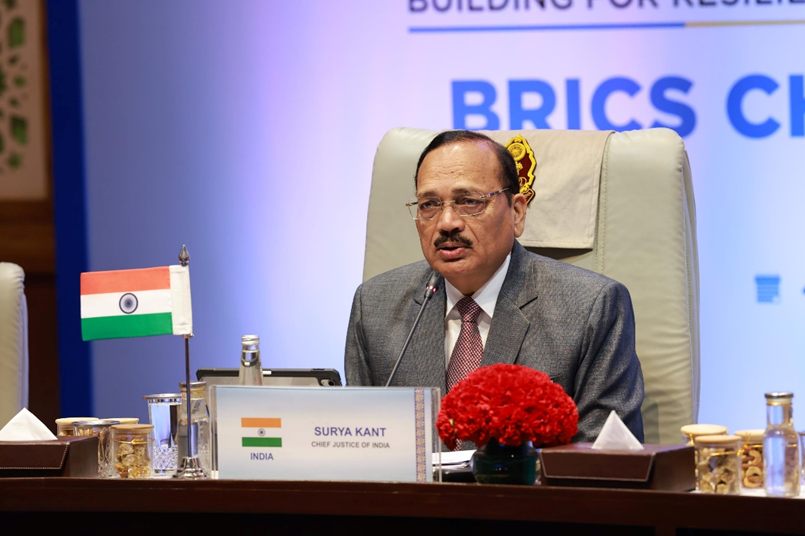
In his address titled “Mediation as a Strategic Mechanism for Resolving International Commercial Disputes in a Globalised Economy”, delivered at the BRICS Chief Justices’ Forum 2026 on 5 September 2026, the Chief Justice emphasised that “the administration of justice can no longer develop in isolation”. The challenges before Courts, whether in Commerce, Technology or Access to Justice, are increasingly shared, and so must be the willingness to learn from one another. Observing that goods, services, ideas and investments now move across borders with ease, while legal systems often remain divided by national boundaries, the Chief Justice highlighted the strategic importance of mediation in international commerce.
The Strategic Case for Mediation in a Globalised Economy
The Chief Justice observed that Courts and Arbitral Tribunals are indispensable, as they provide certainty and protect legal rights, but adjudication cannot address every aspect of an International Commercial Dispute. A contract may be in dispute, while the commercial relationship behind it may still be worth preserving. Mediation, therefore, does not replace litigation or arbitration but offers another way to resolve disputes when the parties are willing to find common ground. While conventional methods of adjudication ask, “Who is legally right?”, mediation asks, “What arrangement will allow the parties to move forward?”. This difference, it was observed, can determine whether a commercial relationship survives a dispute or is lost because of it. Mediation, at its core, is a process of “reason and reconciliation” and can lead to solutions that a judgment or award may not provide, including renegotiated obligations, restructured transactions and phased performance.
The BRICS Opportunity: From Diversity to Institutional Cooperation
“Why does Mediation matter particularly for BRICS Members and Partner Countries?”
Turning to the BRICS Members and Partner Countries, the Chief Justice observed that their diversity can be a strength because it allows cooperation without requiring uniformity. The existing foundation for cooperation was highlighted, including China and India signing the Singapore Convention on Mediation in 2019, Brazil ratifying it in 2025 and India’s Mediation Act, 2023 providing a clear legal framework. The Chief Justice further referred to India’s nationwide initiative, “Mediation for the Nation”, under which 1,05,000 cases were settled through mediation during 2024, while 1,10,000 cases were amicably settled during the four-month period of the initiative in 2025. Similarly, the recently concluded three-day “Samadhan Samaroh” further demonstrated this potential, with 1,712 cases settled 100% more than the number settled at a similar exercise undertaken in 2024. The recently constituted Mediation Council of India on 27 August 2026 was described as the next important stage towards building a structured and credible mediation system by promoting professional standards, quality and accountability.
The Role of the Judiciary in Building Confidence
The Chief Justice emphasised that as trade among BRICS Members and Partner Countries grows, businesses will need dispute-resolution mechanisms that are efficient, credible and workable across different legal and commercial cultures. In this regard, the need to strengthen cooperation between mediation institutions, professional training, multilingual capacity and dialogue among judges, mediators, lawyers and businesses was highlighted. The Chief Justice further observed that judiciaries need not mediate disputes themselves, but can encourage appropriate referrals and ensure that mediated settlements are effectively enforceable. Parties will use mediation fully only when they know that seeking settlement does not mean giving up their legal rights.
Conclusion
Concluding, the Chief Justice observed that the traditions of dialogue and reconciliation have long been part of dispute resolution across the BRICS Members and Partner Countries. Mediation builds on this shared wisdom and gives parties a practical way to resolve disputes while preserving relationships and supporting future cooperation. In a globalised economy, where commercial relationships are often long and complex, the Chief Justice emphasised that mediation can play a strategic role in ensuring that disputes are resolved in a manner that not only addresses the immediate disagreement but also preserves the commercial relationship and restores confidence.
Also Read: SC to Host BRICS Chief Justices’ Forum 2026 in New Delhi| SCC Times
Also Read: BRICS Chief Justices Forum 2026: Chief Justice Surya Kant Holds Bilateral Meetings | SCC Times