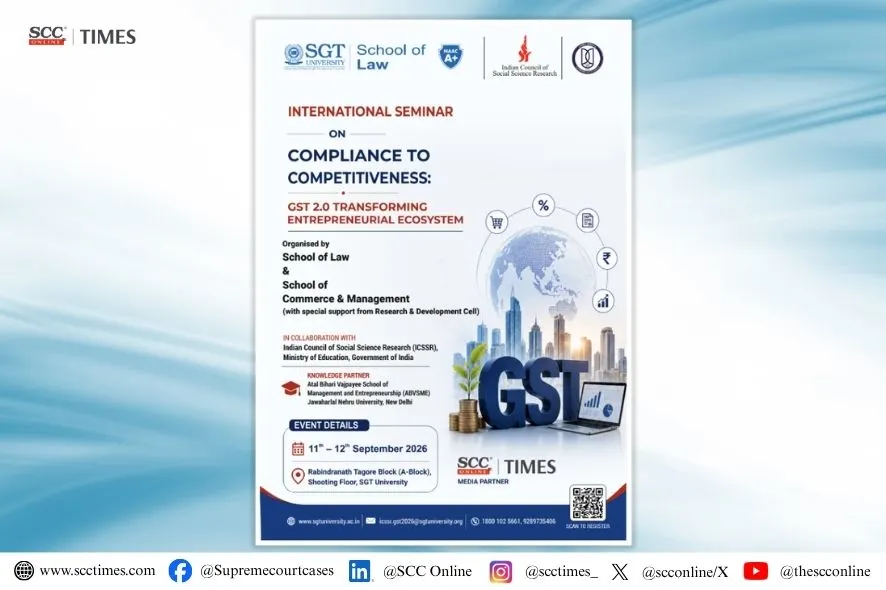
The School of Law at SGT University, Gurugram, in joint organization with the School of Commerce & Management and the Research & Development Cell, and in collaboration with the Indian Council of Social Science Research (ICSSR) and partnership with the Atal Bihari Vajpayee School of Management and Entrepreneurship (ABVSME), Jawaharlal Nehru University, New Delhi, is pleased to announce an International Seminar on GST 2.0 Next Generation Reforms titled ‘Compliance to Competitiveness: Transforming the Entrepreneurial Ecosystem,’ scheduled for September 11 & 12, 2026, at the Shooting Hall, A-Block on the SGT University campus. This highly relevant academic endeavor addresses the critical transition of India’s indirect tax architecture from a system of rigid regulatory conformity to a strategic driver of global market competitiveness, helping businesses navigate complex compliance landscapes while fostering a robust entrepreneurial ecosystem, enhancing the ease of doing business, and driving economic formalization. To thoroughly explore these structural, procedural, and digital shifts under GST 2.0, the seminar will feature a dynamic dual-structure format that commences with a high-level panel discussion featuring leading tax experts, policymakers, and judicial minds to set the legislative and economic context, followed immediately by an interactive paper presentation session where research participants will showcase original, data-driven papers across diverse thematic tracks spanning from fiscal federalism to AI-driven tax administration.
ABOUT SGT UNIVERSITY
Shree Guru Gobind Singh Tricentenary (SGT) University, Gurugram, is a premier educational institution promoted by the Dashmesh Educational Charitable Trust and established under the Haryana Private Universities (Amendment) Act No. 8, 2013. The university is the result of a visionary movement that began with the founding of SGT Dental College in 2002, inspired by the teachings of the revered Shree Guru Gobind Singh Ji, a great philosopher and social reformer who believed that ‘Spread of Learning is the Best Service to Mankind.’ Recognised by the University Grants Commission (UGC), SGT University is committed to advancing research, innovation, and multi-disciplinary education. Located on the outskirts of Gurugram, the university’s lush 70-acre campus offers a serene and resource-rich environment ideal for academic and professional growth. With 19 faculties offering over 200 undergraduate, postgraduate, and PhD programs, the university is a hub of diverse academic pursuits. SGT University’s dedication to academic excellence and holistic development has earned it a prestigious NAAC A+ accreditation, making it one of the youngest institutions in India to achieve this distinction.
ABOUT THE SCHOOL OF LAW
The School of Law was established in 2014 at SGT University. It has statutory recognition from the Bar Council of India and the Government of Haryana. The School of Law was established to aid the students with education on Legislative Law and provide an academically rich environment. The School of Law equips students with a broad perspective, enabling them to excel as law professionals & compete effectively on national & international platforms. The School of Law at SGT University is one of the best colleges in Delhi NCR for Law courses. It provides five courses, including UG, PG, PhD, Diploma and specialised Certification Courses. The School of Law at SGT University is based on the core values of Dedication, Honesty, Integrity, and Respect. They provide the highest quality professional legal education to equip Indian students for transnational practice and to face globalisation challenges.
ABOUT THE SEMINAR
India’s Goods and Services Tax (GST) is one of the most transformative fiscal reforms in post-independence India. As GST evolves into GST 2.0, it is increasingly recognised as a catalyst for economic formalisation, digital governance, fiscal federalism, compliance modernisation, and entrepreneurial growth. Aligned with the vision of Viksit Bharat 2047, this ICSSR-sponsored International Seminar aims to provide a multidisciplinary platform for academicians, policymakers, industry leaders, tax professionals, legal experts, researchers, and students to deliberate on the evolving GST landscape. Through keynote addresses, expert panel discussions, and research paper presentations, the seminar will critically examine GST 2.0 reforms, assess their socio-economic and entrepreneurial impact, identify persistent challenges, and explore future policy directions. The seminar seeks to generate actionable insights for building a more efficient, equitable, and growth-oriented tax ecosystem.
Themes for Panel Discussion
The two-day event will be structured around two primary pillars for a panel discussion:
- Day-01 (11th September 2026): Industry, Compliance & Financial Impact of GST Reforms on MSMEs and Start-ups
-
Day-02 (12th September 2026): Legal, Judicial & Governance Dimensions of GST Reforms
CALL FOR PAPERS — Tracks & Sub-Themes
Track I: GST, MSMEs, Entrepreneurship & Inclusive Formalisation
- GST and Formalisation of the Informal Economy;
- Compliance Cost and Working Capital Challenges for MSMEs,
- Start-ups, Innovation and Indirect Tax Ecosystem;
- Women Entrepreneurs and Tax Literacy, Rural Enterprises;
- Self-Help Groups (SHGs) and Cooperative Models;
- Export Competitiveness and GST Refund Mechanisms;
- Employment Generation and Labour Market Impact;
-
Financial Inclusion and Small Business Sustainability.
Track II: Sectoral Transformation, Markets & Consumer Dynamics under GST
- Sectoral Impact of GST on Manufacturing, Services, FMCG, Retail and Logistics;
- Inverted Duty Structure and Manufacturing Competitiveness;
- GST and Digital Platforms and Gig Economy;
- Real Estate, Tourism, Education and Healthcare under GST;
- GST and Consumer Welfare: Price Pass-through and Awareness;
-
Market Adjustment and Behavioural Responses under GST.
Track III: GST Reforms, Public Policy, Institutional Framework & Sustainability
- GST 2.0: Structural, Procedural and Legal Reforms;
- Rate Rationalisation and Revenue Neutrality Analysis;
- GST Council: Institutional Design and Cooperative Federalism;
- Constitutional and Judicial Dimensions of GST;
- Appellate Mechanisms and Dispute Resolution Framework;
- Anti-Profiteering and Consumer Welfare;
- Policy Simulation Models and Economic Impact Assessment;
- GST and Viksit Bharat Vision 2047;
- Green Taxation within the GST Framework; ESG-Oriented GST Policy Design;
-
Environmental Fiscal Reforms and Climate-Sensitive Taxation.
Track IV: Fiscal Federalism, Digital Governance & Global Perspectives
- Centre—State Revenue Sharing and Compensation Framework under GST, Post-Compensation Era Fiscal Challenges and Revenue Sustainability, Inter-State Trade and IGST Settlement Mechanism;
- Fiscal Federalism and Centre—State Financial Relations under GST;
- Comparative Analysis of GST/VAT Models: EU, ASEAN and OECD Economies;
- Digital Transformation under GSTN;
- Artificial Intelligence and Big Data in Tax Administration;
- E-Invoicing, Automation and Real-Time Compliance Systems;
- Cybersecurity, Data Protection and Tax Fraud Prevention;
-
Blockchain Applications in Indirect Taxation; Digital Public Infrastructure and E-Governance Reforms in Taxation.
Mode : Hybrid
Registration Link : https://forms.gle/34AgH87RCq9tJmvR8
Link to the Brochure:
https://drive.google.com/file/d/1xbwHmCQKj3i6PGukJSO26AtSSz2hmRBV/view?usp=drive_link
Link to the Flyer : https://drive.google.com/file/d/1dGh6RJy23qsSMMFlvbmmlhKiFghLNL2U/view?usp=drive_link
Fee Schedule for Participants: –
- Faculty/Professionals — Rs. 500/-
- Researchers/Scholars (PhD) — Rs. 300/-
- UG/PG Students — Rs. 200/-
-
Foreign Delegates — $30
Important Dates: –
- Abstract Submission – 15/08/2026
-
Full Paper Submission – 23/08/2026
The last date for submission of Abstracts and Full Papers has been extended to Monday, 31st August 2026.
QR Code for Registration