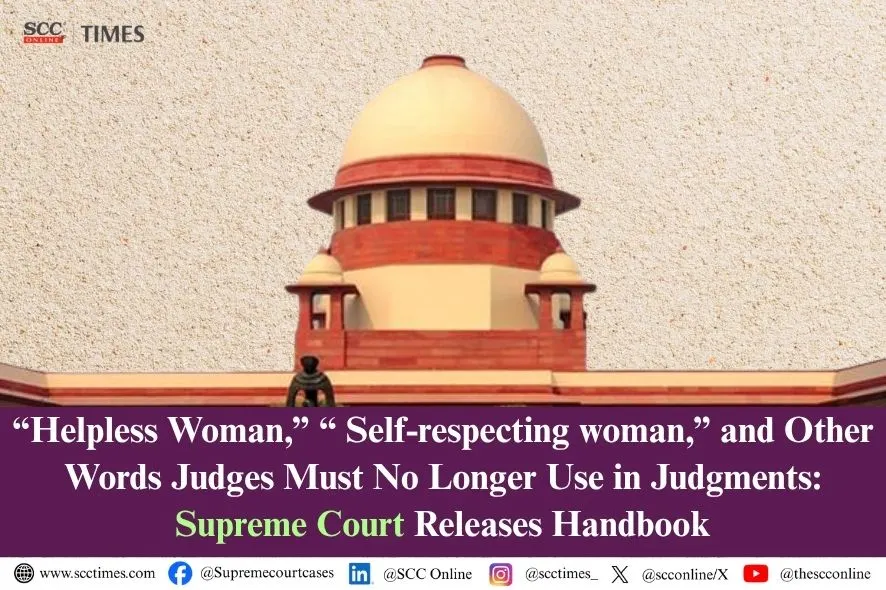
The Supreme Court has released a “Handbook on Judgements and Gender (Sensitivity and Compassion in writing judgements)” after having earlier directed all courts across the country to strictly follow the expressions and guidance set out in the approved report, alongside legal training, underscoring that emotional intelligence is an essential complement to judicial competence in the effective administration of justice.
The Handbook was prepared pursuant to a Supreme Court order dated 10 February 2026 in 2026 SCC OnLine SC 207, arising from a High Court’s modification of a summons order that reduced charges under Sections 376 IPC and 18, POCSO Act, to lesser charges under Section 354B IPC and Sections 9-10, POCSO Act. A Bench led by CJI Surya Kant, with Justices Joymalya Bagchi and N.V. Anjaria, directed the National Judicial Academy to constitute a Committee of Experts to develop guidelines on judicial sensitivity in cases involving sexual offences and vulnerable persons.
The Handbook was prepared by a five-member Committee of Experts chaired by Justice Aniruddha Bose, former Judge of the Supreme Court of India and Director of the National Judicial Academy, Bhopal. The Committee comprised Justice Sonia G. Gokani, former Chief Justice of the High Court of Gujarat; Anuradha Shankar, former Director General of Police, Madhya Pradesh; Dr. Surat Singh, Advocate, Supreme Court of India; and Prof. Lucy T.V. Zehol of the Department of Anthropology, North-Eastern Hill University, Shillong. The Committee was assisted by Dr. Sonam Jain, faculty member at the National Judicial Academy. The Committee’s recommendations were based on an analysis of 125 trial court judgments from across the country, undertaken with the assistance of all State Judicial Academies.
Justice Aniruddha Bose, while explaining the context of the Handbook observed that while the publication captures prevalent writing styles in gender-related judgments, it is not intended to serve as a permanent guideline, as language continues to evolve. He emphasised that words commonly used in everyday speech cannot find place in judicial decisions and that judgments in gender-related cases must be founded on empathy and sensitivity. Stressing the collective responsibility of judges, lawyers and the legal community to create a language ecosystem free from offensive and undesirable expressions, he noted that the use of appropriate and sanitised language in legal proceedings can comfort victims, prevent their re-traumatisation and help eradicate deep-seated gender-based prejudices.
Also Read: Highlights: Supreme Court’s Handbook on Combating Gender Stereotypes | SCC Blog
The evolution of gender jurisprudence in India has closely followed the increasing participation of women in workplaces and public life, bringing new forms of discrimination and exploitation before courts. Judicial decisions such as Vishaka, Air India v. Nergesh Meerza, Githa Hariharan and Naz Foundation have significantly shaped a rights-based and empathetic approach to gender justice. Adjudication in gender-related cases requires more than the application of legal principles; it calls for sensitivity towards victims, particularly in cases of sexual offences, where insensitive courtroom practices and graphic narration of the offence may re-traumatise survivors and discourage them from seeking justice.
Gendered/Stereotype Language in Judgments and Alternative
The Handbook underscores that judicial language must be respectful, neutral and free from gender stereotypes, emphasising that sensitive judicial expression is integral to ensuring fairness, dignity, impartiality and public confidence in the justice system. It notes that the need for such sensitivity is particularly significant in cases involving sexual assault, domestic violence, harassment and abuse, where reliance on gender stereotypes or “rape myths” may re-traumatise survivors, discourage reporting of offences and shift the focus away from the conduct of the accused. Referring to Phul Singh v. State of Haryana, the Handbook observes that expressions such as “sex stress”, though used in earlier judgments, are inconsistent with contemporary gender-sensitive jurisprudence and should be avoided.
|
Traditional/Problematic Phrase |
Neutral, and legally appropriate alternatives |
|
The body of women as play ground |
Violated bodily autonomy of complainant(s)/victim(s) |
|
Helpless woman; helpless female |
Survivor / Complainant |
|
Where women are honoured, there the gods rejoice |
Avoid religious/cultural references; focus on legal rights |
|
It destroys the very soul of a helpless woman |
Crime caused severe trauma to the survivor |
|
Victimization, soul destroyed |
Survivor experienced harm/trauma |
|
Traditional/Problematic Phrase |
Neutral, and legally appropriate alternatives |
|
Female members/persons (for victims) |
Victim / Survivor / Complainant |
|
Gold digger (economic motive) |
Avoid speculation; focus on evidence |
|
Suffering from psychological neurosis |
Survivor may experiencing trauma/distress |
|
Woman in non-permissive society |
Person in a conservative society |
|
Allow women to walk freely |
All individuals have right to move freely and safely |
|
Self-respecting woman |
Women may be used without any adjective |
|
Poor helpless minor girl |
Minor victim / Child survivor |
|
Hormonal changes, desire, temptation |
Avoid physiological explanations unless absolutely necessary |
|
She was enticed away (good faith) |
Accused lured/abducted victim by gaining trust |
|
Honour, shame |
Avoid “honour”/“shame”; focus on survivor’s rights |
|
Victim of another person’s lust |
Victim/survivor of sexual assault/violence |
|
Stigma as inevitable consequence |
Focus on justice/rehabilitation |
|
Outraged the modesty |
Sexual assault/violation of bodily autonomy |
|
Serious health consequences as a female |
Serious health consequences for the victim/survivor |
|
Traditional/Problematic Phrase |
Neutral, and legally appropriate alternatives |
|
Haunt throughout her life |
Survivor may face ongoing challenges |
|
Physical relationship (for rape/assault) |
Sexual assault / rape (if the offending act is non- consensual and/or victim is a minor) |
|
Disrobing (unless provided in the statute) |
Forced removal of clothing (part of sexual assault) |
|
Status and prestige of family is at stake |
Focus on harm to victim/ survivor; avoid “honour” shaming |
|
Scars left remain lifelong |
Survivor may need ongoing support; focus on recovery |
|
Her private part/chest/ vagina, victim girl |
Use neutral medical/legal terms; refer to child/survivor |
|
Accused acted as with his granddaughter |
Focus on age difference & power dynamics, not family |
|
Destroyed life, betrayal, shameful conduct |
Survivor experienced severe harm |
|
Modesty |
Bodily autonomy |
|
Offends esteem/dignity |
Violation of survivor’s bodily autonomy and rights |
|
Girl child is vulnerable |
All children are entitled to protection under the law |
|
Sex slave |
Survivor subjected to repeated sexual violence/exploitation — while being kept under control |
|
Brothel keeper |
Perpetrator of trafficking/sexual Exploitation (the term brothel may be used if statutorily necessary) |
|
Sterling character (victim’s character) |
Character evidence is irrelevant in sexual offences |
|
Lust satisfaction |
Act of sexual violence/assault; Prudent attribute – avoid trivializing crime |
|
Illiterate/rustic witness |
Witness (mention education only if legally relevant) |
|
Whore (derogatory term) |
Survivor / Victim |
|
Inability to control emotions, male-dominated society |
Avoid rationalizing crime; focus on accountability/law |
The Handbook while referring to Phul Singh v. State of Haryana, (1979) 4 SCC 413, observed that expressions such as “sex stress”, though used in earlier judgments, are inconsistent with contemporary gender-sensitive jurisprudence and should be avoided. It recommends replacing outdated or stigmatizing expressions with neutral and inclusive terminology, such as using sex worker instead of prostitute, call girl or fallen woman (except where statutory language requires otherwise), and adopting terms such as gay, lesbian, intersex and SOGIESC (Sexual Orientation, Gender Identity, Expression and Sex Characteristics) while referring to persons of diverse sexual orientations and gender identities. It also refers to UNICEF’s Glossary of Terms and Concepts on Gender Equality1 as a useful resource for promoting inclusive and region-sensitive judicial language.
Terms to be Avoided
-
The guidelines caution against the use of victim-blaming, moralistic and gender-stereotypical expressions in judicial proceedings, as such language reinforces prejudice and undermines the dignity of survivors.
-
Courts should avoid terms reflecting patriarchal notions such as “honour”, “bashfulness”, “sanctity” and “helpless female”, and instead focus on the victim’s autonomy, dignity and constitutional rights.
-
Expressions suggesting that victims exaggerate allegations or behave in a particular manner after trauma should be avoided, as responses to sexual violence vary from person to person and must be assessed on evidence.
-
Judicial language should refrain from unnecessary comments on a victim’s appearance, lifestyle, character or sexual history, unless legally relevant.
-
Terms such as “lust” should be avoided as they may trivialise sexual offences; courts should use legally precise expressions such as “sexual assault”, “sexual violence” or “offence”.
-
Referring to Aparna Bhat v. State of Madhya Pradesh, (2021) 3 SCC 247, the guidelines reiterate that judgments must remain free from patriarchal stereotypes, victim-blaming and insensitive observations, ensuring language that preserves the dignity of survivors.
Also Read: Access to Justice for Women in India: Progress, Pitfalls, and the Road Ahead
The guidelines underscore that sensitivity in judicial decision-making is not limited to the use of appropriate language but extends to adopting a compassionate, trauma-informed and victim-centric approach throughout the judicial process. By ensuring dignity, privacy, equal treatment and protection from secondary victimisation, courts can strengthen confidence in the justice system while upholding constitutional values of equality and fairness. Gender-sensitive adjudication requires continuous awareness, training and conscious avoidance of stereotypes, enabling judges to balance the rights of the accused with the need to provide a safe and respectful environment for victims and vulnerable persons.
Also Read: SC Guidelines: Retention and destruction of records| SCC Times
1. (https://www.unicef.org/rosa/media/1761/file/Genderglossarytermsandcon cepts.pdf)