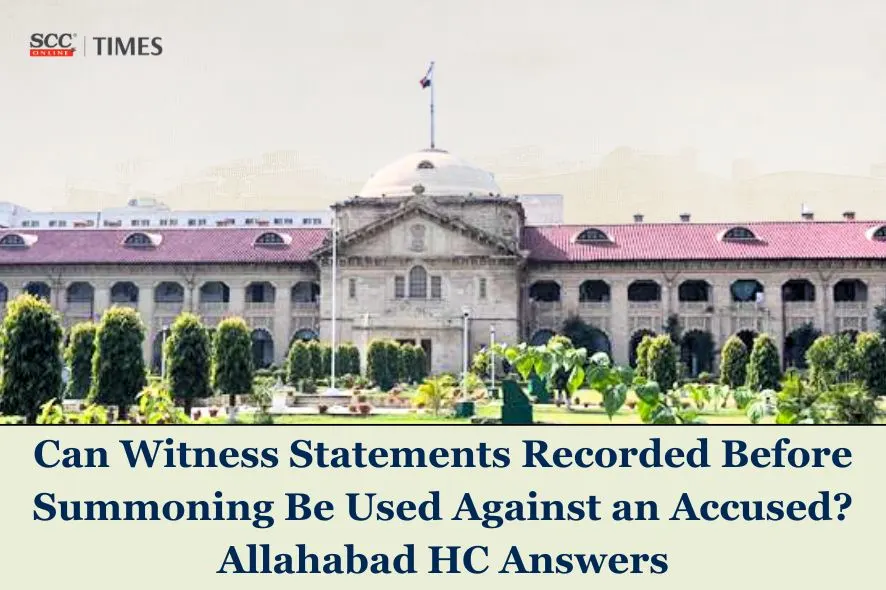
Allahabad High Court: In a criminal appeal filed by the accused, challenging his conviction under 302, 307, 506(2), and 148, Penal Code, 1860, the Division Bench of Rajesh Singh Chauhan and Subhash Vidyarthi JJ., allowed the appeal, after observing that the trial court had relied on witness statements recorded before the accused was summoned to face trial. The Court held that such evidence could not be read against the accused, particularly when the witness, after his summoning, did not support the prosecution. Accordingly, the Court set aside the judgment and acquitted the accused of all the charges.
Background
On 8 March 2008, one “V” was sitting on a platform in front of his house when the accused along with 3 others arrived carrying firearms and opened fire. “V” sustained grievous gunshot injuries and was rushed to the District Hospital, Hardoi, and subsequently referred to Lucknow owing to his serious condition, where he succumbed to his injuries.
The case was tried against four accused people, wherein the accused with 3 others were convicted. The trial court held that Witness 2 was an eyewitness of the incident, and he had also stated that the accused was carrying a country-made pistol and all the accused persons had fired with intention of killing “V”. The trial court held that it is established that the accused was involved in the incident and merely because one “P” has stated in his examination that the accused was not involved in the incident, the prosecution story does not become doubtful. Accordingly, the present appeal was filed.
Analysis
The Court stated that the trial court erred, because Witness 1 had stated about involvement of the accused in his statement recorded on 1 February 2011, i.e., before the accused was summoned to face the trial, and this statement cannot be read against the present accused. Later, in his statement recorded after commencement of the accused’s trial, Witness 1 had stated that the accused was not involved in the incident and only this evidence could be read by the trial court for deciding the correctness of the charges levelled against him.
Similarly, the Court stated that Witness 2’s statement was recorded on 25 February 2009 and after the accused was summoned to face the trial, Witness 2 did not come forward to get his testimony recorded. Thus, Witness 1’s testimony recorded was summoned to face the trial, cannot be read against the accused.
The Court observed that the evidence recorded prior to the accused’s summoning could not be read against him in view of Section 273, Criminal Procedure Code, 1973 (CrPC). Referring to Hardeep Singh v. State of Punjab, (2014) 3 SCC 92, the Court held that evidence relied upon for summoning an accused under Section 319 CrPC cannot form the basis of his conviction. Further, relying on Nirmal Singh v. State of Haryana, (2000) 4 SCC 41 and Jayendra Vishnu Thakur v. State of Maharashtra, (2009) 7 SCC 104, the Court reaffirmed that an accused has a valuable and statutory right to cross-examine a witness, and statements recorded in his absence cannot be utilised unless conditions under Section 299 CrPC are satisfied.
Decision
The Court held that the prosecution had failed to establish the accused’s guilt and the trial court’s conviction, rendered without adverting to the crucial aspects of the matter, was unsustainable in law, and accordingly acquitted the accused of all charges.
[Pramod Kumar Singh v. State of U.P., 2026 SCC OnLine All 10411, decided on 22-5-2026]
Advocates who appeared in this case:
For Appellant: Suyesh Pradhan
Buy Penal Code, 1860 HERE

Buy Code of Criminal Procedure, 1973 HERE