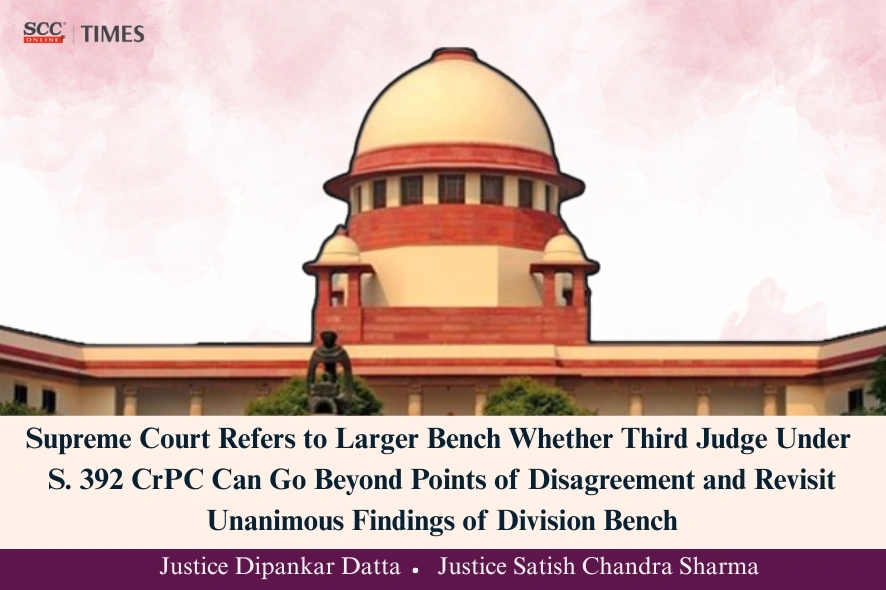
Supreme Court: In a matter concerning the scope of judicial power exercisable by a third Judge under Section 392, Criminal Procedure Code, 1973 (CrPC, 1973), where a Division Bench hearing a criminal appeal delivers divergent opinions, the Division Bench comprising Dipankar Datta* and Satish Chandra Sharma, JJ. examined whether the third Judge’s jurisdiction extends beyond the points of disagreement and permits reconsideration of findings unanimously reached by the original Bench. Finding that the issue raises substantial questions regarding the interpretation of Section 392 CrPC and the correctness of the decision in Sajjan Singh v. State of M.P., (1999) 1 SCC 315, the Court referred the matter to a larger Bench for authoritative determination.
Background
The case arose from the conviction of the brothers in a murder trial, where the trial court had convicted them under Sections 148, 149, and 302, Penal Code, 1860 (IPC). On appeal, the High Court Division Bench partially differed: One Judge upheld the conviction of 2 brothers while acquitting the third, whereas the other Judge upheld conviction of all 3 accused. Due to this divergence, the matter was referred to a third Judge under Section 392 CrPC, who went beyond the limited point of disagreement and acquitted all the accused. This approach was challenged by the State and the complainant before the Supreme Court.
Issues
1. Whether, in view of a division of opinion between the 2 Judges of a Division Bench hearing an appeal under Chapter 29, CrPC, 1973, the third Judge before whom the appeal is laid is obliged to deliver his opinion agreeing with either one of the 2 opinions, or whether such Judge is empowered to render an opinion which diverges from the opinions expressed by both Judges who originally heard the appeal?
2. Whether the third Judge is obliged to confine his opinion only to the points of disagreement between the 2 Judges, or whether such Judge is competent and empowered in law to differ from the conclusions unanimously reached by both Judges of the Division Bench and deliver an independent opinion at variance with those unanimous conclusions?
3. Whether the third Judge, upon the appeal being laid before him under Section 392 CrPC 1973, is not bound by the unanimous conclusions of the 2 Judges of the Division Bench; and if so, whether in the event of disagreement with such concurrent findings, the third Judge ought to refer the appeal for rehearing and decision by a larger Bench?
Analysis and Decision
The Court undertook an extensive analysis of the historical evolution of the provision, comparing Section 392 CrPC with its predecessor Section 429, Criminal Procedure Code, 1898 (1898 Code). It examined conflicting judicial precedents, particularly State of A.P. v. P.T. Appaiah, (1980) 4 SCC 316 which supported a broad interpretation allowing the third Judge to reconsider the entire case, and Bhagat Ram v. State of Rajasthan, (1972) 2 SCC 466 which supported a narrower interpretation restricting the third Judge to the specific points of difference. The Court also revisited the authoritative decision in Sajjan Singh which had previously endorsed a wider jurisdiction of the third Judge.
The Court observed that under Section 392, Criminal Procedure Code, 1973, when Judges of a Division Bench differ in opinion, the appeal along with their opinions is placed before a third Judge, whose opinion ultimately forms the basis of the final judgment. While the third Judge may agree with either of the 2 views, situations may arise where the third Judge adopts a different course, such as directing the taking of additional evidence under Section 391 CrPC before deciding whether the conviction should be maintained or set aside. However, this principle alone does not resolve the broader questions concerning the scope of the third Judge’s powers.
The Court observed that there are significant textual and structural differences between Section 429, 1898 Code and Section 392, 1973 Code. It particularly emphasised the legislative use of the expressions “an appeal” and “the appeal” in Section 392, interpreting them to mean that while the provision is triggered by any appeal under Chapter 29 that results in a split decision, the jurisdiction of the third Judge is ultimately confined to the specific appeal or part of the appeal in which disagreement has arisen. The Court reasoned that a blanket power to reopen even unanimous findings of the Division Bench could lead to anomalous and arbitrary results, especially in composite appeals involving multiple accused, thereby raising concerns under Article 14 of the Constitution.
At the same time, the Court acknowledged that the broad interpretation in Sajjan Singh had been followed for a considerable period and had influenced judicial practice. However, it expressed reservations about its correctness, particularly in failing to account for the structural limitations inherent in Section 392 CrPC. The Court highlighted practical inconsistencies that could arise if the third Judge were permitted unrestricted reappreciation of the entire case, including the possibility of overturning unanimous findings without any procedural safeguard such as reference to a larger Bench.
A significant aspect of the Court’s reasoning was that a composite appeal filed by multiple convicts does not merge their individual statutory rights of appeal into a single inseparable proceeding. In substance, each convict possesses an independent appeal, even if all appeals are presented through one memorandum. Therefore, where the Division Bench unanimously dismisses the appeals of certain appellants and differs only with respect to another appellant, only the appeal concerning the disputed appellant can be referred under Section 392.
The Court further reasoned that a contrary interpretation would produce irrational and anomalous consequences. If a third Judge were permitted to reopen issues unanimously decided by the original Bench merely because another part of a composite appeal involved disagreement, litigants filing composite appeals would gain an unfair advantage over those filing separate appeals. Such a result could create inconsistency and potentially offend the principle of equality under Article 14 of the Constitution.
The Court also illustrated that accepting the reasoning in Sajjan Singh could permit a third Judge to reverse unanimous acquittals or convictions concerning appellants whose cases were never the subject of disagreement before the Division Bench. This outcome was considered inconsistent with the scheme and purpose of Section 392.
Ultimately, the Court did not conclusively settle the entire legal position. Instead, it held that the matter raised substantial questions regarding the correctness of Sajjan Singh and referred the issue to a larger Bench for authoritative determination. Pending that decision, the Court left the present appeals to be decided in accordance with the larger Bench’s ruling.
[Rakesh Kumar Gupta v. State of U.P., 2026 SCC OnLine SC 1102, decided on 9-6-2026]
*Judgment authored by: Justice Dipankar Datta
Advocates who appeared in this case:
For Appellant(s): Mr. Mudit Sharma, AOR Ms. Nandini Sharma, Adv. Mr. Shashank Shekhar Pandey, Adv. Mr. Ritesh Dhyani, Adv. Mr. Kamlendra Mishra, AOR Mr. Rajeev Kumar Dubey, Adv. Mr. Chandrika Prasad Mishra, Adv. Mr. Ashiwan Mishra, Adv. Ms. Aditi Mishra, Adv. Mr. Suraj, Adv.
For Respondent(s): Mr. Sidharth Luthra, Sr. Adv. Mr. Satwik Misra, Adv. Ms. Gunjan Dogra, Adv. Ms. Devashree, Adv. Mr. Karl P. Rustomkhan, Adv. Mr. Suhail Ahmed, Adv. Mr. Parv Arora, Adv. Ms. Asees Kaur, Adv. Ms. Udita Singh, AOR Mr. Rajan Kumar Chaurasia, Adv. Mr. Arvind Kumar Sharma, AOR Mr. Adarsh Kumar Pandey, Adv.
Buy Code of Criminal Procedure, 1973 HERE

Buy Penal Code, 1860 HERE