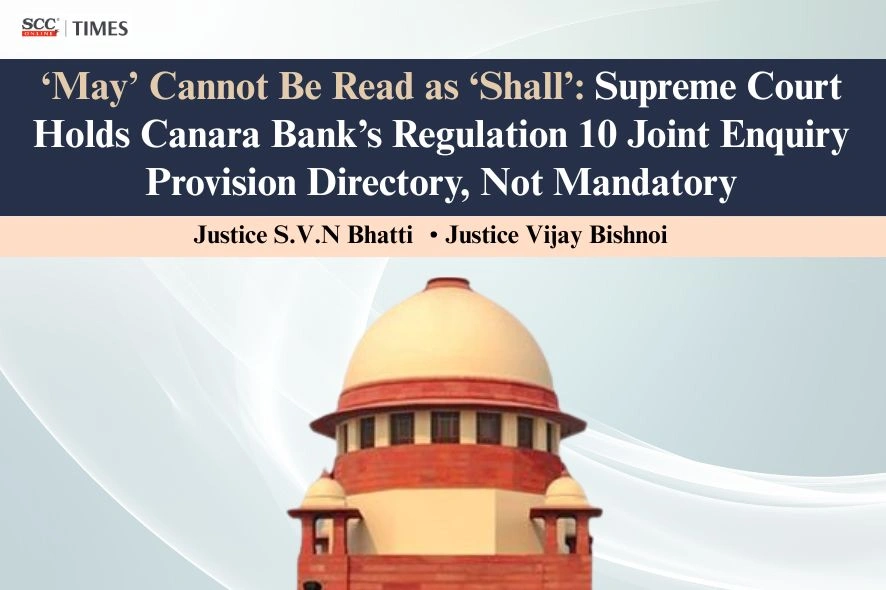
Supreme Court: In a civil appeal concerning disciplinary proceedings initiated against a Senior Manager of Canara Bank in relation to irregular sanction of credit facilities to two trading firms, a Division Bench of S.V.N. Bhatti* and Vijay Bishnoi, JJ., partly upheld the decision of the Division Bench of the High Court setting aside the order of punishment imposed upon the bank officer.
The Court held that the findings recorded in the departmental enquiry stood vitiated due to reliance upon statements of persons who were not examined during the enquiry proceedings, thereby denying the delinquent officer an opportunity to rebut the material relied upon against her and violating principles of natural justice. However, the Court clarified that Regulation 10, Canara Bank Officer Employees’ (Discipline and Appeal) Regulations, 1976, which provides that disciplinary proceedings against multiple employees “may” be conducted jointly, is directory and not mandatory, and does not confer any right upon an employee to insist upon a common enquiry.
Background
The case arose from disciplinary proceedings initiated against the first respondent, who was serving as a Senior Manager at the Diplomatic Enclave Branch, New Delhi, of the appellant Bank and was also a member of the three-member Credit Sanction Committee. The Committee had sanctioned credit facilities to Aman Trading Company and Creative Trading Company. Subsequently, the bank alleged that the loans were sanctioned negligently and in collusion, without proper verification of the borrowers’ credentials and the securities offered, thereby constituting misconduct under the Canara Bank Officer Employees’ (Discipline and Appeal) Regulations, 1976 (1976 Regulations).
A charge-sheet dated 27 July 2005 was issued containing 2 Articles of Charge. Article I alleged that, in relation to Aman Trading Company, the respondent failed to independently verify the existence of the business, conduct proper credit investigation, authenticate collateral ownership, verify banking records and guarantor credentials, and ensure compliance with sanction conditions. It was also alleged that she allowed large cash withdrawals without monitoring end-use and recommended renewal of facilities without obtaining audited balance sheets. Article II, concerning Creative Trading Company, alleged similar lapses, including failure to scrutinise legal reports, detect discrepancies in identity documents and signatures, verify guarantors’ net worth, independently verify the business and collateral, and ensure compliance with banking norms before recommending the credit facility.
In the departmental enquiry, the charges were held proved and the disciplinary authority imposed punishment by order dated 31 May 2006. Challenging the proceedings, the respondent contended that she was merely a committee member and not the final sanctioning authority, while other officers were responsible for investigation and verification. She further alleged violation of natural justice on the ground that the enquiry relied upon statements of persons who were not examined during the proceedings, and asserted that she was discriminated against because other officers involved were awarded only minor penalties. The bank defended the action by asserting that, as Senior Manager in charge of the Credit Department, she bore direct responsibility for ensuring compliance with safeguards and proper scrutiny before sanctioning loans.
The learned Single Judge dismissed the writ petition on 2 September 2013, holding that the respondent had acted negligently, sufficient opportunity had been granted during the enquiry, and no case of discrimination or procedural illegality was made out. However, on appeal, the Division Bench set aside both the disciplinary order and the Single Judge’s decision. The Division Bench held that the enquiry officer had relied upon statements of co-accused officers recorded during preliminary investigation, though those officers were never examined in the enquiry, thereby denying the respondent an opportunity to rebut the material relied upon against her. It concluded that the findings were unsupported by legally admissible evidence and vitiated for lack of a semblance of evidence. The Bench also observed that no vigilance angle was involved in the matter and, therefore, consultation with the Central Vigilance Commission was unnecessary. Consequently, the order of punishment was quashed. Hence, the present civil appeal was filed at the instance of Canara Bank.
Issues
1. Whether the impugned judgment in setting aside the order of punishment dated 31 May 2006 exceeded the scope of judicial review of a decision taken in the disciplinary proceedings initiated against an employee?
2. Whether Regulation 10, 1976 Regulations is mandatory or directory in deciding whether a common cause of action against more than one employee should be through a common or independent disciplinary proceeding?
Analysis
The Supreme Court observed that the scope of judicial review in disciplinary matters is well settled and reiterated that courts ordinarily do not interfere with findings of fact unless there is perversity, absence of evidence, or violation of principles of natural justice. Upon perusal of the record, the Court held that the findings recorded by the Division Bench on the merits of the enquiry did not depart from the settled principles governing judicial review. The Court noted that the errors pointed out by the High Court in relation to the findings against the first respondent were not immaterial and, therefore, the impugned judgment to that extent warranted confirmation. The Court thus accepted the conclusion of the Division Bench that reliance by the enquiry officer upon statements of persons who were not examined in the disciplinary proceedings had vitiated the enquiry, as the respondent was denied an opportunity to rebut the material relied upon against her.
The Court thereafter considered the interpretation of Regulation 10, 1976 Regulations and the question whether the expression “may” therein should be construed as “shall”. Emphasising settled principles of statutory interpretation, the Court observed that a provision must be interpreted according to its plain meaning and without placing stress or strain upon the language employed. It held that “may” cannot ordinarily be read as “must” so long as the language retains its natural meaning, except in situations where such construction is necessary to effectuate a legal right. Referring to the decision of the High Court of Andhra Pradesh in T. Baba Prasad v. Andhra Bank, 2011 SCC OnLine AP 276, which interpreted Regulation 10, Andhra Bank Officer Employees (Discipline and Appeal) Regulations, 1981 a provision pari materia to the 1976 Regulations. The Court approved the view that the provision is directory and facilitative rather than mandatory. The Court agreed that Regulation 10 merely vests discretion in the employer to order joint or common proceedings where more than one officer is involved, and does not confer any corresponding right upon a delinquent employee to insist upon a joint enquiry. The Court further observed that construing “may” as mandatory would unnecessarily curtail the discretion of the management in dynamic circumstances, particularly where the roles of delinquent officers, the nature of charges, or the competent disciplinary authorities differ.
Decision
Accordingly, the Supreme Court affirmed the findings of the Division Bench insofar as they related to the infirmities in the disciplinary proceedings and the violation of principles of natural justice, but set aside the view taken by the Division Bench regarding Regulation 10, 1976 Regulations. Holding that the expression “may” in Regulation 10 is directory and not mandatory, the Court approved the interpretation adopted in T. Baba Prasad v. Andhra Bank and rejected the contrary view. The civil appeal was disposed of with a direction to the appellant Bank to settle the account of the first respondent in light of the judgment within 6 weeks.
[Canara Bank v. Prem Latha Uppal, 2026 SCC OnLine SC 847, decided on 12-5-2026]
*Judgment authored by: Justice S.V.N. Bhatti