When the National Commission to review the working of the Constitution circulated papers for public consultation, he encouraged students to prepare and submit representations.
“Guru Brahma, Guru Vishnu, Guru Devo Maheshwara Guru Sakshat Parabrahma Tasmai Shree Guruve Namah”
— The Guru is the Supreme Being; salutations to the revered teacher.
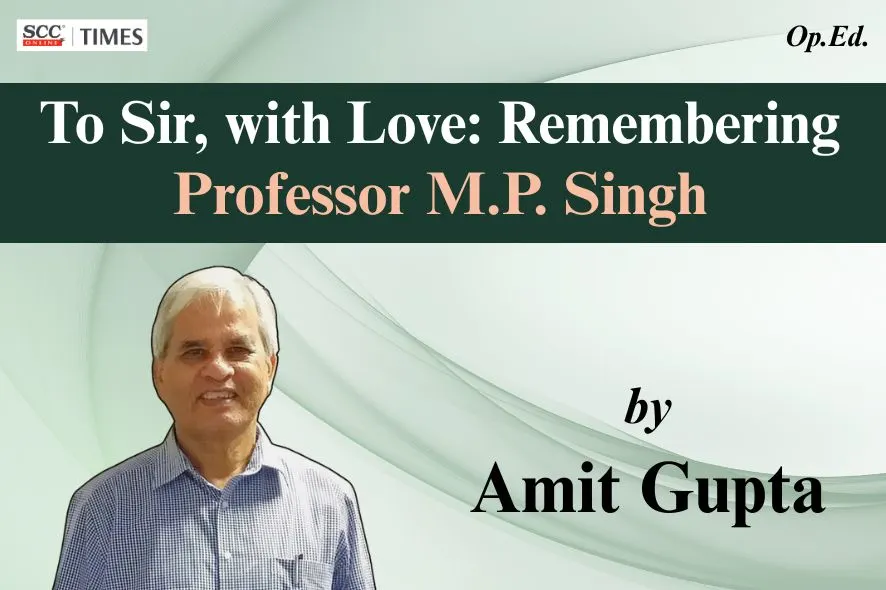
Prof. M.P. Singh, Professor Emeritus at the Faculty of Law, University of Delhi, was in every sense a true guru, guide, and mentor. His passing is a profound loss for the legal community. He was among the most respected scholars of constitutional law and an extraordinary teacher whose guidance shaped generations of students. His contributions to legal scholarship were immense, ranging from Indian constitutional law and German administrative law to comparative constitutional law and Indian legal and constitutional history. Yet, perhaps his most enduring legacy lies in the profound impact he had on the students fortunate enough to learn from him.
For many of us, attending his lectures was a transformative experience. At the Campus Law Centre, I was not in the class formally assigned to him for teaching constitutional law. Yet, that hardly mattered. Like many students, attending his lectures felt far more important — even at the cost of missing other scheduled classes. Seats had to be secured in advance; otherwise, one often ended up standing at the back of an already full classroom. That was not merely a reflection of his reputation, but a testament to the richness and depth of what he offered. With Prof. Singh, the classroom was not simply about reciting constitutional provisions or case law — it was a space where learning unfolded through dialogue, inquiry, and rigorous intellectual engagement.
One of the most enduring memories from those lectures was the long and engaging discussions on Articles 14, 15 and 16 of the Constitution, dealing with equality, non-discrimination, and equal opportunity in public employment. These discussions often spanned multiple lectures, drawing students into lively debates on affirmative action and reservation policies in education and public employment. Many of us approached these topics with skepticism, questioning their fairness or scope. Prof. Singh never dismissed such concerns. Instead, he welcomed them, guiding us through the historical, social, and constitutional contexts that shaped these policies. I particularly recall how he emphasised that the concept of “merit” cannot be viewed through a single prism. By the end of these discussions, many of us had gained a deeper and more nuanced understanding of the role and purpose of reservations within our constitutional framework.
Prof. Singh’s commitment to learning extended well beyond the classroom. When the National Commission to review the working of the Constitution circulated papers for public consultation, he encouraged students to prepare and submit representations. These efforts eventually culminated in a seminar organised under the aegis of the Campus Law Centre, bringing together professors and students to engage seriously with questions of constitutional policy. For many of us, it was our first experience of contributing meaningfully to discussions shaping the nation’s legal framework.
Among his most widely recognised scholarly contributions was his revision of V.N. Shukla’s
Despite his towering academic stature, Prof. Singh was remarkably humble, warm, and approachable. His home and office were always open to students seeking guidance. He treated each student as an individual, nurturing curiosity and encouraging independent thought. It was his encouragement that persuaded me to pursue a Master’s degree — a step I might not have taken without his guidance. His mentorship extended beyond academic instruction; it fostered intellectual confidence and personal growth.
In the broader landscape of legal scholarship, Prof. Singh was not merely a teacher but a guiding intellectual force who shaped our understanding of India’s constitutional ethos. His writings on federalism, fundamental rights, and comparative constitutional law remain essential reading for anyone seeking a serious understanding of the Constitution.
The influence of a teacher cannot be measured by publications or titles alone. It is also reflected in the lives of the students they have mentored, and in the ideas and values those students carry forward into society. Prof. Singh embodied that influence. He was also an able administrator. As Vice-Chancellor of the West Bengal National University of Juridical Sciences in Kolkata, he encouraged young scholars and helped strengthen the academic standing of the institution during his tenure.
His passing is, therefore, both the loss of a distinguished scholar and a cherished mentor. For countless students, he was far more than a professor; he was a guide who helped us understand the deeper purpose of the Constitution and our responsibilities as members of the legal community. His legacy endures — in the books he shaped and in the generations of students who continue to carry forward the values he so passionately embodied.
To Sir, with love and gratitude.
*BCL (Oxford) and LLM (Columbia) University graduate practicing in the Supreme Court and the Delhi High Court. Author can be reached at: aguptalaw@gmail.com.