Disclaimer: This has been reported after the availability of the order of the Court and not on media reports so as to give an accurate report to our readers.
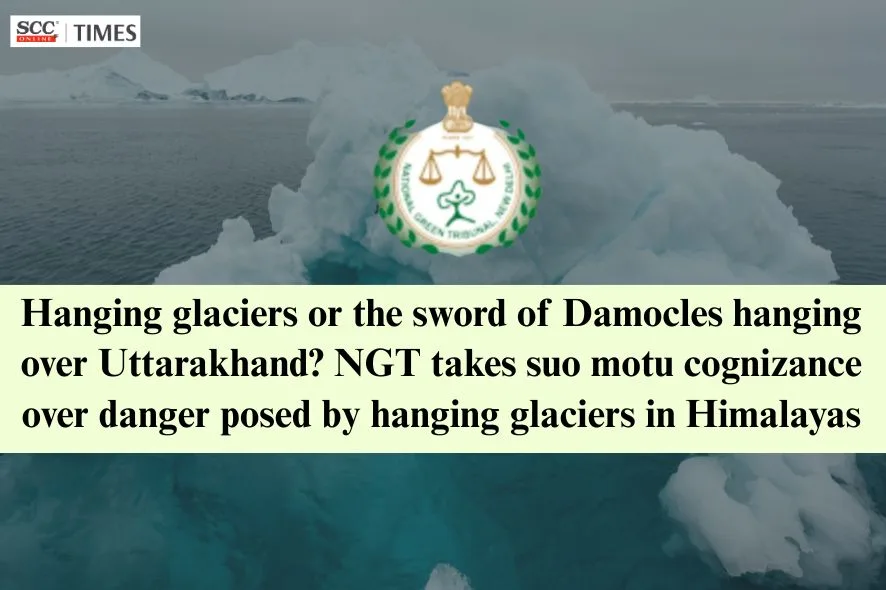
National Green Tribunal: In a suo motu application registered by the Principal Bench, based on a newspaper report on “Danger Posed by Hanging Glaciers on Mountain Slopes in Central Himalaya”, the Bench of Prakash Shrivastava, J., (Chairperson) and Dr Afroz Ahmad (Expert Member) impleaded the Ministry of Environment, Forest and Climate Change (MoEFCC), Central Pollution Control Board (CPCB), Uttarakhand Tourism Development Board, National Mission for Clean Ganga, Department of Urban Development, Uttarakhand and National Institute of Hydrology, and directed them to file a reply in the present matter.
Background
The NGT took suo motu cognizance after the publication of a news item about the danger posed by hanging glaciers on mountain slopes in the Central Himalaya. The NGT noted that the newspaper reported that glacier retreat had caused tributary glaciers to detach from trunk glaciers, destabilising previously stable mountain glaciers, which were often offset through snow or ice avalanches, a typical feature of hanging glaciers. However, such natural processes became hazardous when occurring near settlements or infrastructure, particularly in a seismically active region.
The NGT noted the findings of 4 researchers from the Indian Institute of Science (IISc), Bengaluru, the Indian Institute of Technology (IIT), Bhubaneswar, and the Defence Research and Development Organisation (DRDO), Chandigarh, which revealed that glaciers in the Alaknanda basin of Uttarakhand, a key headstream region of the Ganga, posed a growing yet largely overlooked danger, with a sharp rise in human exposure driven by rapid development in high-altitude areas.
The researchers assessed the potential avalanche reach and impact, using satellite imagery, elevation models, and avalanche simulations, concluding that in a worst-case scenario, flows could extend to major settlements such as Mana, Badrinath, and Hanuman Chatti. According to the researchers, the rapid increase in exposure had made the situation more alarming as the estimated areas within vulnerable zones had expanded significantly, from about 8000 square metres in the year 2000 to over 150,000 square metres projected by the year 2030.
The researchers argued that adopting targeted monitoring in high-risk Himalayan locations could significantly reduce future risks. Although full-scale systems may be difficult to implement across such vast terrain, a practical first step would be to identify the most hazardous glaciers and focus resources on them.
Action by NGT
At the outset, the NGT stated that the news item indicated a violation of the provisions of the Environment (Protection) Act, 1986, raising substantial issues relating to compliance with environmental norms and implementation of the provisions of the scheduled enactment.
The NGT referred Municipal Corpn., Greater Mumbai v. Ankita Sinha, (2022) 13 SCC 401, to state that the Supreme Court has recognised the power of the Tribunal to take suo motu action. Accordingly, the NGT impleaded the MoEFCC, CPCB, Uttarakhand Tourism Development Board, National Mission for Clean Ganga, Department of Urban Development, Uttarakhand and National Institute of Hydrology, and directed them to file a reply in the present matter.
[News Item Titled “Study Flags Overlooked Danger Posed by Hanging Glaciers on Mountain Slopes in Central Himalaya” Appearing in the Hindu, 2026 SCC OnLine NGT 210, decided on 24-4-2026]