Disclaimer: This has been reported after the availability of the order of the Court and not on media reports so as to give an accurate report to our readers.
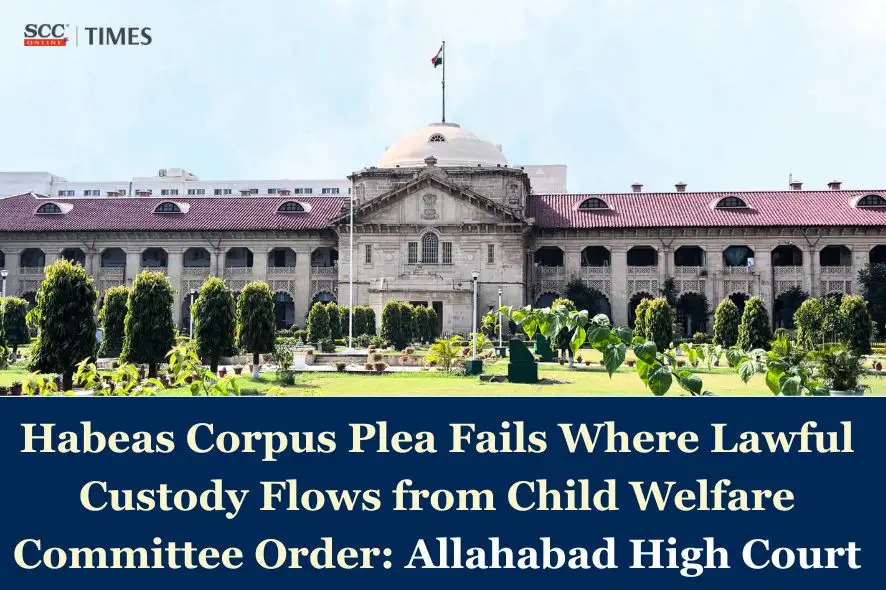
Allahabad High Court: In a habeas corpus writ petition filed by the husband seeking custody of his wife (corpus) alleging illegal detention in Rajkiya Bal Grah (Balika), Vrindavan, the Single Judge Bench of Sandeep Jain, J., dismissed the petition holding that habeas corpus not maintainable against lawful custody of State where the corpus is in custody pursuant to a judicial order passed by the Child Welfare Committee under the Juvenile Justice (Care and Protection of Children) Act, 2015 (JJ Act).
Background
In the instant case, the petitioner claimed right for the custody of the corpus, his wife, and contended that she was in illegal custody of the State, in Rajkiya Bal Grah (Balika), Mathura, against her wishes.
The State opposed the petition submitting that a criminal case was pending against the petitioner, who had allegedly married the corpus when she was a minor and that the corpus had been lawfully detained pursuant to a judicial order of the Child Welfare Committee, and therefore her custody was lawful.
Analysis and decision
The Court relied upon the Full Bench decision in Rachna v. State of U.P., 2021 SCC OnLine All 211, to reiterate that a writ of habeas corpus is not maintainable where the custody of the corpus is as per judicial orders passed by a Magistrate or a court of competent jurisdiction or a Child Welfare Committee.
The Court, relied upon Mayank Ojha v. State of U.P., 2025 SCC OnLine All 6064, and emphasised that, the JJ Act, provides a complete mechanism for child welfare and that the Child Welfare Committee exercises powers of a Magistrate under Section 27, JJ Act and for all purposes. Once such an order is passed, it can be challenged only before the appropriate court through an appeal or other remedies as provided by law.
The Court also referred the Supreme Court decision in Nirmala v. Kulwant Singh, (2024) 10 SCC 595, where it was held that habeas corpus is an extraordinary remedy and, in child custody matters, is maintainable only when the detention is illegal, unauthorised, or without authority of law, particularly when no efficacious alternative remedy is available.
Applying the settled principles, the Court found that the corpus was in lawful custody of the State pursuant to the order dated 18 December 2025 passed by the Child Welfare Committee, Sambhal, under Section 27(9), JJ Act and thus, dismissed the petition.
[Deeksha v. State of U.P., 2026 SCC OnLine All 3146, decided on 22-4-2026]
Advocates who appeared in this case:
For the petitioner: Maohammd Nadeem
For the respondent: G.A.