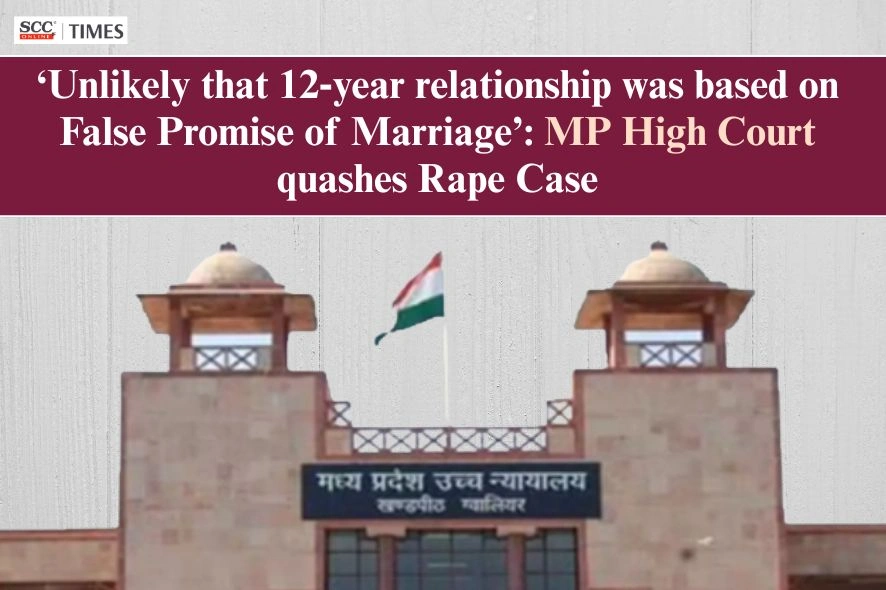
Madhya Pradesh High Court: Examining whether allegations of false promise to marriage in long-term relationships could vitiate consent under the provisions governing sexual offences, a Single Judge Bench of Vinay Saraf, J. reiterated that for such a claim to succeed, the promise must be false from inception, made in bad faith, and shown to have directly influenced the woman’s decision to engage in the sexual act.
The Court was called upon to decide an application for quashment of FIR under Sections 351(2) and 69 of Nyaya Sanhita, 2023 (BNS) whereby the complainant had levelled allegations against the applicant of developing physical relations with her under a false promise of marriage. The bench, while exercising its inherent power under Section 528, Nagarik Suraksha Sanhita, 2023 (BNSS), quashed the FIR against the applicant stating that the Court does not find any ingredient or material to make out the alleged offences.
Background
In the case at hand, the applicant met the complainant in December 2012 at the Army Canteen, Shahjahanabad, Bhopal, after which they started communicating over mobile phone. As per the FIR, the complainant had alleged that the applicant had represented himself as a bachelor and, on a false promise of marriage, established physical relations with her, which continued on several occasions thereafter. In 2013, the complainant came to know that the applicant was already married, but he allegedly stated that he was not living with his wife, intended to obtain a divorce, and would marry the complainant in the future. Relying on this assurance, the relationship continued until February 2025, when the complainant discovered that the applicant was in contact with other women and had made similar promises to them. It was further alleged that the applicant later threatened the complainant, following which she lodged the FIR. The present application was thus filed by the applicant seeking quashment of the FIR.
Analysis, Law, and Decision
After considering arguments advanced and perusing the record and statement made by the complainant under Section 183, BNSS, the Court noted that the applicant and the complainant had known each other since 2012 and had maintained a physical relationship for nearly 12—13 years. Both parties being well educated and employed in uniformed services, it could not be believed that the complainant developed the physical relationship with the applicant on the pretext of false marriage and continued the same without any demur or objection even after knowing the fact that the applicant is already married.
The Court observed that “consent” of a woman with respect to Section 375 IPC must involve an active and reasoned deliberation towards the proposed act. To establish whether such consent was vitiated by a “misconception of fact” arising out of a promise to marry, two propositions must be established:
-
first, that the promise of marriage was false, given in bad faith and with no intention of being adhered to at the time it was made; and
-
second, that the false promise bore a direct nexus to the woman’s decision to engage in the sexual act.
Applying the same to the case at hand, the Court found it unconvincing that the complainant, being a woman working in the Police Department, would have continued to meet the applicant and maintained a prolonged physical relationship with him in the absence of voluntary consent.
The Court observed that the relationship between the applicant and the complainant had continued for a long period, and therefore it was difficult to accept the allegation that the applicant had established physical relations solely on the basis of a false promise of marriage. The Court further noted that the FIR appeared to have been lodged after the relationship between the parties deteriorated, to pressurize the applicant to continue the relationship.
The Court, hence, held that the case appeared to be one of a consensual relationship rather than rape, and that the continuation of the criminal proceedings would amount to an abuse of the process of law.
Thus, while exercising its inherent powers under Section 528 BNSS, the Court quashed the FIR, observing that no material or ingredients were made out to constitute the alleged offences.
[X v. State of Madhya Pradesh, 2026 SCC OnLine MP 3188, decided on 11-3-2026]
Advocates who appeared in this case:
For the Applicant: Kailash Chandra Ghildiyal, Senior Advocate with Awadhesh Kumar Ahirwar, Advocate
For the Complainant: Nalini Gurung, Panel Lawyer, Dinesh Tripathi, Advocate