Disclaimer: This has been reported after the availability of the order of the Court and not on media reports so as to give an accurate report to our readers.
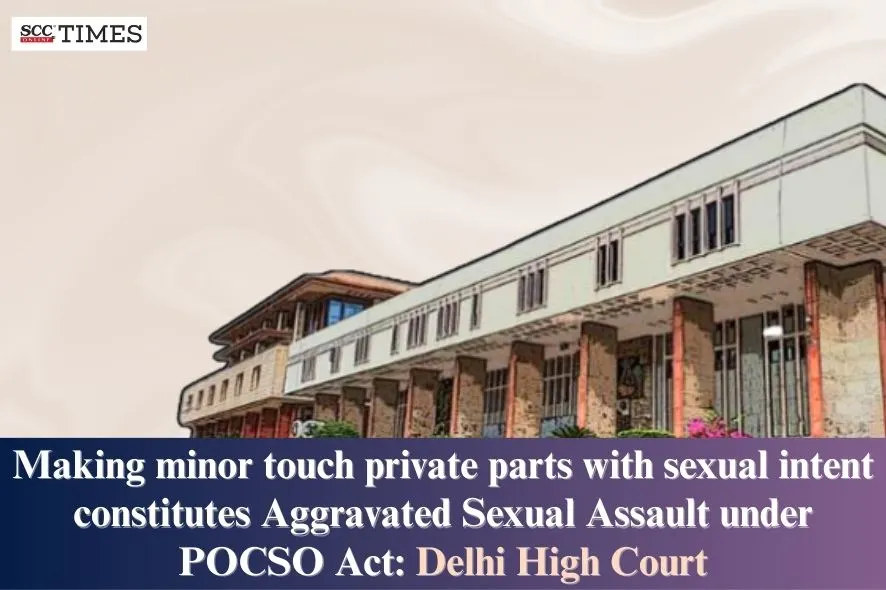
Delhi High Court: In a criminal appeal challenging the appellant’s conviction for the offence of committing aggravated sexual assault upon a child of tender age, aged about 3 years and 11 months, punishable under Section 10 of the Protection of Children from Sexual Offences Act, 2012 (POCSO Act), a Single-Judge bench of Neena Bansal Krishna,* J., held that making a minor touch private parts with sexual intent amounts to aggravated sexual assault under Section 10 POCSO Act, and upheld that conviction under POSCO Act.
In the instant matter, the prosecution case arose from an incident dated 17-06-2022, when the victim, a girl aged 3 years and 11 months, was allegedly sexually assaulted by the appellant, who was a tenant residing in the same premises. The child’s mother had left the child at the house of her grandmother, situated a few houses away, while she went out for medical tests. The child returned alone to her own house to use the toilet.
Upon returning, the child encountered the appellant. According to the version narrated by the child to her mother, the appellant removed her undergarment, exposed his private part and made the child touch it, and also indulged in “chedkhani”. The child narrated the incident when she saw the appellant again, whereupon he allegedly fled from the spot.
The mother first informed her mother-in-law, who advised her to wait for the return of her husband. Upon the husband’s return on 19-06-2022, a PCR call was made. The child was medically examined, and the mother’s statement was recorded, leading to registration of the FIR. The child’s statement under Section 164 CrPC was also recorded. After investigation, charges were framed initially under Section 6 POCSO Act and Section 376 IPC.
The prosecution examined six witnesses, including the victim (PW-1), her mother (PW-2), the police officials, and the doctor who conducted the medical examination. The medical report recorded no injuries, and internal examination was not conducted as consent was declined.
Upon conclusion of trial, the trial court convicted the appellant not for penetrative assault, but for the lesser offence of aggravated sexual assault under Section 9(m) punishable under Section 10 of the POCSO Act, and also under Sections 354/354A/354B IPC. The appellant was sentenced to seven years’ rigorous imprisonment under Section 10 POCSO Act, along with fine.
Aggrieved the appellant challenged the conviction primarily on the grounds — material contradictions between the child’s statements under Sections 161 and 164 CrPC; delay of two days in lodging the FIR, (failure of the Trial Court to assess the competency of the child witness under Section 33 POCSO Act; absence of medical corroboration; non-examination of the grandmother, who was the first recipient of disclosure, and alleged false implication due to rent dispute and personal animosity.
The Court noted that the core allegation of sexual assault remained consistent throughout the testimony of the child and her mother. The Court held that the minor variations in expression was natural, given the tender age and limited vocabulary of the victim.
“…age of the victim has to be kept in mind while appreciating her statement, the limits on the vocabulary of the Child Victim at the age of 03 years and 11 months or even 05 years, cannot be overlooked.”
The Court held that the deviation in the Section 164 CrPC statement was not to be fatal, as “merely on the basis of statement under Section 164 CrPC, the previous statement of the child and the entire evidence cannot be discarded.” The Court further held that absence of injuries was inconsequential, considering the nature of assault and the fact that no penetrative assault was ultimately proved.
The Court noted that sexual abuse of children remains shrouded in shame, guilt and family honour, and hesitation in reporting such offences, particularly when the accused is a known person, is natural. Therefore, the Court opined that the delay in FIR was satisfactorily explained.
The Court asserted that “making a small child touch the private part with sexual intent amounts to aggravated sexual assault”, squarely attracting Section 10 of the POCSO Act. The Court held that the prosecution had established the offence beyond reasonable doubt and that the presumption under Section 29 POCSO Act stood unrebutted.
The Court found no substance in the defence of false implication, noted that such defence was vague, unsubstantiated and not even put to the complainant in cross-examination. However, the Court found merit in the contention that no charge had been framed under Sections 354/354A/354B IPC, and therefore conviction under those provisions could not be sustained.
The Court set aside the conviction and sentence under Sections 354/354A/354B IPC but upheld the conviction and sentence under Section 10 of the POCSO Act.
[Dharmendra Kumar v. State (Govt. of NCT of Delhi), 2026 SCC OnLine Del 10, Decided on 05-01-2026]
*Judgment by Justice Neena Bansal Krishna
Advocates who appeared in this case:
Mr. Prateek Kumar, Ms. Ankita, Mr. Prassant Kumar Sharma and Mr. Chetan Charitra, Counsel for the Appellant
Mr. Utkarsh, APP, Counsel for the State
Ms. Tanya Agarwal (DHCLSC) and Mr. Krishna Kumar Keshav, Counsel for the complainant
Buy Protection of Children from Sexual Offences Act, 2012 HERE
Buy Penal Code, 1860 HERE
Buy Code of Criminal Procedure, 1973 HERE