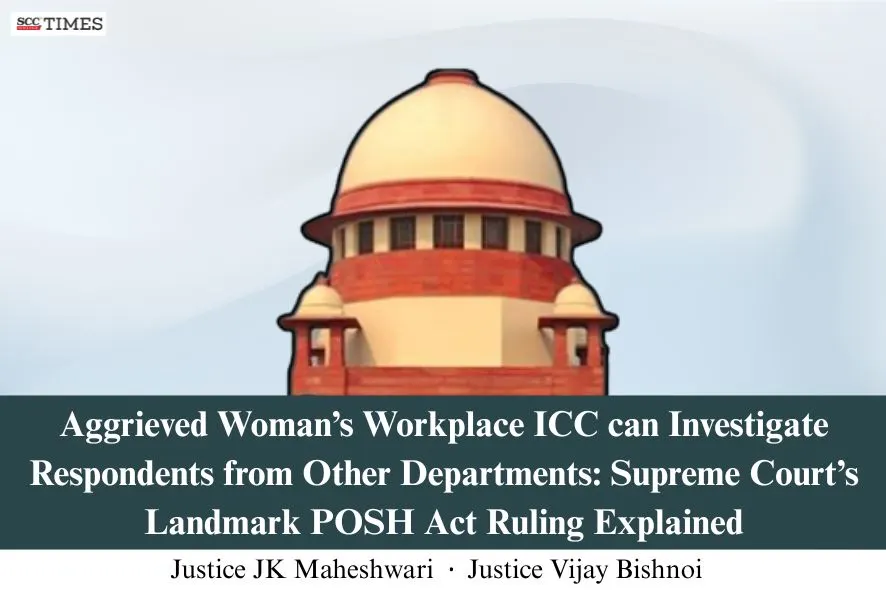
Supreme Court: In a significant ruling, the bench of JK Maheshwari* and Vijay Bishnoi, JJ has held that an Internal Complaints Committee (ICC) constituted at the workplace of an aggrieved woman can conduct a preliminary inquiry under the Sexual Harassment of Women at Workplace (Prevention, Prohibition and Redressal) Act, 2013 (POSH Act), even if the ‘respondent’ is employed in a different government department.
Also Read: SHe-Box and Beyond: Your Essential Guide to Navigating the PoSH Complaint Process
Background of the Case
In the case at hand, a 2010-batch Indian Revenue Service (IRS) officer, who, at the relevant point of time, was posted as OSD, Investigation, Central Board of Direct Taxes, Delhi, was accused of sexual harassment by a 2004-batch Indian Administrative Service (IAS) officer at her workplace in Krishi Bhawan, New Delhi on 15-05- 2023
The IRS Officer challenged the jurisdiction of the ICC at the workplace of the aggrieved IAS officer, alleging that only the ICC in his own department could inquire into the complaint. He argued that since the Department of Revenue was his controlling authority, the ICC constituted under the Department of Food and Public Distribution did not have the jurisdiction to entertain the complaint filed by the aggrieved woman under Section 9 of the POSH Act. Hence, it was only the ICC constituted under his own Department which can institute ICC proceedings against him.
The Central Administrative Tribunal (CAT), Principal Bench, New Delhi upheld the ICC’s inquiry and observed that the word ‘workplace’ has been defined in the POSH Act in relation to the aggrieved woman and the complaint under 15 Section 9 of the POSH Act may be enquired upon even when the ‘respondent’ has no relation whatsoever with the workplace of the aggrieved woman. Later, the Delhi High Court also confirmed CAT’s decision.
The IRS Officer, hence, approached the Supreme Court, challenging the High Court’s judgment.
Supreme Court’s Analysis and Ruling on ICC Jurisdiction under POSH Act
The Supreme Court emphasized that the POSH Act’s definition of “workplace” is broad, encompassing places visited during the course of employment.
Interpretation of “where” under Section 11(1) of the POSH Act
The Court noted that Section 11(1) of the POSH Act outlines how an ICC or Local Committee must act upon receiving a complaint from an aggrieved woman and that the word “where” in the section refers to situations or contingencies, not a physical location. It sets out three distinct scenarios:
-
‘Where’ the ‘respondent’ is an ‘employee’, the ICC shall proceed to make inquiry into the complaint, in accordance with the provisions of the service rules applicable to the ‘respondent’;
-
‘Where’ no applicable service rules exist, ICC shall proceed to make inquiry into the complaint, in such manner as may be prescribed;
-
‘Or’ ‘where’ respondent is a domestic worker, the Local Committee shall, if prima facie case exists, forward the complaint to the police, within a period of seven days for registering the case under Section 509 of the IPC and any other relevant provisions of the said Code where applicable.
The Court explained that the phrase “where the respondent is an employee” is a procedural trigger, directing the ICC to follow relevant service rules; it is not a jurisdictional limitation.
The Court further noted that on reading the section as a whole it was evident that it prescribes procedure rather than restricting which ICC can hear the complaint. Therefore, an ICC at the workplace of the aggrieved woman can validly exercise jurisdiction even if the respondent works in a different department.
Hence, the appellant’s claim that jurisdiction is confined to the ICC of the respondent’s own department, could not be accepted.
Whether the ‘respondent’ must be an employee of the same workplace as the ‘aggrieved woman’?
The Court noted that the definitions of “employee” and “workplace” under the POSH Act are completely neutral, in the sense that they do not suggest that the ‘respondent’ must necessarily be an employee of the workplace where the aggrieved woman works. The word “respondent” is defined as the person against whom a complaint is filed, the word “employee” means a person employed at a workplace and the word “workplace” includes any place visited in the course of employment, including during official travel.
The Court hence noted that the expansive definitions of these words enable the ICC constituted at the aggrieved woman’s workplace to exercise jurisdiction over an employee of a different workplace. None of these definitions provide that the ‘respondent’ must necessarily be an employee of the same workplace where the aggrieved woman works.
Delving into the object behind the POSH Act, the Court observed that the Act does not merely punish acts of sexual harassment, but actively imposes a legal duty on employers to prohibit and prevent harassment, it ensures that the women in each workplace have open access to a mechanism for redressal of complaints of sexual harassment in the form of ICC. It aims to bring about safety and accountability in the workplace in order to enable women to pursue their career without the fear of a hostile environment. Hence, if the aggrieved woman had to approach the ICC constituted at the workplace of the ‘respondent’ for every third-party incident, it would fall short of the aforesaid object.
The Court held that a narrow interpretation of provisions of the POSH Act would beget several procedural and psychological barriers for the aggrieved woman and would create a situation where the aggrieved woman would have to appear before the ICC at an alien workplace in order to pursue her remedy in law.
The Court observed,
“The taboo around sexual harassment at the workplace and the fear of stigma which may be attached to the aggrieved woman as a consequence of a complaint regarding sexual harassment already poses a massive psychological barrier for the aggrieved women which actively dissuades them from pursuing their remedy in law. In such view of the matter also, the intent of the legislature behind giving such a wide meaning to the word ‘workplace’ to go beyond the bounds of the traditional meaning implying location of the office, cannot be brushed aside by narrow construction of other provisions of the POSH Act.”
Argument that only Respondent’s employer can take disciplinary action against him
The Supreme Court was also unimpressed by the argument that why only the ICC of the respondent’s department has jurisdiction to entertain a complaint under Section 9 of the POSH Act is that it is only his department which can take disciplinary action against him, and hence, the inquiry must be conducted by the ICC constituted under the aegis of the Appellant’s employer.
The Court held that the said argument was not in line with the scheme of the POSH Act and also failed to differentiate the authority to inquire into the facts and the authority to enforce or act on the findings. The Court explained that while the ICC constituted at the workplace of the aggrieved woman or the employer may not have the authority to impose a penalty / punishment on the ‘respondent’ as a consequence of the proceedings under the POSH Act, its findings can certainly be acted upon by the employer of the ‘respondent’.
The Court held that,
-
The ICC proceedings instituted in the aggrieved woman’s department can be considered the first-stage of inquiry which carries out a preliminary / fact-finding inquiry, after which the report of the ICC may be sent to the employer / department of the ‘respondent’.
-
Depending on the findings of the ICC (at the aggrieved woman’s workplace) as the first stage, the ‘employer’ may then take a decision to initiate disciplinary proceedings under the applicable service rules and in such disciplinary proceedings, the ICC constituted at the workplace of the ‘respondent’ shall be the inquiring authority.
-
While conducting the disciplinary proceedings against the ‘respondent’, the ICC at the workplace of the ‘respondent’ shall have reference to the report of the fact-finding inquiry by the ICC constituted at the workplace of the aggrieved woman.
Summary of Supreme Court Ruling on ICC Jurisdiction under the POSH Act
-
The phrase “where the respondent is an employee” in Section 11 does not limit ICC proceedings to the ICC of the respondent’s own workplace. Restricting jurisdiction in this way would contradict the object and social welfare intent of the POSH Act.
-
Section 2(o)(v) provides a wide definition of workplace, including any place visited by an employee during the course of employment, supporting broader ICC jurisdiction.
-
Under Section 13, the ICC conducts a preliminary/fact-finding inquiry and submits its report to the employer. If the employer initiates disciplinary proceedings, the ICC of the respondent’s department acts as the formal inquiry authority under CCS CCA Rules, 1965.
-
Even if the respondent works in a different department, their employer must cooperate with the ICC constituted at the aggrieved woman’s workplace under Section 19(f), providing information promptly. The ICC report is to be sent to the respondent’s department for further action under the POSH Act and relevant service rules.
[Sohail Malik v. Union of India, 2025 SCC OnLine SC 2751, decided on 10-12-2025]
*Judgment Authored by Justice JK Maheshwari
Advocates who appeared in this case:
For Appellant(s): Mr. Piyush Sharma, AOR Mr. Anuj Kumar Sharma, Adv. Mr. Aditya Dikshit, Adv. Mr. Shivesh Srivastava, Adv.
For Respondent(s): Ms. Aishwarya Bhati, A.S.G. Ms. Archana Pathak Dave A.S.G. Mr. Raj Bahadur Yadav, AOR Ms. Ruchi Kohli, Adv. Ms. Priyanka Das, Adv. Ms. Preeti Rani, Adv. Mr. B K Satija, Adv. Mr. Shubhranshu Padhi, Adv. Mr. Noor Rampal, Adv. Mr. Shreekant Neelappa Terdal, AOR Mr. Abhay Kumar, AOR Mr. Shagun Ruhil, Adv. Mr. Shreenivash, Adv. Mr. Rakesh Kumar, Adv.