Top Legal Developments [9 — 15 March 2026] | Passive Euthanasia; Creamy Layer Status; Flexi-Hours for Women in Maharashtra; and more
A quick roundup to cover all the important legal developments and cases this week.
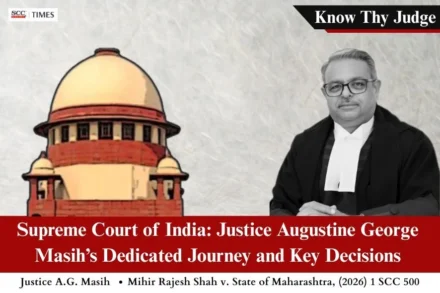
Justice Augustine George Masih served as a Judge of Punjab and Haryana High Court, and as a Chief Justice of Rajasthan High Court before being appointed as the Judge of the Supreme Court of India on 9 November 2023.
The Court impleaded Union of India through Secretary, Department of Legislation and State of Uttar Pradesh through its Chief Secretary as new party respondent.
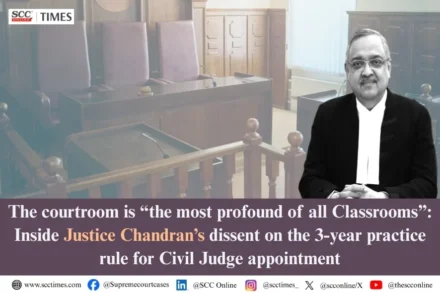
“The judiciary would do well to remain circumspect of these practical realities, and interpret service rules in a manner that furthers the very object of a selection process, that is, the selection of the most suitable candidates from suitable candidates for appointment in a timely manner.”
Strong concerns are raised about misinterpretation and improper implementation of the newly adopted definition of the Aravalli Hills and Ranges. Their dissent arises from perceived ambiguity in the directives, creating a pressing need for further clarification to avoid regulatory gaps that could undermine the ecological integrity of the Aravalli region.
“When a party is unable to analyse, comment or argue on a contention raised by the other party, it will certainly be deemed as a breach of natural justice and thereby, also a violation of the most fundamental notions of justice.”
The High Court had directed that all the candidates who participated in CLAT UG 2025 with respect to the Sets ‘B’, ‘C’ & ‘D’ of question papers shall, as a consequence, be granted the marks indicated against the said question.
“Misuse of the process of Court with an intent to tarnish the image of judiciary, threatening the integrity, and the efficiency of the judicial system cannot be allowed to be overlooked”.
“Equitable considerations do apply when the Court considers the prayer for maintenance under Section 25. The reason is that Section 25 lays down that while considering the prayer for granting relief under Section 25, the conduct of the parties must be considered.”
“It must be established that all the accused had preplanned and shared a common intention to commit the crime with the accused who has actually committed the crime.”
“The Constitutional Courts can lay down the principles governing the grant of bail or anticipatory bail, however, the Constitutional Courts cannot interfere with the discretion of Trial Courts by laying down the form in which an order should be passed while deciding bail applications…Explanation of a Judicial Officer can be called for only on the administrative side.”
“Article 21 of the Constitution does not end with the pronouncement of the sentence but extends to the execution stage of that sentence. An inordinate delay in the execution of the sentence of death has a dehumanising effect on the accused. An inordinate delay caused by circumstances beyond the prisoners’ control mandates the commutation of a death sentence.”
The Supreme Court also emphasized that there needs to be a mechanism for keeping a vigil to ensure that there is no unauthorised felling of trees.
The claims pertaining to the transfer fees, etc., cannot be dealt with by courts or tribunals as the same relates to the commercial wisdom of the Committee of Creditors for they are the best persons to determine their interests, and any such interference is non-justiciable except as provided by Section 30(2) of IBC 2016.
Supreme Court clarified that till the date of communication of the order on the regularisation application, the limited interim relief granted on 6-08-2024 will continue to operate.
V. Senthil Balaji was arrested and remanded to judicial custody on 14-06-2023 for an alleged offence under Section 3 of PMLA.
The Delhi High Court had ruled that the Central Delhi Court Bar Association shall be recognized as the Court annexed Bar Association for the Rouse Avenue District Court Complex in the national capital.
“Royalty is in the nature of a tax or an exaction. It is not merely a contractual payment but a statutory levy under Section 9 of the MMDR Act.”
Supreme Court said that authorizing the Central Government to lay down the terms of mining leases and grant approval to concessions, the MMDR Act seeks to ensure that there is uniformity in the terms for working of mines and extraction of minerals.
“The payments made to the Government cannot be deemed to be a tax merely because the statute provides for their recovery as arrears”.