Delhi HC: Ancestral property can be attached under PMLA if property represents value equivalent to proceeds of crime
“The plea of the property being ancestral does not ipso facto grants immunity from attachment under the PMLA.”

Bringing you the Best Analytical Legal News


“The plea of the property being ancestral does not ipso facto grants immunity from attachment under the PMLA.”

This article offers a clear overview of daughters’ property rights under Hindu law—how the law under Hindu Succession Act, 1956 worked before the 2005 Amendment, and how the amendment transformed daughters into coparceners by birth. It traces the major Supreme Court rulings leading up to Vineeta Sharma (2020) 9 SCC 1, clarifies common myths, and answers practical FAQs.
With the departure of year 2025 a recap of the most notable decisions of the Supreme Court of India is a must. 2025 has been a landmark year especially in respect to verdicts on judicial services, environmental causes such as Aravali Hills, activism for stray animals. The Court also laid to rest the questions of Governor and President’s powers vis-a-vis giving assent to Bills and flagged pendency of cheque bounce cases in courts.
“The petitioner claiming appointment on the basis of grandfather’s land being acquired almost 45 years back and claiming to be a project affected persons was contrary to the advertisement.”
“It was arguable that an educated person had executed a document which was registered and then claimed ignorance of the nature of the transfer, which could not be fathomed.”
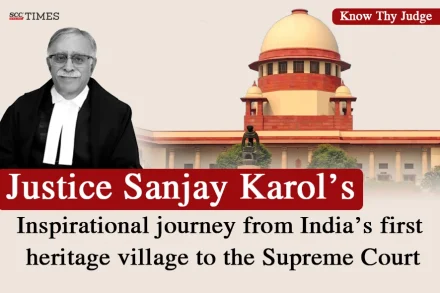
Hailing from Garli, India’s first heritage village, Justice Sanjay Karol served his parent High Court of Himachal Pradesh as Acting Chief Justice and High Courts of Tripura and Patna as Chief Justice before his elevation as a Supreme Court Judge on 06-02-2023.

“Ancestral property is a rightful heritage, not a personal asset.”
Stay informed on the latest Supreme Court judgments of July 2025 on Bihar’s Electoral Roll revision, recording of spousal conversations; Tribal woman’s rights over ancestral property; Guidelines on collection of DNA evidence and mental health of college students. Explore notable rulings shaping the legal landscape.
“One would think that in this day and age, where great strides have been made in realizing the constitutional goal of equality, this Court would not need to intervene for equality between the successors of a common ancestor and the same should be a given, irrespective of their biological differences, but it is not so”.
This report covers the Supreme Court’s Never Reported Judgment, on ancestral property, dating back to the year 1954.
While interpreting the provisions of Senior Citizens Act, 2007, the Courts must bear the objectives and purposes for which the statute was enacted.
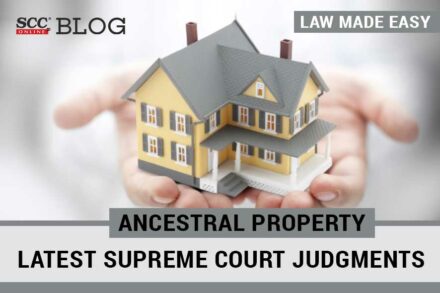
We often get to hear the term ‘ancestral property’, but the exact meaning of the term remains unknown to most of us.
Senior Citizens have every right to protect themselves and in case of ill-treatment and abuse by their children/ legal heirs, can approach the Maintenance Tribunal for their eviction from their property of any kind, which includes both Ancestral as well as Self Acquired Property.
Chhattisgarh High Court: A Division Bench of Goutam Bhaduri and Deepak Kumar Tiwari JJ. entitled father-in-law to pay maintenance to widowed daughter-in-law
Bombay High Court: Mangesh S. Patil, J., decided on the following questions for consideration: Whether in a suit for partition and possession
Bombay High Court, Bench at Aurangabad: Vibha Kankanwadi, J., while addressing a matter revolving around the property, observed that, Article 254 of
Sikkim High Court: If a father keeps his self-acquired property for the purpose of mortgage, can his sons interfere in the same?
Bombay High Court: Noting the misery of parents aged 90 years, G.S. Kulkarni, J., observed that, “Daughters are daughters forever and sons
Bombay High Court: The Division Bench of Ujjal Bhuyan and Madhav J. Jamdar, JJ., while explaining the provisions under Maintenance and Welfare