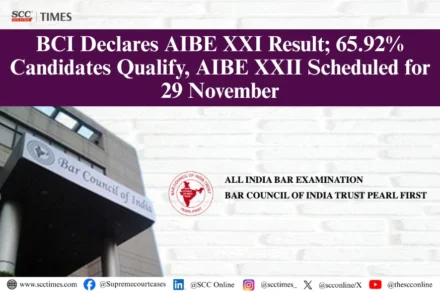
BCI Declares AIBE XXI Result; 65.92% Candidates Qualify, AIBE XXII Scheduled for 29 November
BCI has announced the AIBE XXI result, with 65.92% candidates qualifying the examination, and has scheduled AIBE XXII for 29 November 2026.
Continue reading
Bringing you the Best Analytical Legal News


BCI has announced the AIBE XXI result, with 65.92% candidates qualifying the examination, and has scheduled AIBE XXII for 29 November 2026.
Continue reading
The upcoming Parliament Monsoon Session 2026 is expected to focus on tax reforms, judicial capacity, foreign contribution regulation, MSME-related measures and higher education governance through several key legislative proposals.
Continue reading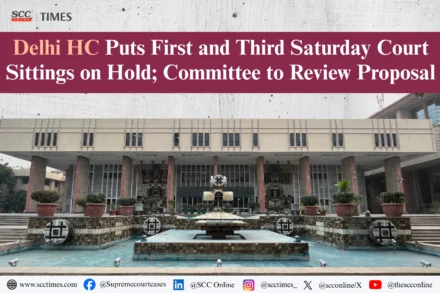
Delhi High Court has deferred the implementation of its decision declaring the first and third Saturdays as court sitting days and has constituted a committee to reconsider the proposal.
Continue reading
BCI has issued a comprehensive circular on social media conduct, digital ethics, court decorum and professional responsibility, directing State Bar Councils and law colleges to ensure immediate implementation and sensitisation.
Continue reading
Amid reports causing confusion, TRAI has clarified the distinct use of 1600 series numbers for trusted communications and 140 series numbers for promotional calls.
Continue reading
Ministry of Minority Affairs has nominated Harjit Singh Grewal as Chairperson, S. Munawari Begum as Vice-Chairperson and Glenn E Souza Ticlo as Member of the National Commission for Minorities.
Continue reading
Central Government has brought the National Anti-Doping Act, 2022 into force from 15 July 2026 and the National Anti-Doping (Amendment) Act, 2025 into force from 16 July 2026, strengthening India’s anti-doping regulatory and enforcement framework in sports.
Continue reading
BCI has granted existing Centres of Legal Education until 31 July 2026 to complete approval renewal applications for existing courses, sections and sanctioned intake, while excluding new colleges, courses and additional sections from the relaxation.
Continue reading
Goa Government has notified the VB-GRAM G Scheme, 2026, enhancing the rural employment guarantee from 100 to 125 days while introducing digital monitoring, social audits and grievance redressal mechanisms.
Continue reading
SEBI has moved the procedural requirements for transfer and transmission of securities out of Schedule VII of the LODR Regulations and into SEBI-specified circulars, giving the regulator flexibility to update the framework without a formal amendment to the Regulations each time.
Continue reading
Delhi High Court has suspended DHJS officer Vinay Singhal with immediate effect pending disciplinary proceedings and barred him from leaving Delhi without prior permission.
Continue reading
Maharashtra Gov has notified the Maharashtra Child and Adolescent Labour (Prohibition and Regulation) (Amendment) Rules, 2025, amending Child and Adolescent Labour Rules to strengthen child labour prohibition, regulate child artists, operationalise rehabilitation funds and enhance employer compliance obligations.
Continue reading
The Ministry of Labour and Employment has prescribed the procedure for seeking a determination on whether an activity of an establishment constitutes a core activity under the OSHWC framework.
Continue reading
EPFO has operationalised VISHWAS, 2026 under the EPF Scheme, 2026, enabling settlement of eligible EPF damages cases at concessional rates to reduce litigation and promote compliance.
Continue reading
Office of the CGPDTM has directed all registered Intellectual Property (IP) Attorneys to complete e-KYC verification within one month of the public notice.
Continue reading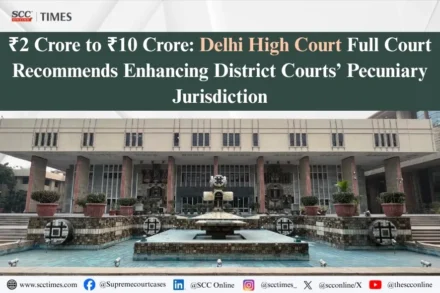
Coordination Committee of All District Courts Bar Associations of Delhi thanked members of the District Bar following the recommendation of the Hon’ble Full Court of the High Court of Delhi to enhance the pecuniary jurisdiction of District Courts to ₹10 crore.
Continue reading
Eligible CAB employees can now access additional NPS investment options aligned with their retirement goals and risk preferences.
Continue reading
MCA has extended the Companies Compliance Facilitation Scheme, 2026 till 31 August 2026, giving companies additional time to complete pending statutory filings amid ongoing restoration of MCA systems.
Continue reading
Following the SC’s directions in Ajay Vijh v. Indian Banks Association, the BCI has announced measures relating to disciplinary oversight, continuing legal education, mentoring and institutional reforms.
Continue reading
Health Ministry has notified the Drugs (Ninth Amendment) Rules, 2026, adding Navi Mumbai Airport as a designated entry point for drug imports and increasing the total number of notified import ports to 42.
Continue reading