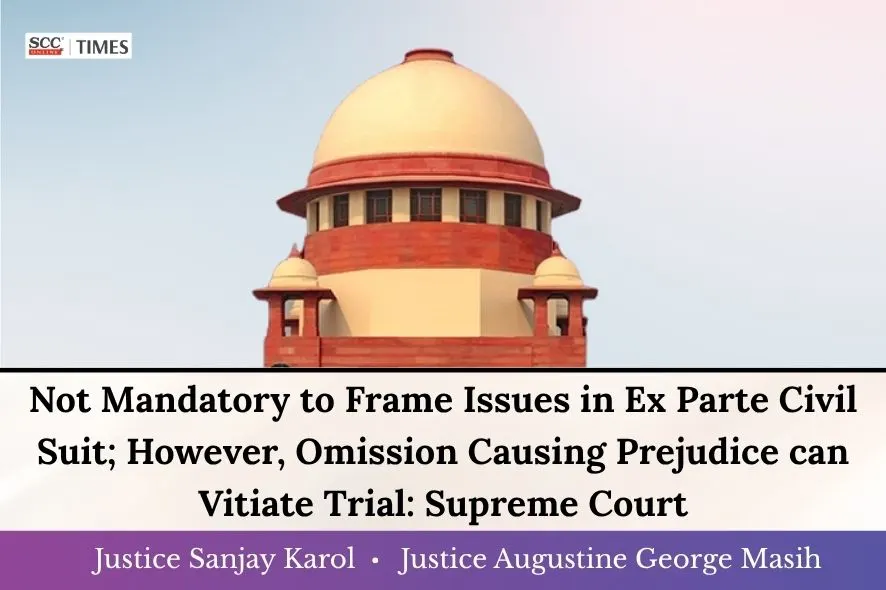
Supreme Court: While considering this appeal which raised an important question regarding procedural obligations of a civil court while adjudicating a suit ex parte, the Division Bench of Sanjay Karol and Augustine George Masih*, JJ., held that though the framing of issues in an ex parte suit is not mandatory by virtue of Order 14 Rule 6, Civil Procedure Code, 1908 (CPC), but the judgment must be in conformity with the provisions of the CPC. Thus, Order 20 Rule 4 CPC comes into picture.
The Court further added that if the omission to frame the issues causes prejudice to the parties, then the same can vitiate the trial. It was further held that the courts must determine “points for determination”, which are like issues, and answer them to resolve the matter of controversy between the parties.
Also Read: Purpose of framing issues is to enable parties to lead evidence so as to prove or disprove facts
Background
The present matter was related to suit for specific performance of an agreement to sell. The present appeal challenged the High Court’s judgment dated 21 January 2025 whereby the Court affirmed the judgment and decree passed by the City Civil Court at Calcutta (trial court), vide which suit filed by the appellant for specific performance for agreement to sell was dismissed ex parte.
The appellant’s counsel contended that no issue regarding the respondent’s title was framed, the onus to prove the same did not fall on the appellant and since the appellant was not put to notice of the said issue and therefore, he could not have been expected to lead evidence in support of the same. It was further argued that the trial court and High Court disregarded the procedure prescribed i.e. for issues to be framed before trial, as the same puts the parties to notice of the facts that are required to be proved in a given case.
The respondent, despite service, chose not to appear before the courts below or before the Supreme Court. The Amicus Curiae appointed by the Supreme Court was directed to get in touch with respondent directly in writing, apprise him about pendency of present appeal, his right to engage a counsel of his choice and his right of being represented through a legal aid counsel. Having done so, still the respondent remained unrepresented.
Court’s Assessment
Perusing the matter, the Court framed the following issues:
-
whether the absence of formal framing of issues vitiates ex parte proceedings,
-
what constitutes a legally sustainable judgment in such circumstances.
The Court deemed it fit to delve into the statutory provisions contained in the CPC and as well as the existing jurisprudence developed by the Court. The Court noted that Section 2(9) CPC defines “judgment” as the statement given by the Judge of the grounds of a decree or order. Section 2(2) CPC defines “decree” as the formal expression of an adjudication which, so far as regards the court expressing it, conclusively determines the rights of the parties with regard to all or any of the matters in controversy in the suit and may be either preliminary or final.
The Court further noted that Order 14 Rule 1(6) CPC explicitly provides that framing of issues is not required where the defendant at the first hearing of the suit makes no defense. Order 20 Rule 4(2) CPC states that judgments of courts shall contain a concise statement of the case, the points for determination, the decision thereon, and the reasons for such decision. The Court explained that although the framing of issues where defendant does not present a defense is not mandated, still the importance of framing of issues cannot be underscored.
The Court referred to Makhan Lal Bangal v. Manas Bhunia, (2001) 2 SCC 652, wherein the importance of framing issues was emphasised upon. The Court in Makhan Lal Bangal (supra) held that framing issues is an imperative stage in any civil proceedings as it narrows down the scope of trial by separating wheat from the chaff. Therefore, the real dispute between the parties is determined and the conflict between the parties is narrowed.
Furthermore, it was noted that in Maya Devi v. Lalta Prasad, (2015) 5 SCC 588, the Court had held that in case the defendant has been proceeded against ex parte, it is the duty of the court to pass the decree only after ascertaining the factual and legal veracity of the claim of the plaintiff.
Explaining the meaning and scope of “points of determination”, the Court stated that points for determination in a judgment are essentially the legal and factual issues the court must resolve. They correspond to the issues framed during trial (Order 14 CPC), but in the judgment they are stated as the points to be decided. Thus “points for determination” are the court’s restatement of the disputed questions (issues) that were placed before it, and the judgment must answer each. They serve to concentrate the court’s reasoning and ensure completeness of adjudication.
Even when a defendant fails to appear or file a written statement, the court cannot dispense with the points for determination altogether. The Court explained that even in default or ex parte suits, the court should identify the legal points (even if obvious) and give a reasoned answer. Simply granting a decree on default is not enough under Section 2(9) CPC doing so would be a “material irregularity”. Thus, points should be framed (or recited from existing pleadings) and addressed regardless of default.
Hence, the Court held that when it comes to ex parte suits, framing of issues is not mandatory; however, if such omission causes prejudice, then the trial can get vitiated. The Court stated that test for finding as to whether the omission to frame the issues have caused prejudice to the parties or not can be laid down on the touchstone as to whether parties that go to trial had knowledge that: (i) a particular question is in issue and (ii) parties had opportunity to lead evidence on that issue.
The Court pointed out that in the present case, all 3 essentials of a suit for specific performance, i.e. a valid contract; breach committed by defendant and readiness and willingness of the plaintiff to perform his part of contract, were present. However, the suit was dismissed for lack of title in favour of the respondent. No issues or points for determination were framed for the same. Appellant at no point was given an opportunity to lead evidence on the same.
In the absence of any issues, and especially in the absence of any pleading contesting title of the respondent, the appellant could not have been expected to prove such title in a suit for specific performance of agreement to sell. Therefore, omission to frame issues had caused prejudice to the appellant. Hence, the judgment and decree passed by the trial court did not fulfil the requirements of a judgment as provided in the CPC.
Decision
Therefore, the Court set aside the trial court and High Court’s decision. The matter was remanded to the trial court with a direction to frame issues and accord opportunity to the parties to lead evidence.
Also Read: Production of Documents in Civil Cases by Parties on their Own Volition: A Comprehensive Analysis
[Pramod Shroff v. Mohan Singh Chopra, 2026 SCC OnLine SC 598, decided on 16-4-2026]
*Judgment by Justice Augustine George Masih
Advocates who appeared in this case:
Mr. Jai Sahai Endlaw, Adv., Ms. Sagarika Kaul, Adv., Mr. Rishabh Singhle, Adv., Mr. Sujoy Chatterjee, AOR, For Petitioner(s)
Mr. Anup Kumar, AOR, Ms. Neha Jaiswal, Adv., For Respondent(s)