
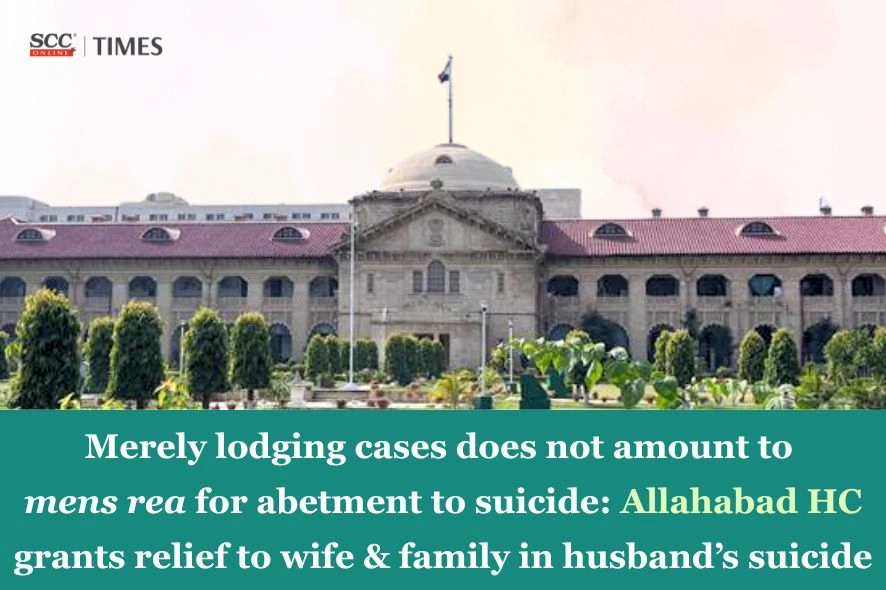
Allahabad High Court: In a set of applications filed under Section 482, Criminal Procedure Code, 1973 (CrPC), seeking quashing of FIRs lodged against them for abetment of suicide of the deceased by lodging cases against him, the Single Judge Bench of Sameer Jain, J., allowed the applications, holding that there was no material available on record which could demonstrate the guilty intention of the accused persons and it could not be said that applicants were, prima facie, responsible for the death of the deceased.
Background
The accused wife got married to the son of the informant, and after marriage, the accused allegedly started pressurising her now deceased husband to take his share in the ancestral property. When he refused, she, along with her close relatives, pressured him more and lodged false cases against him. Allegedly, due to this, the deceased husband had to quit his job and was under distress from court cases. Ultimately, in 2022, he committed suicide using a firearm.
Accordingly, an FIR was lodged against the accused wife and her family under Section 306 Penal Code, 1860 (IPC). After submission of the charge-sheet, the Court concerned took cognizance and issued summons to the accused persons. Hence, the instant applications.
As per the prosecution, the accused persons harassed the deceased and lodged false cases against him, due to which he was running in the courts for the last several years and was under great distress.
Analysis
At the outset, the Court reiterated that if from the entire material collected by the investigating officer (IO) during the investigation, the alleged offence is not made out against the accused, then the charge-sheet filed against him and the proceedings pending against him can be quashed.
The Court noted that, as per the record, IO procured a suicide note of the deceased during the investigation, which reflected that after marriage, matrimonial issues arose between the deceased and the accused wife. Due to such matrimonial discord, she lodged cases against him, and since the last two years, he has been continuously attending the Court, which were getting delayed due to non-cooperation of the accused persons. This caused him severe tension, and he committed suicide.
The Court stated that to constitute an offence under Section 306 IPC, abetment is necessary, and for abetment, instigation is necessary. In this regard, the Court placed reliance on Ramesh Kumar v. State of Chhattisgarh, (2001) 9 SCC 618, wherein the Supreme Court defined instigation. In Laxmi Das v. State of W.B., 2025 SCC OnLine SC 120, the Supreme Court relied on Ramesh Kumar (supra) to state that instigation is to goad, urge forward, provoke, incite, or encourage to do “an act”. To satisfy the requirement of instigation, though it is not necessary that actual words must be used to that effect, or what constitutes instigation must necessarily and specifically be suggestive of the consequence. Yet a reasonable certainty to incite the consequence must be capable of being spelled out.
Accordingly, the Court held that to attract Section 306 IPC, the alleged suicide committed by the deceased must be in consequence of instigation by the accused. In the case at hand, the deceased was dealing with cases lodged by the accused persons, who were his wife and her family members, and their matrimonial relationship was not cordial. However, the Court opined that if he committed suicide due to this reason, then it cannot be said that it was due to the abetment of the accused persons. Prima facie, it could not be said that the suicide committed by the deceased was in consequence of cases lodged by the accused persons.
Furthermore, the Court stated that the accused did not have any mens rea to abet the deceased to commit suicide, as merely by lodging cases, even false cases, it could not be said that the accused persons had mens rea to abet the deceased to commit suicide. Even if due to the false cases, the deceased was under distress, then also it could not be said that he did not have any other option except to commit suicide.
In this regard, the Court referred to Kamaruddin Dastagir Sanadi v. State of Karnataka, 2024 SCC OnLine SC 3541, wherein the Supreme Court held that discord and differences in domestic life are quite common in society and commission of suicide depends on mental status of the victim unless and until some guilty intention on the part of the accused is apparent, it is not possible to show, accused committed offence punishable under Section 306 IPC.
Therefore, the Court held that there was no material available on record which could demonstrate the guilty intention of the accused persons, and it could not be said that the applicants were, prima facie, responsible for the death of the deceased and committed the offence under Section 306 IPC.
Accordingly, the Court allowed the applications, thereby quashing the criminal proceedings.
[Megha Khatri v. State of U.P., Application u/S 482 No. 6530 of 2024, decided on 6-4-2026]
Advocates who appeared in this case:
For the petitioner: Swati Agrawal Srivastava
For the respondent: A.G.A.Rajeev Dhar Dwivedi, Anil Kumar Shukla, Sudarshan Singh, Anurag Pandey
Buy Code of Criminal Procedure, 1973 HERE
Buy Penal Code, 1860 HERE