
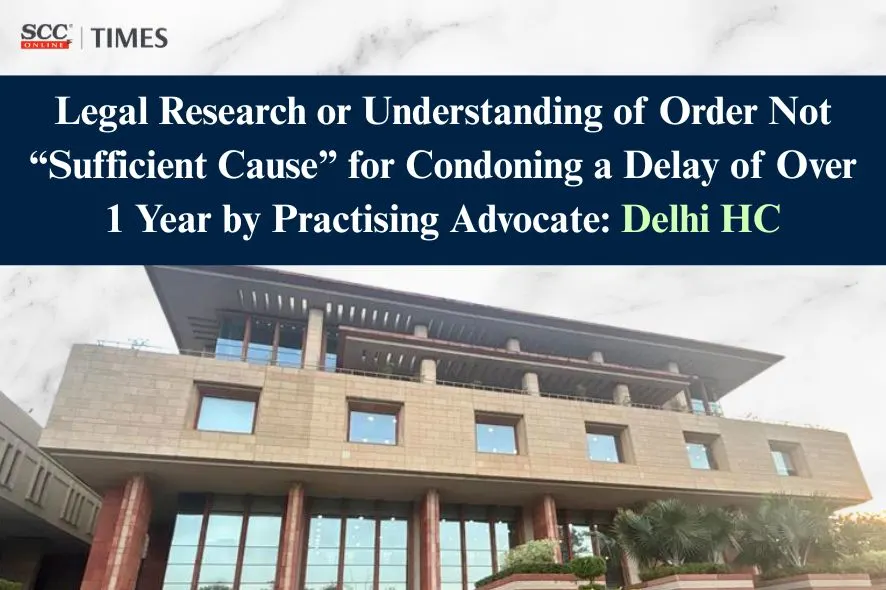
Delhi High Court: In a petition filed under Section 482, Criminal Procedure Code, 1973 (CrPC) with a delay of 412 days, seeking to set aside the Additional Sessions Judge’s order dated 19 January 2023, whereby the Revisional Court had remanded the matter back to the trial court for reappreciation of pre-summoning evidence and for rehearing arguments on the issue of summoning of the accused persons, the Single Judge Bench of Dr Swarana Kanta Sharma*, J., dismissed the application seeking condonation of delay, holding that inability to understand the impugned order and conducting legal research “sufficient cause” for condoning the delay.
Background
In the instant matter, the petitioner sought condonation of delay stated to be 412 days, though he argued that the actual delay was approximately 316 days depending upon the applicable limitation standard. It was contended that the delay was neither intentional nor deliberate. According to him, there exists no prescribed limitation period for invoking jurisdiction under Section 482 CrPC against an order of the Sessions Court, and therefore, technically no delay had occurred.
The petitioner further explained that he was a practising advocate and he faced difficulty in understanding the implications of the impugned order and had to undertake detailed legal research before filing the present petition. It was emphasised that the present matter ought to be decided on merits rather than dismissed on technical grounds like limitation.
However, the State as well as Respondents 2 to 7 opposed the application vehemently, contending that no plausible or sufficient cause had been shown for condoning such an inordinate delay of more than one year. It was pointed out that the petitioner had full knowledge of the impugned order at the time it was passed, and his subsequent conduct reflected negligence and lack of due diligence in pursuing the remedy.
Analysis
At the outset, the Court reiterated the settled principles governing condonation of delay. It relied upon Mool Chandra v. Union of India, (2025) 1 SCC 625, emphasising that it is not the length of delay but the sufficiency of the cause that is determinative and State of Odisha v. Managing Committee of Namatara Girls High School, 2026 SCC OnLine SC 191, wherein it was held that condonation of delay is not a matter of right and lies within judicial discretion, and that a distinction must be drawn between a genuine explanation and a mere excuse. The Court also reiterated that the applicant must furnish a cogent and satisfactory explanation covering the entire period of delay, preferably on a day-to-day or stage-wise basis.
Upon examining the petitioner’s explanation, the Court noted that the application was silent regarding the steps taken during the long intervening period after the impugned order and there was no disclosure of specific dates, events, or circumstances explaining why the petitioner failed to approach the Court within a reasonable time. Thus, found it unsatisfactory.
The Court held that “the explanation that the petitioner was engaged in understanding the impugned order and conducting legal research in itself cannot be a ground for condoning the delay of about one year, especially when the petitioner himself is a practising advocate”.
The Court further noted that if the petitioner genuinely faced difficulty, he could have sought legal assistance. The record did not indicate any due diligence or promptitude on his part. The Court emphasised that accepting such explanations would dilute the requirement of demonstrating “sufficient cause” and render the law of limitation ineffective.
Addressing the petitioner’s argument that no limitation period is prescribed for filing a petition under Section 482 CrPC, the Court acknowledged that thought no specific statutory limitation exists, but such petitions must nevertheless be filed within a reasonable time and must not suffer from delay and laches. Relying on Londhe Prakash Bhagwan v. Dattatraya Eknath Mane, (2013) 10 SCC 627, the Court held that even in the absence of a prescribed limitation period, an aggrieved person must approach the Court within a reasonable time.
The Court found the plea of being engaged in legal research or misunderstanding the order to be inadequate to justify such prolonged delay and held that the explanations offered by the petitioner did not meet the threshold of “sufficient cause”.
The Court emphasised that accepting such grounds would render the principles of limitation and delay redundant, making it difficult for courts to refuse condonation in any case. The Court found that the petitioner had failed to account for the delay satisfactorily and had not demonstrated due diligence in pursuing his remedy.
Decision
In view of the above analysis, the Court dismissed the application for condonation of delay, holding that no sufficient cause had been made out. Consequently, the main petition under Section 482 CrPC, being barred by delay and laches, was also dismissed.
[Ajit Kumar Gola v. State (GNCTD), 2026 SCC OnLine Del 1399, decided on 4-4-2026]
*Judgment by Justice Dr. Swarana Kanta Sharma
Advocates who appeared in this case:
Ms. Rupali Bandhopadhya, ASC for the State with Mr. Abhijeet Kumar and Ms. Amisha Gupta Advs. along with SI Priyanka, Counsel for the Respondent/State
Mr Sunil Dalal, Sr. Adv. alongwith Mr. Ankit Rana, Mr. Tushar Rohmetra, Mr. Rajiv Singh, Ms. Shipra Bali, Mr. Bharat Khurana, Mr. Sarthak Malhotra and Mr. Anubhav Sharma, Advs., Counsel for the Respondent 2 to 7