
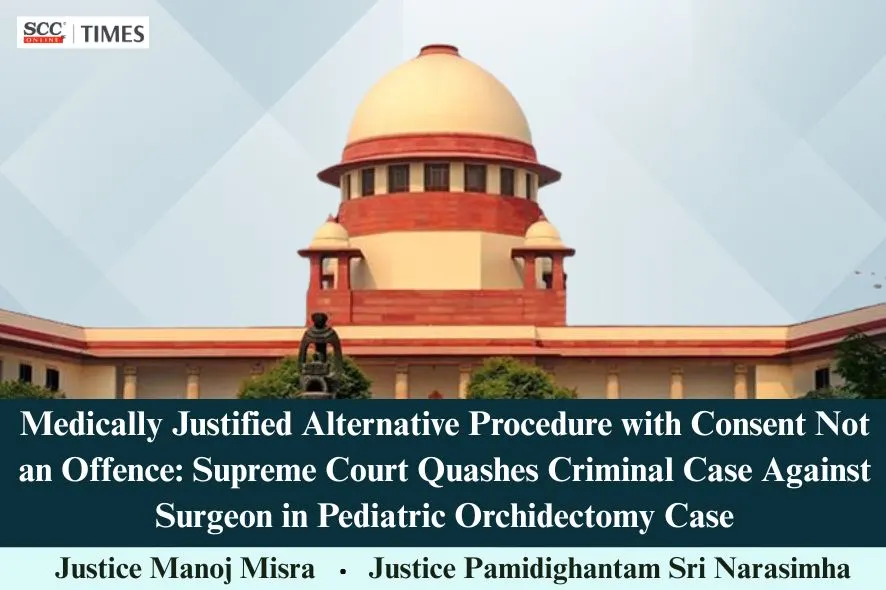
Supreme Court: In a criminal appeal concerning alleged unauthorised surgical intervention on a minor, a Division Bench of Manoj Misra* and Pamidighantam Sri Narasimha, JJ., allowed the appeal and quashed proceedings against the operating surgeon. The Court held that the surgeon had obtained valid consent for surgery, and that Orchidectomy, performed as an alternative to Orchidopexy in cases of undescended testicle, was medically justified. The Court emphasised that mere interpolation of the alternative procedure in the consent form, without evidence of malice, does not constitute a criminal offence, and that continuation of criminal proceedings in such circumstances would amount to abuse of process of law.
Background
The case arises from a medical dispute in which the de facto complainant alleged that his one-and-a-half-year-old son was admitted for a surgical procedure (Orchidopexy) to correct an undescended testicle. The complainant contended that while consent was given for Orchidopexy, no consent was obtained for Orchidectomy (removal of the testicle), which was nonetheless performed. He further alleged that the consent form was interpolated to include Orchidectomy, amounting to forgery.
Based on these allegations, an FIR was registered at Ambathur Police Station on 8 August 2006 under Sections 312, 325, 426, 120-B, 406, 465, 468, 471, and 501 Penal Code, 1860 (IPC) . Following investigation, the police submitted a charge-sheet against the operating surgeon, which led to registration of C.C. No. 13 of 2008. Aggrieved, two petitions under Section 482 Criminal Procedure Code, 1973 (CrPC) were filed before the High Court: One by the complainant seeking constitution of a three-member Medical Board for an expert opinion, and another by the surgeon seeking quashing of the proceedings.
The High Court directed constitution of a Medical Board, which opined that the Orchidectomy was medically appropriate but should have been performed with parental consent. Further clarification was obtained from the Directorate of Medical and Rural Health Services regarding the consent form. Despite these expert reports, the charge-sheeted proceedings continued, prompting the surgeon to file a petition seeking quashing of the case. The High Court dismissed the petition, leading to the present appeal.
Analysis, Law, and Decision
The Court considered the rival submissions and the materials on record, emphasising that the appellant is a qualified surgeon whose credentials were not in dispute. Recognising that medical professionals occupy a distinct position under criminal law, the Court noted that Sections 88 and 92 IPC provide exceptions for acts done in good faith for the benefit of a person, with or without consent, even if harm results. The issue in the present case was not negligence but whether the consent for surgery was valid and whether Orchidectomy had been improperly interpolated into the consent form.
The Court examined the opinion of the Medical Board, which affirmed that Orchidectomy is an accepted alternative procedure in cases of undescended testicle to prevent future malignancy, and that the procedure adopted by the surgeon was medically appropriate. The Court noted that the consent form, executed by the father of the child, mentioned both Orchidopexy and Orchidectomy in the same column with a slash, indicating that the alternative procedure was contemplated. There was no evidence of different ink, handwriting, or malice on the part of the surgeon.
While issues of interpolation in a document are ordinarily questions of fact for trial, the Court held that in a summary proceeding under Section 482 CrPC, it may examine such matters to prevent abuse of process or secure justice. Considering that the consent form was in order, the procedure was medically justified, and there was no evidence of ill intent, the Court concluded that the continuation of criminal proceedings would constitute an abuse of the process of law.
Accordingly, the Court allowed the appeal and set aside the High Court’s order.
[S. Balagopal v. State of T.N., 2026 SCC OnLine SC 528, decided on 6-4-2026]
*Judgement authored by: Justice Manoj Misra
Buy Penal Code, 1860 HERE
Buy Code of Criminal Procedure, 1973 HERE