
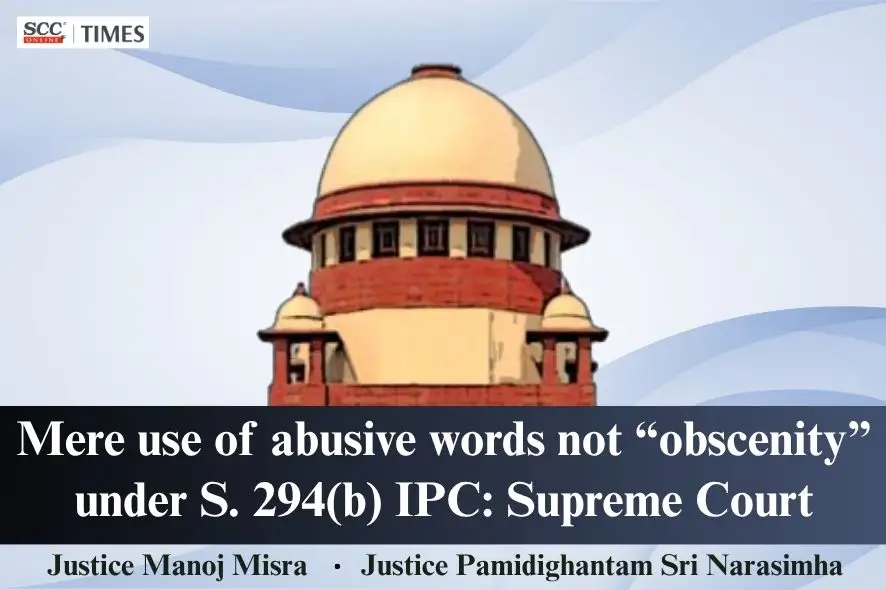
Supreme Court: In criminal appeals arising out of a fatal incident triggered by a boundary dispute between close relatives, a Division Bench of Manoj Misra* and Pamidighantam Sri Narasimha, JJ., partly allowed the appeals and examined the scope of offences under Sections 294(b), 304 Part II, and the applicability of Section 34 IPC. The Court held that mere use of abusive language during a heated altercation does not constitute “obscenity” under Section 294(b) IPC, and set aside the conviction on that count.
Background
The prosecution case arose from a long-standing boundary dispute between the deceased, and his late brother. The accused persons are the children of deceased’s late brother. On 20 September 2014when the deceased was putting up a fence on the disputed property, all the accused objected to the same. The deceased, however, asserted his right and continued the work, which led to a sudden altercation. In the course of the incident, A-1 attacked with an aruval intending to assault the deceased, but the blow was intercepted by brother of the deceased PW4, who sustained injuries on his shoulder, leg, and toe. When the deceased attempted to intervene and rescue PW4, A-2 struck him on the head with a wooden log, rendering him unconscious. Thereafter, A-3 and A-4 assaulted both the deceased and PW4 with sticks, and all the accused fled the scene.
The injured were immediately taken to the hospital, where the deceased was found to have sustained a lacerated wound on the left parietal region of the scalp. He was referred to higher medical centres but succumbed to his injuries during treatment.
Upon trial, all four accused were charged under Sections 294(b), 323, 324 and 302 read with Section 34 IPC. By judgment dated 27 February 2017, the trial court acquitted A-3 and A-4 of all charges, while convicting A-1 under Section 324 IPC and A-2 under Section 325 IPC, imposing a fine on A-1 and sentencing A-2 to two years’ rigorous imprisonment with fine.
Aggrieved thereby, the widow of the deceased preferred an appeal against acquittal and partial acquittal, while A-1 and A-2 challenged their convictions. The High Court, by judgment dated 26 March 2019, affirmed the acquittal of A-3 and A-4, but modified the conviction of A-1 and A-2 by additionally convicting them under Section 294(b) IPC and under Section 304 Part II IPC (read with Section 34 IPC in respect of A-1), while maintaining A-1’s conviction under Section 324 IPC.
By a subsequent order dated 4 April 2019, both A-1 and A-2 were sentenced to one month’s rigorous imprisonment under Section 294(b) IPC and five years’ rigorous imprisonment with fine under Section 304 Part II IPC, with the sentence under Section 324 IPC as imposed by the trial court being retained in respect of A-1. Aggrieved by the said judgment and order of the High Court, A-1 and A-2 have preferred the present appeals.
Analysis
The Court, after considering the evidence, found certain facts to be undisputed: the incident arose out of a boundary dispute between close relatives; it occurred suddenly when the deceased was fencing the property despite objection; it was preceded by heated exchanges; and the weapons used (aruval and log) were not premeditatedly brought but picked up from the spot in the heat of the moment. It was also noted that the eyewitness sustained only simple injuries, and the deceased suffered a single fatal blow on the head.
On the issue of offence under Section 294(b) IPC, the Court clarified that “obscenity” must involve something appealing to prurient interest, as understood from Section 292 IPC. It held that mere use of abusive language such as “bastard”, does not satisfy this test, especially when such words are commonly used in modern era during heated conversations. Accordingly, the conviction under Section 294(b) IPC was set aside.
With respect to common intention under Section 34 IPC, the Court carefully examined the role of A-1 and found no evidence to establish that he shared the intention to cause the fatal injury. A-1 had initially attacked but caused injuries only to the intervening eyewitness, which were not grievous. There was no evidence of exhortation, participation in the fatal blow, or any subsequent assault on the deceased. In these circumstances, the Court held that it would be unsafe to attribute common intention to A-1 for the act committed by A-2. Consequently, A-1’s conviction under Section 304 Part II read with Section 34 IPC was set aside, while his conviction under Section 324 IPC for causing hurt by a dangerous weapon was affirmed. Considering that he had already undergone part of the sentence, his sentence was reduced to the period already undergone.
As regards A-2, the Court upheld the finding that his act amounted to culpable homicide under Section 304 Part II IPC. It agreed with the High Court that a forceful blow on the head with a log, resulting in skull fracture and brain injury, clearly indicated knowledge that such an act was likely to cause death, thus satisfying the requirement of Section 299 IPC. However, the Court refrained from examining whether the case would fall under the graver provision of Section 304 Part I IPC in the absence of an appeal by the State.
On the question of sentence, the Court took into account mitigating factors, including the fact that the incident was a result of a sudden quarrel between relatives, there was no premeditation, the weapon used was not inherently dangerous but picked up from the spot, and only a single blow was inflicted. In light of these circumstances, the Court held that the sentence of five years’ rigorous imprisonment imposed on A-2 was excessive and reduced it to three years.
Decision
Accordingly, the appeals were partly allowed: The conviction of A-1 under Section 304 Part II read with Section 34 IPC and under Section 294(b) IPC was set aside, with his conviction under Section 324 IPC maintained and sentence reduced to period already undergone; the conviction of A-2 under Section 304 Part II IPC was affirmed but his sentence was reduced from five years to three years’ rigorous imprisonment.
[Sivakumar v. State, Criminal Appeal No. 1807 of 2019, decided on 6-4-2026]
*Judgement authored by: Justice Manoj Misra
Buy Penal Code, 1860 HERE