
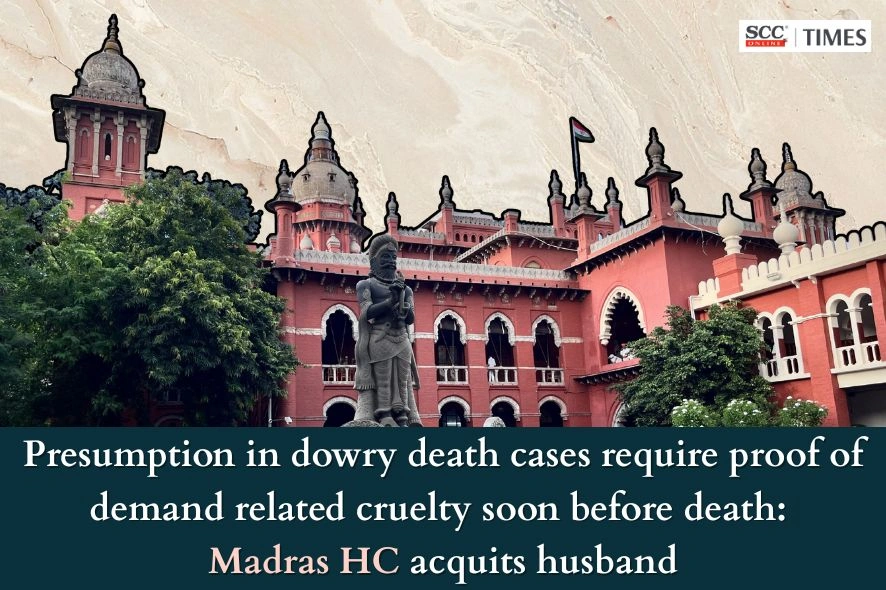
Madras High Court: In a criminal appeal arising out of allegations of dowry death under Sections 498-A and 304-B, Penal Code, 1860 (IPC) and Section 4, Dowry Prohibition Act, 1961 (Dowry Prohibition Act), a Single Judge Bench of G. Arul Murugan, J., held that the trial court erred in convicting the appellant without corroborative evidence. The Court emphasised that inconsistencies in witness testimonies, hostile witnesses, and the Revenue Divisional Officer’s (RDO) categorical report negated the prosecution’s case. Accordingly, the Court set aside the trial court’s order of conviction and sentence, acquitted the husband of all charges, cancelled the bail bond, and directed refund of any fine amount paid.
Background
The marriage was solemnised in April 2014. At the time of marriage, 2½ sovereigns of gold and Rs 50,000 in cash were allegedly given as dowry. It was alleged that thereafter the deceased was subjected to harassment and cruelty for additional dowry. On 26 February 2016, after alleged harassment, the deceased consumed poison and died in the hospital the same morning.
The prosecution relied mainly on PW1 (mother) and PW2 (sister) to establish harassment and dowry demands. However, several witnesses including PW5 to PW11 turned hostile, and the RDO’s report opined that there was no prima facie evidence of dowry-related harassment.
The husband argued that there was no evidence of dowry demand or cruelty soon before death and pointed to inconsistencies in witness statements and medical records. It was contended that the trial court wrongly raised the presumption under Section 113-B, Evidence Act, 1872 (Evidence Act) without foundational facts.
Subsequently, the State argued that PW1 and PW2 had spoken about harassment and that the deceased was driven to suicide due to cruelty, corroborated by injuries noted in the post-mortem report.
Analysis and Decision
The Court emphasised that unless it is established that the deceased was subjected to cruelty in connection with dowry demand soon before death, the presumption under Section 113-B, Evidence Act cannot be raised, and the offence under Section 304-B IPC will not get attracted. The Court noted that though for an offence under Section 498-A IPC, cruelty in respect of the demand of dowry or harassment is sufficient, still there is no evidence or material available to establish that the deceased was harassed and subjected to cruelty at the hands of the accused.
The Court observed that the deceased committed suicide within 1½ years of marriage, and the evidence has been consistent to the effect that the husband and the deceased lived happily for one year. It was noted that there was absolutely no material to show that there had been any instance of cruelty or harassment meted out to the deceased by the husband thereafter in the six months prior to the date of occurrence. Therefore, in the absence of any such evidence, the Court concluded that the charges for offences under Sections 498-A and 304-B IPC and Section 4, Dowry Prohibition Act had not been proved.
The Court highlighted that the trial court, by relying on the evidence in chief examination, had come to the conclusion that the deceased was driven to commit suicide due to harassment in respect of demand of dowry and had convicted the appellant for offences under Sections 498-A and 304-B IPC and Section 4, Dowry Prohibition Act. However, the trial court failed to note that only when the prosecution proves the foundational facts and there is evidence to show that cruelty was meted out to the deceased in respect of demand of dowry soon before death, the presumption under Section 113-B, Evidence Act would arise.
The Court emphasised that on reappraisal of the entire materials and evidence available on record, the charges against the husband were not proved. Further, the prosecution had not proved the foundational facts to raise the presumption under Section 113-B Evidence Act, and there is absolutely no material or evidence in respect of demand of dowry, which has also been confirmed.
The Court also noted that all the witnesses, PW5 to PW11, including mahazar and confession witnesses, had turned hostile. It was observed that there was a huge discrepancy in the evidence produced, and all these aspects had not been considered by the trial court in arriving at a finding convicting the husband. Therefore, the findings arrived at by the trial court were perverse and should not be sustained.
Accordingly, the Court set aside the conviction and sentence imposed by the trial court, acquitted the appellant of all charges, cancelled the bail bond, and directed that any fine amount paid be refunded. The criminal appeal was allowed.
[Das v. State of T.N., 2026 SCC OnLine Mad 3288, decided on 30-3-2026]
Advocates who appeared in this case:
For the Appellant: S. Saravana Kumar
For the Respondent: R. Kishore Kumar
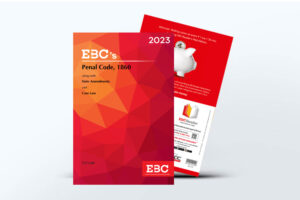
Buy Penal Code, 1860 HERE