Disclaimer: This has been reported after the availability of the order of the Court and not on media reports so as to give an accurate report to our readers.
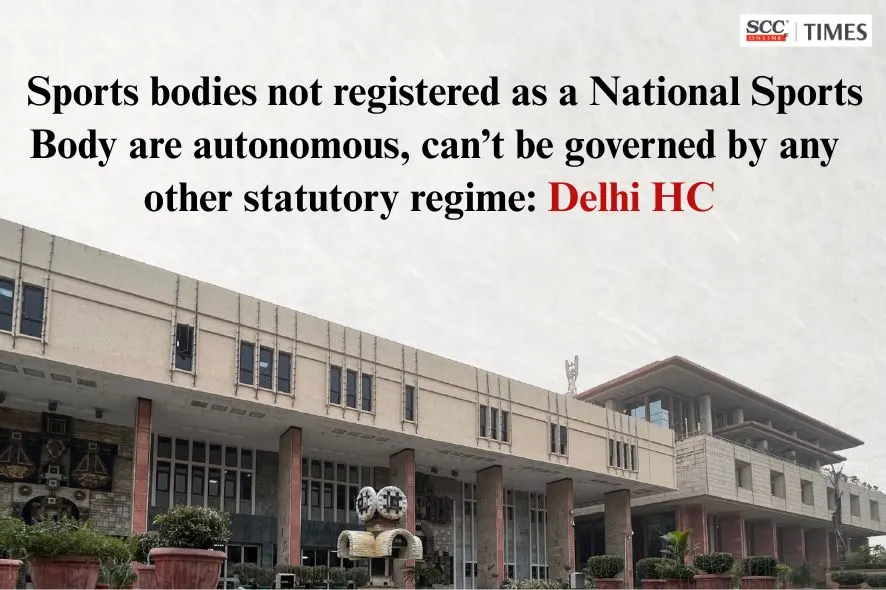
Delhi High Court: In an appeal challenging judgment dissolving the ad hoc Committee appointed to manage the affairs of Ski and Snowboard India, and direction to conduct its elections, the Division Bench of Devendra Kumar Upadhyaya*, CJ., and Tejas Karia, J., modified the impugned judgment by setting aside it to the extent Appellant 1 had been directed to pay the fee to the Returning Officer for conducting the election of Respondent 1, and instead directed the Respondent 1 to pay the said fee. holding that Respondent 1 was an independent body governed by the provisions of its memorandum of association and by-laws and the rules and regulations, and appellant lacked authority to appoint a committee to manage affairs of an independent body.
Background
The present petition arose from an Office Order passed by the passed by Appellant 1, President, Indian Olympic Association, whereby an ad hoc Committee comprising four members was appointed to manage the affairs of Respondent 1, Ski and Snowboard India, including the selection of the athletes and making entries for participation of sportspersons in international events. The said ad hoc Committee was also mandated to conduct the elections of the Executive Committee of Respondent 1.
Aggrieved, Respondent 1 instituted a writ petition challenging the said Office Order. The Single Judge Bench allowed the petition and quashed the impugned Office Order. The Single Judge held that Respondent 1 is an independent body registered as a society under the Karnataka Societies Registration Act, 1960, and that the appellant did not have any jurisdiction, authority or power to replace the Executive Committee of Respondent 1 by appointing an ad hoc Committee to manage its affairs. Therefore, the ad hoc Committee was dissolved with immediate effect. The Single Judge thereafter appointed a retired judge as the Returning Officer to conduct the election of Respondent 1. Appellant was directed to pay the fee of the Returning Officer for conducting the election of Respondent 1.
Aggrieved, Appellant 1 preferred an appeal assailing the said judgment.
Issues
-
Whether Article 17.5, Memorandum and Rules and Regulations of Indian Olympic Association (as amended up to 2 November 2022) (IOA Constitution), permits the appointment of an ad hoc Committee of the Respondent 1?
-
Whether the direction issued by the Single Judge for conducting the election of Respondent 1 was contrary to the provisions contained in the National Sports Governance Act, 2025 (Act, 2025) and the National Sports Governance (National Sports Bodies) Rules, 2026 (Rules, 2026)?
-
Whether Respondent 1 was required, under Rule 18, Rules, 2026 , to amend its by-laws in conformity with the provisions of the Act, 2025, before any elections could be ordered to be held?
Analysis and Decision
At the outset, the Court observed that Appellant 1’s contention regarding the vested power and authority of Appellant 1 to appoint an ad hoc Committee was highly misconceived, and was based on a complete misreading of the provisions contained in Article 17.5, IOA Constitution. The Court noted that the Indian Olympic Association is a society registered under the Societies Registration Act, 1860, and the said rules and regulations have been framed by it for the purposes of governing its own affairs, and it was only in this context that the provisions contained in Article 17.5 had to be interpreted and understood. The Court noted that the “Commissions/Committees” referred to in Article 17.5 are necessarily to be the “Commissions/Committees” formed by the President of the Indian Olympic Association to transact certain businesses assigned to such “Commissions/Committees” of the Indian Olympic Association alone and not those of any other body or society like Respondent 1.
Therefore, the Court found this ground to be untenable.
The Court found Appellant 1’s contention that direction issued by the Single Judge for conducting the election of the Respondent 1 was contrary to the provisions of the Act, 2025 and the Rules, 2026, as misconceived. The Court stated that it was an admitted fact that Respondent 1 was not a National Sports Federation (NSF) recognised by the Ministry of Youth Affairs and Sports, Government of India. The Court observed that the provisions of the Act, 2025, are neither applicable to Respondent 1, nor its affairs can be said to be governed by them, unless it gets itself established as a National Sports Body (NSB) in terms of the requirements of the provisions of the Act, 2025. The Court noted that the Ministry concerned had not disputed the fact that Respondent 1 was not recognised as an NSF even under the National Sports Development Code of India, 2011 (Code, 2011), which governed the affairs of NSFs, before the enactment of the Act, 2025.
The Court outrightly rejected the third issue raised by Appellant 1 with respect to the fulfilment of the requirement of Rule 18, Rules, 2026, before conducting elections of Respondent 1. The Court noted that the said amendment, in conformity with the provisions of the Act, 2025, as per the provisions contained in Rule 18, Rules, 2026, was only required to be followed by an NSB. The Court reiterated that Respondent 1 was neither an NSB as per the Act, 2025, nor an NSF in terms of the provisions of the Code, 2011. Therefore, the Court held that the question of applicability of the Act, 2025, over the affairs of Respondent 1 did not arise at all, and the reliance placed on Rule 18 was highly misplaced.
The Court stated that Respondent 1 was an independent body duly registered as a society under the Karnataka Societies Registration Act, 1960. The Court opined that the the affairs of Respondent 1 were to be governed by the provisions of its memorandum of association and by-laws and the rules and regulations registered with the Registrar of Societies of the State of Karnataka in terms of the provisions of the Karnataka Societies Registration Act, 1960, till Respondent 1 itself decides to seek registration or recognition under the new statutory regime introduced by enacting the Act, 2025. The Court stated that even if Respondent 1 was assumed to be affiliated with Appellant 1, no enabling provision had been shown which allows it to appoint an ad hoc Committee to manage the affairs of its affiliate body.
Accordingly, in view of the statement of the Ministry of Youth Affairs and Sports that Respondent 1 is not a recognised NSF or NSB, either in terms of the Code, 2011 or the Act, 2025, the Court held that the very premise of the argument advanced by Appellant 1 was based on an absolute misreading of the provisions. The need to fulfil the statutory requirements under the Act, 2025, and the rules made thereunder by Respondent 1 would arise only when it intends to be recognised or registered as an NSB in terms of Section 3, Act, 2025, which stage had not yet arisen. The Court upheld the reliance of the impugned judgment on Bihar Olympic Assn. v. Indian Olympic Assn., (2025) 1 HCC (Del) 348, wherein it was held that the Indian Olympic Association is not vested with any authority or power to appoint any ad hoc Committee in relation to the functions of an independent body or association.
However, the Court conceded that Appellant 1 was not liable to pay the fee of the Returning Officer for conducting the election of Respondent 1. The Court stated that since Respondent 1 was an independent body, saddling the responsibility of bearing the expenses of conducting its elections on Appellant 1 was not justified.
Hence, the Court modified the impugned judgment by setting aside the direction pertaining to the payment of the fee by the Indian Olympic Association, and upheld the quashing of the Office Order and dissolution of the ad hoc Committee with immediate effect, along with the direction to conduct the elections of Respondent 1.
[Indian Olympic Assn. v. Ski and Snowboard India, LPA 104 of 2026, decided on 23-3-2026]
*Judgment authored by Chief Justice Devendra Kumar Upadhyaya
Advocates who appeared in this case:
For the appellants: Senior Advocate Gopal Jain with Aashita Khanna, Aanya Agarwal and Vidushpat Singhania, Advocates
For the respondents: Neha Singh, Advocate for Respondent 1; Udit Dedhiya, SPC with Apurva Sachdev, Preyansh Gupta, Advocates & Amit Rana, GP.