
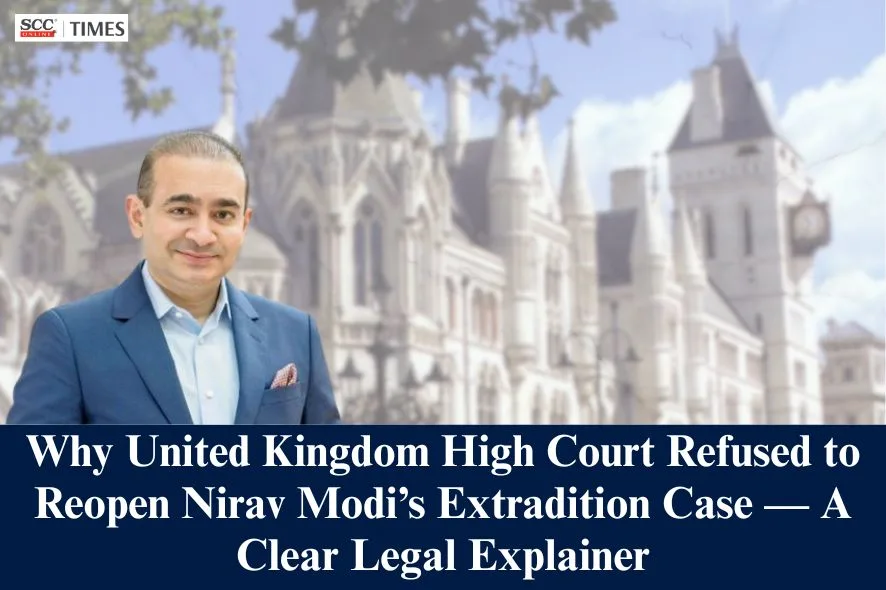
High Court of Justice, United Kingdom: In his application to re-open the extradition appeal, Nirav Modi relied on the Bhandari v. Government of India, [2025] EWHC 449 (Bhandari case), wherein it was found that torture and ill-treatment by investigative authorities in India are “commonplace and endemic,” creating a serious risk if he were extradited, as he would likely be detained and interrogated by multiple agencies. The Bench of Stuart-Smith and Jay JJ., stated that the possibility of Nirav Modi’s release on bail in India does not increase the risk of interrogation considering the assurances provided by Government of India. The Court further stated that it was unnecessary to determine whether the video-conferencing facilities at Arthur Road Prison are adequate for Nirav Modi to attend his trial remotely, noting that while attendance in person is preferable, there is no real risk of torture or ill-treatment during the journey from prison to the trial court in Mumbai, and accordingly, refused to re-open the extradition appeal of Nirav Modi.
Background
Nirav Modi’s extradition requests arose from three sets of criminal proceedings in India. The first, brought by the Central Bureau of Investigation (CBI), was related to an alleged fraud on Punjab National Bank that caused losses of more than £700 million. The second, initiated by the Enforcement Directorate, related to the alleged laundering of the proceeds of that fraud. A further request was a third set of CBI proceedings, involving allegations of interference with evidence and witnesses in the bank fraud case. Nirav Modi was arrested in the UK on 19 March 2019 and has been held in custody at HMP Wandsworth since 20 March 2019.
The District Judge at Westminster Magistrates’ Court found no bars to Nirav Modi’s extradition and referred the case to the Secretary of State. On 15 April 2021, his extradition to India was ordered. Nirav Modi appealed the decision, but the appeal was dismissed after the Government of India provided assurances that he would be held at Barrack 12 of Arthur Road Jail in Mumbai and would have access to “any relevant and necessary” medical treatment, including care from a private doctor or mental health expert of his choice.
On 18 August 2025, Nirav Modi filed an application to re-open his extradition appeal, relying on the decision in the Bhandari case (supra). The said judgment highlighted that torture and ill-treatment by investigative authorities in India are “commonplace and endemic.” It was stated, if extradited, Nirav Modi would face an unacceptable risk of such treatment, as he would likely be detained and interrogated by multiple investigative agencies.
Analysis, Law, and Decision
The Court stated that the jurisdiction to re-open an extradition appeal requires both the presence of exceptional circumstances and the identification of a real injustice that must be addressed. The Court further observed that the decision in the Bhandari case (supra) paints a troubling picture of the use of prohibited methods to obtain confessions, describing such practices as “commonplace and endemic.”
The Court noted that, on one hand, mutual confidence and trust between two friendly states bound by treaty arrangements must carry considerable weight, along with the solemn assurances provided within that framework. On the other hand, it acknowledged that some of the affidavit evidence came from individuals who, as highlighted in the Bhandari case (supra), had condoned or ignored unacceptable treatment of detainees. Nevertheless, the Court found that this argument could only go so far, since the assurances given by the Government of India were made in good faith, intended to be binding, and not offered with any intention of evading them should circumstances arise.
The Court observed that the Government of India had provided a set of assurances that were comprehensive, detailed, and reliable. It held that, for present purposes, it was sufficient that these assurances were cognisable at a diplomatic level, since any breach would severely damage the relationship of mutual trust and confidence between India and the United Kingdom, particularly in the case of such a high-profile individual as Nirav Modi.
The Court considered Nirav Modi’s claim that UK authorities might still be asked to consent to his interrogation. It explained why this possibility did not help him:
-
The Secretary of State would be very unlikely to consent, given the Bhandari ruling and the Court’s own judgment in this case.
-
In any event, the Secretary of State probably does not have the legal power to consent under section 129 of the Extradition Act, 2003.
-
It is inconceivable that the Secretary of State would allow a trial to proceed if it relied on a confession obtained through interrogation.
Because of these points, the investigating authorities would surely realize that interrogation would serve no practical purpose.
The Court concluded that the Directorate of Revenue Intelligence (DRI) is bound by the assurances provided, meaning that even if Nirav Modi were produced before the Surat Court in Gujarat, he could not be interrogated there. The Court further stated that the possibility of Nirav Modi being released on bail in India does not expose him to any greater risk of interrogation considering those assurances. Finally, the Court stated that it did not need to resolve the issue of whether the video-conferencing facilities at Arthur Road Prison are adequate for Nirav Modi to attend his trial remotely. While it is preferable that he attend in person, the Court found no real risk of torture or ill-treatment during the journey from the prison to the trial court in Mumbai and accordingly refused to re-open the extradition appeal of Nirav Modi.
[Nirav Deepak Modi v. Government of India, 2026 SCC OnLine EWHC 1, decided on 25-3-2026]
Advocates who appeared in this case:
For the Applicant: Edward Fitzgerald KC and Graeme L. Hall (instructed by Boutique Law LLP)
For the Respondent: Helen Malcolm KC and Nicholas Hearn (instructed by The Crown Prosecution Service)