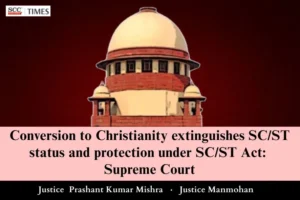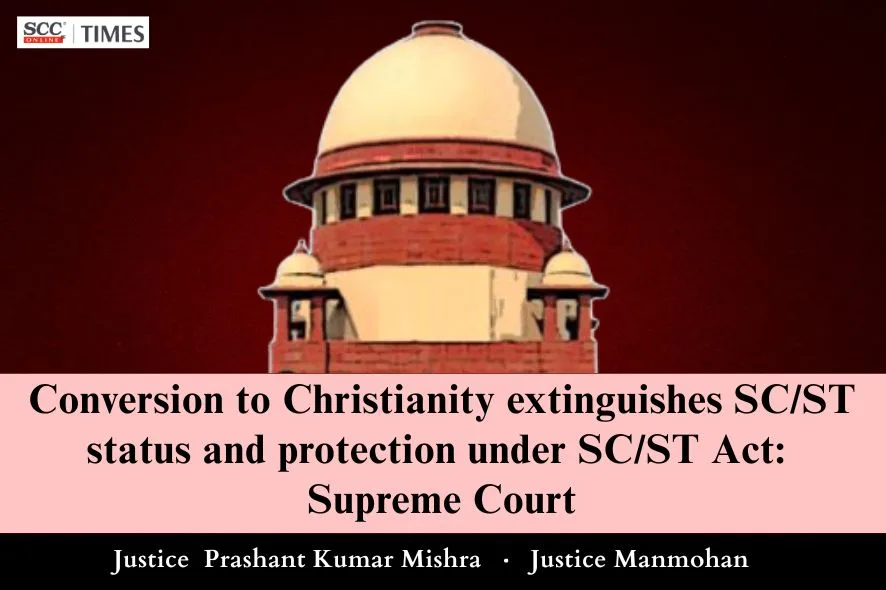
Supreme Court: In appeal challenging the quashment of criminal proceedings under Scheduled Castes and Scheduled Tribes (Prevention of Atrocities) Act, 1989 (SC/ST Act) and Penal Code, 1860 (IPC), and thus, raising an important question as to whether a person born in a Scheduled Caste but professing Christianity could invoke the provisions of the SC/ST Act, the Division Bench of Prashant Kumar Mishra* and Manmohan, JJ., held that:
-
The appellant, having professed Christianity, could not claim the status of Scheduled Caste and therefore could not invoke the provisions of the SC/ST Act.
-
No person who professes a religion other than Hinduism, Sikhism or Buddhism shall be deemed to be a member of a Scheduled Caste.
-
The State Government Order and caste certificate could not override the Constitution (Scheduled Castes) Order, 1950.
-
The High Court had rightly exercised its power under Section 482 CrPC as the allegations under both the SC/ST Act and IPC did not disclose a sustainable case.
Factual Matrix
The instant appeal arose from the High Court of Andhra Pradesh High Court’s judgment dated 30 April 2025 whereby criminal proceedings related to offences under Sections 3(1)(r), (s) and 3(2)(va), SC/ST Act and Sections 341, 506 and 323 read with Section 34 IPC, were quashed in exercise of jurisdiction under Section 482, Criminal Procedure Code, 1976 (CrPC).
The appellant claimed that he belongs to the Madiga community, a notified Scheduled Caste in Andhra Pradesh, and had been conducting Sunday prayer meetings as a Pastor for several years. He alleged that due to his religious activities he received threatening phone calls containing caste-based abuses.
According to the complaint, on 3 January 2021 he was assaulted and abused by caste name while conducting prayers, and on 24 January 2021 he was wrongfully restrained by the respondents and others, beaten, threatened with death, and abused in public view. Based on his complaint, FIR was registered for offences under the SC/ST Act and IPC. Investigation was conducted, statements of witnesses were recorded, and a charge-sheet was filed before the Special Court under the SC/ST Act.
The accused approached the High Court under Section 482 CrPC seeking quashment of the proceedings on the ground that the appellant had converted to Christianity and was functioning as a Pastor and therefore could not claim the status of Scheduled Caste under the Constitution (Scheduled Castes) Order, 1950 [Constitution (Scheduled Castes) Order]. The High Court accepted this contention and quashed the proceedings, holding that continuation of the prosecution would amount to abuse of process of law. Aggrieved thereby, the appellant approached the Supreme Court.
Issues for Determination
-
Whether a person who has converted to Christianity and openly professes that religion can claim Scheduled Caste status under the Constitution (Scheduled Castes) Order?
-
Whether such a person can invoke the protections of the SC/ST Act?
-
Whether the High Court was justified in exercising its powers under Section 482 CrPC to quash the criminal proceedings against the accused.
Court’s Analysis
-
Background and Statutory framework
The Court examined Articles 341 and 342, Constitution (Scheduled Castes) Order, particularly Clause 3, which provides that no person who professes a religion other than Hinduism, Sikhism or Buddhism shall be deemed to be a member of a Scheduled Caste. It noted that Christianity had not been included under this Order by any of these amendments.
Referring to State of Kerala v. Chandramohan, (2004) 3 SCC 429, where the concept of “tribe” and its characteristics, the Court stated that once a person belonging to a Scheduled Tribe converts to another religion and it is proved that the person in question has completely renounced himself from the customs, rituals and other traits of his tribe, and has assimilated into the converted religion following its practices and customs, a reasonable inference can be drawn that such a person should not be considered a part of the tribe.
The Court to several precedents including, C.M. Arumugam v. S. Rajagopal, (1976) 1 SCC 863; Guntur Medical College v. Y. Mohan Rao, (1976) 3 SCC 411; M. Chandra v. M. Thangamuthu, (2010) 9 SCC 712 and K.P. Manu v. Scrutiny Committee for Verification of Community Certificate, (2015) 4 SCC 1, where it was consistently held that Scheduled Caste status depends not only on birth but also on the religion professed at the relevant time under the Presidential Order issued under Article 341 of the Constitution of India, and conversion to a religion not recognised under Clause 3, Constitution (Scheduled Castes) Order, results in loss of Scheduled Caste status unless reconversion and community acceptance are proved.
The Court referred to Punjabrao v. D.P. Meshram, 1964 SCC OnLine SC 76, and explained the meaning of the word “profess”, as an open declaration or practice of a religion. It was noted that “the essence of the word lies in the open avowal of one’s religious beliefs in a manner discernible to the public at large. It is not merely a question of personal belief or private conviction, but requires an outward manifestation of one’s faith”.
-
Cumulative legal Principles
Upon a cumulative reading of precedents, Constitution (Scheduled Castes) Order and Constitution (Scheduled Tribes) Order, 1950, the Court summarised the governing principles for determining the entitlement of a person to be recognised as a member of a Scheduled Caste or Scheduled Tribe as follows:
-
A claimant must belong to a caste or tribe notified under Clause 2, Constitution (Scheduled Castes) Order and Constitution (Scheduled Tribes) Order and such status must be established by clear, cogent, and unimpeachable evidence.
-
A person professing a religion other than Hindu, Sikh or Buddhist cannot be treated as Scheduled Caste. Conversion to any religion not specified in Clause 3, Constitution (Scheduled Castes) Order results in immediate and complete loss of Scheduled Caste status from the moment of conversion regardless of birth.
-
Statutory benefits, including protection under the SC/ST Act, cannot be extended to persons who are not deemed Scheduled Caste under the Presidential Order.
-
A person cannot simultaneously profess and practice a religion other than the ones specified in Clause 3, Constitution (Scheduled Castes) Order and claim membership of a Scheduled Caste at the same time.
-
In case of reconversion, the following three conditions must be cumulatively and conclusively established:
-
“There must be a clear proof that the person originally belonged to a caste notified under the Constitution (Scheduled Castes) Order.
-
There must be credible and unimpeachable evidence of bona fide reconversion to the original religion, accompanied by complete and unequivocal renunciation of the religion to which conversion had taken place, total dissociation therefrom, and actual adoption and observance of the customs, usages, practices, rituals, and religious obligations of the original caste.
-
There must be satisfactory and credible evidence establishing acceptance and assimilation by the members of the original caste and the concerned community. Mere self-proclamation is insufficient, i.e. the community must recognise and accept the person as one of their own.”
These conditions are mandatory and the burden of proving reconversion lies entirely on the claimant, to be proven through unimpeachable evidence.
-
-
State Government orders granting concessions cannot override constitutional or statutory provisions.
-
The determination of Scheduled Tribe status cannot rest on conversion alone but must turn on whether the claimant continues to possess and is recognised for the essential attributes of tribal identity, including customary practices, social organisation, community life, and acceptance by the tribal community concerned.
-
Application to present case
The Court observed that the evidence on record clearly established that the appellant had been functioning as a Pastor for more than 10 years, conducting Christian prayer meetings and openly professing Christianity. Such conduct amounted to a clear public declaration of faith, bringing him within the meaning of “professes a religion” under Clause 3, Constitution (Scheduled Castes) Order.
While the appellant was born into the Madiga community, the Court held that once he converted to Christianity, his Scheduled Caste status stood extinguished in law by virtue of Clause 3. Since Christianity is not one of the religions recognised under Clause 3, the appellant ceased to be a member of the Scheduled Caste upon conversion.
The Court further noted that the appellant had neither claimed nor proved reconversion to Hinduism nor demonstrated acceptance by the original caste community. Therefore, the requirements for restoration of Scheduled Caste status were not satisfied.
Rejecting the reliance on the Andhra Pradesh Government Order, the Court clarified that caste certificate issued by the authorities could not override the constitutional position, and the State Government order extending non-statutory concessions had no application to statutory benefits or penal provisions under the SC/ST Act.
The Court further examined whether the High Court was right in quashing proceedings against Respondents 2 to 7. Referring to State of Haryana v. Bhajan Lal, 1992 Supp (1) SCC 335, the Court held that where allegations even if taken at face value do not disclose the commission of an offence, the High Court was justified in quashing proceedings.
At the very outset, the Court unequivocally stated that the offences registered under the SC/ST Act against respondents cannot be sustained as the appellant ceased to be a member of the Scheduled Caste community upon his conversion to Christianity and cannot subsequently invoke the provisions of the SC/ST Act.
In the present case, the statements of witnesses did not corroborate the allegation of assault by a large group, medical evidence showed only simple injury, and independent witnesses did not support the version of wrongful restraint or intimidation. Therefore, the basic ingredients of offences under Sections 341, 323 and 506 IPC were not established even prima facie.
Court’s Decision
The Court affirmed the High Court’s judgment and held that the High Court had rightly exercised its power under Section 482 CrPC as the allegations under both the SC/ST Act and IPC did not disclose a sustainable case. Accordingly, the Court dismissed the appeal.
[Chinthada Anand v. State of A.P., Criminal Appeal No. 1580 of 2026 , decided on 24-3-2026]
*Judgment by Justice Prashant Kumar Mishra
Buy Code of Criminal Procedure, 1973 HERE
Buy Penal Code, 1860 HERE