

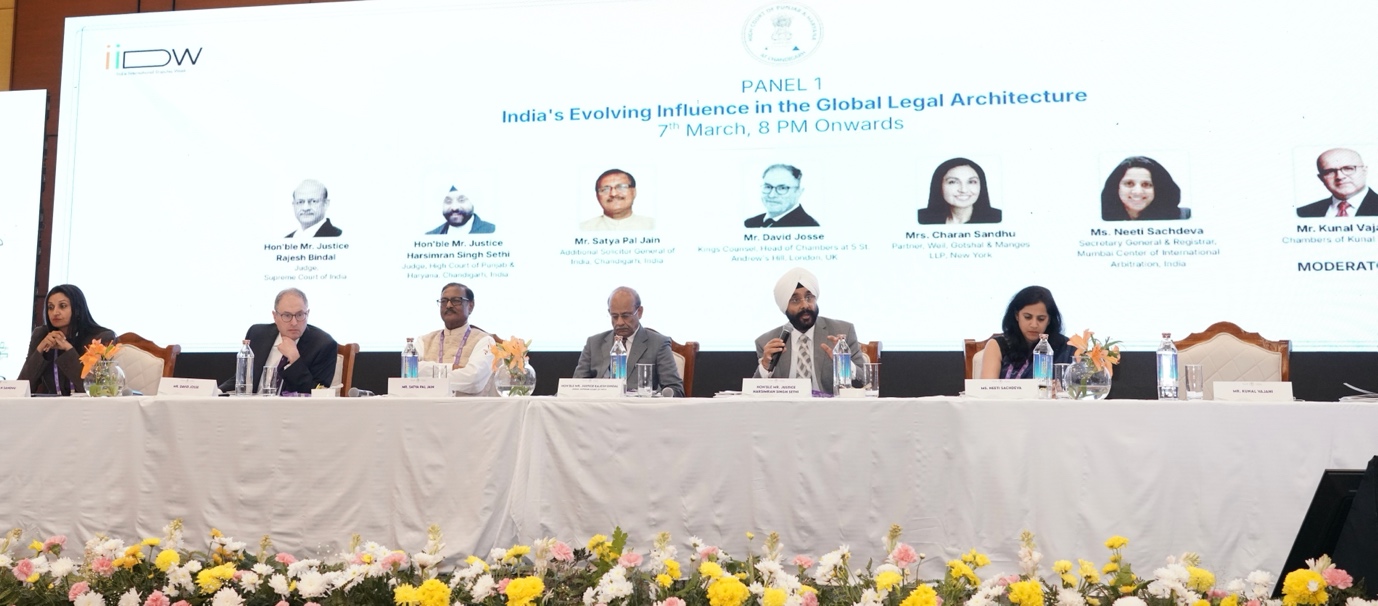
During India International Disputes Week 2026, the session “India’s Evolving Influence in the Global Legal Architecture” examined India’s evolving engagement with international legal norms and its potential role in shaping global dispute-resolution frameworks.
Moderated by Mr. Kunal Vajani, Chambers of Kunal Vajani, Mumbai, the session brought together distinguished jurists and international practitioners, including Justice Rajesh Bindal, Judge, Supreme Court of India, Justice Harsimran Singh Sethi, Judge, High Court of Punjab and Haryana, Mr. Satya Pal Jain, Additional Solicitor General of India, Mr. David Josse KC, Head of Chambers, 5 St Andrew’s Hill, London, Ms. Charan Sandhu, Partner, Weil, Gotshal & Manges LLP, New York, and Ms. Neeti Sachdeva, Secretary General and Registrar, Mumbai Centre for International Arbitration, who shared insights on constitutional doctrine, arbitration jurisprudence, international criminal law, and the evolving architecture of global legal governance.
India’s Engagement with the Global Legal Order
Mr. Kunal Vajani opened the panel by reflecting on the transformation in India’s engagement with the global legal order. He observed that India had long been perceived as a jurisdiction that absorbed and adapted international legal norms, but that phase, he suggested, had now passed. According to him, India, today, was increasingly participating in shaping those very norms.
Framing the central inquiry before the panel, he posed a broader question: whether India’s influence in the global legal order was merely incremental or genuinely normative, whether Indian institutions commanded the recognition corresponding to the country’s economic stature, and what reforms would be necessary for India not merely to participate but to lead in shaping global legal frameworks.
Constitutional Thought and Global Legal Influence
Directing the first question to Justice Rajesh Bindal, Mr. Vajani referred to the evolution of Indian constitutional jurisprudence over the past seven decades and asked which aspects of India’s constitutional philosophy were most capable of influencing the international legal order.
Responding to the question, Justice Rajesh Bindal reflected on the intellectual vitality of the Indian Constitution and described it as an intellectual property.
“That is the beauty of our Constitution. As the society changes, we change. It’s going with the need of the society.”
According to him, this dynamic constitutional approach offers lessons for jurisdictions across the world. Justice Bindal identified two areas where Indian jurisprudence has significantly influenced global legal thinking, the development of environmental law and principles aimed at preserving ecological balance.
Responding to a follow-up question, Justice Bindal pointed to the Basic Structure Doctrine and the evolution of environmental jurisprudence as two significant contributions of Indian constitutional law that have already begun influencing legal thinking beyond India.
Judicial Temperament and International Commercial Law

Mr. Vajani then posed a question to Justice Harsimran Singh Sethi, noting that India’s judicial temperament does not always comfortably align with the unsentimental imperatives of international commercial law.
Addressing the relationship between Indian judicial approaches and the demands of international commercial law, Justice Sethi emphasised that while procedural rules are important, they cannot override the ultimate objective of delivering substantive justice.
According to him, dispute resolution must maintain a proportionate balance between procedure and fairness so that legal processes ultimately serve their intended purpose.
“In case the judgment needs interference, despite following procedure, which is the intention of the Indian court, interference should be done in order to achieve that the basic purpose for which the resolution started should also be done.”
Public Policy Doctrine in Arbitration
The discussion also examined the public policy doctrine in arbitration, a frequently debated aspect of India’s arbitration jurisprudence.
Justice Sethi observed that public policy considerations should not be invoked in a manner that undermines commercial certainty.
“Once two parties have entered into a contractual obligation, those obligations need to be fulfilled and in case there is a dispute, those have to be decided on the basis of the government conditions mentioned therein.”
Civilisational Foundations of Indian Law

Offering a governmental perspective, Mr. Satya Pal Jain reflected on the philosophical foundations of India’s legal culture. He emphasised that principles associated today with modern concepts such as human rights, environmental protection, and universal brotherhood were deeply embedded in India’s civilisational ethos long before the adoption of the Constitution.
“India is one country where we were secular right from day one. We have never been a bureaucratic state. No discrimination with any religion, any community.”
According to him, these values drawn from India’s historical and philosophical traditions continue to shape India’s approach to governance and law. He also highlighted that negotiation, mediation, and dialogue have historically been recognised in Indian traditions as the most effective pathways to resolving disputes.
India and International Criminal Law
On India’s absence from the Rome Statute of the International Criminal Court (ICC), Mr. David Josse observed that although the Rome Statute has been adopted by more than 120 countries, several major global powers have not joined the ICC, creating structural challenges for the institution.
“India, going forward, will play a very important part in trying to act as some sort of bridge between those countries and perhaps rebuilding ICC.”
He suggested that India’s geopolitical position places it in a unique position to contribute to the evolution of international criminal law and potentially act as a bridge between competing international perspectives.
Investor Confidence and Arbitration Reform
Directing a question to Ms. Charan Sandhu, Mr. Vajani asked what structural reform India must undertake to inspire confidence among international investors and their legal counsel.
Responding from the perspective of a corporate lawyer advising multinational clients, Ms. Sandhu emphasised that the most critical factor for global investors is predictability in the enforcement of contracts.
“For us as a country, in India, we should be aspiring to develop that expertise, develop that commercial contracting expertise.”
She further highlighted the importance of neutrality, specialised expertise within the arbitration ecosystem, and efficient dispute-resolution timelines. According to her, international businesses often seek jurisdictions where arbitration proceedings are efficient and where interim relief and final awards can be delivered within commercially reasonable timelines.
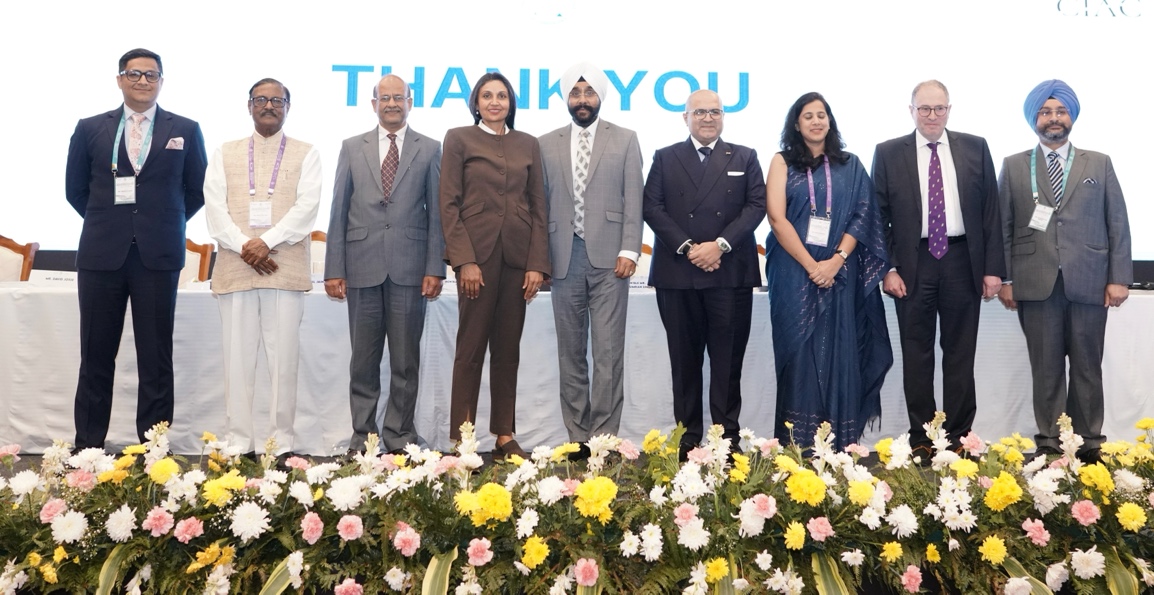
As the session concluded, the organisers thanked the speakers, moderators, and participants for their contributions and engagement. They also acknowledged the support of the Punjab and Haryana High Court in facilitating the initiative and advancing institutional dispute resolution.