Disclaimer: This has been reported after the availability of the order of the Court and not on media reports so as to give an accurate report to our readers.
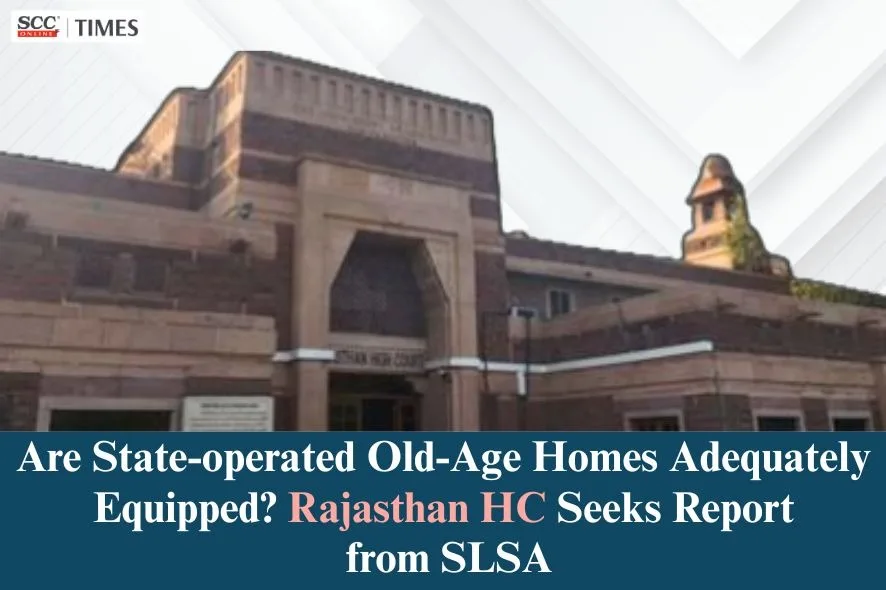
Rajasthan High Court: While considering the writ petition wherein the respondent was required to submit the necessary compliance report including appropriate scheme and roadmap for establishment of at-least one old age home in every district of Rajasthan, the Division Judge Bench of Pushpendra Singh Bhati and Sangeeta Sharma, JJ., observed that establishment of old age homes, as envisaged under Section 19, Maintenance and Welfare of Parents and Senior Citizens Act 2007 (the Act), is therefore a significant step towards fulfilling the statutory and constitutional mandate. The Court, hence, directed the Rajasthan State Legal Services Authority (Rajasthan SLSA) to file a report to have a comprehensive understanding of the facilities and welfare measures available in State-operated old-age homes in Rajasthan, to further strengthen the implementation of the legislative intent.
The Court stated that “Indian civilization has, since time immemorial, accorded a position of reverence to the elderly. The concept of ‘Matru Devo Bhava, Pitru Devo Bhava’ from the Taittiriya Upanishad reflects a foundational value that shaped the social fabric of the country. The elderly have always been regarded as repositories of wisdom, experience and guidance, and the family structure in India traditionally evolved around respect, care and emotional security for its senior members.”
The Court further stated that the joint family system ensured that ageing was accompanied by dignity, belonging and social support, making care for senior citizens a matter of natural duty rather than legal enforcement, however, with passage of time and changing socio-economic patterns such as urbanisation, migration and nuclear family structures, the traditional support mechanisms have undergone transformation. Thus, institutional and legal support systems assume greater importance in ensuring that senior citizens continue to live with dignity, care, and security.
The Court stressed that the commitment of the Constitution towards the welfare of all sections of society finds its expression at the very outset in the Preamble and the concern for senior citizens is inherently embedded within this constitutional vision of social justice and human dignity. Articles 21, 41 and 46 of the Constitution, read together, provide the constitutional foundation for policies and measures aimed at ensuring care, security and dignity for senior citizens.
Further, the Court stated that the global community has long acknowledged the importance of safeguarding the rights and well-being of older persons and more recently, the United Nations Decade of Healthy Ageing (2021—2030) has renewed global focus on creating age-friendly environments, improving access to healthcare and ensuring dignified living for the elderly. India’s domestic legal and policy framework reflects alignment with these internationally recognised principles and commitments.
The Court stated that the Act is a beneficial legislation intended to ensure maintenance, protection and welfare of senior citizens, including the establishment and maintenance of old age homes with adequate facilities. Section 19 of the Act specifically envisages the establishment of old age homes in every district for indigent senior citizens.
The Court further stated “India is presently undergoing a significant demographic transition marked by a steady rise in its elderly population. Recent demographic assessments indicate that the proportion of senior citizens (60 years and above) in the country, which stood at approximately 10.5 per cent in 2022, is projected to rise to 20.8 per cent by the year 2050. It is further projected that by 2046, the elderly population in India will outnumber children in the age group of 0-14 years. This demographic shift is primarily attributable to increased life expectancy and declining fertility rates, resulting in an ageing population that requires structured social and institutional support systems.” The trend of ageing index highlighted that a progressively larger segment of the population was entering an age bracket that might require assistance in terms of healthcare, shelter, and social security, thereby underscoring the importance of dedicated facilities and welfare measures for senior citizens.
The Court noted that a significant proportion of the elderly population resided in rural areas where access to medical and support infrastructure was comparatively limited and stated that the said factors collectively emphasised that old age homes and similar institutional arrangements, as envisaged under the Act served an important role in providing medical support, shelter and dignified living conditions to senior citizens who might not have adequate family or economic support.
The Court stressed that establishment of old age homes, as envisaged under Section 19 of the Act, is therefore a significant step towards fulfilling the statutory and constitutional mandate. However, the true objective of such homes was realised not merely by their existence, but by ensuring that they were adequately equipped with basic amenities, medical facilities, and welfare support for the residents. The Court stated that “Proper functioning of these homes ensures that senior citizens residing therein are able to live in conditions of safety, dignity and care, in consonance with the spirit of the Act and the constitutional values discussed hereinabove. Periodic assessment of such facilities, therefore, becomes a constructive exercise aimed at strengthening the welfare framework for the elderly.”
The Court noted that for senior citizens, 31 homes were presently operating in Rajasthan and emphasised that the existence of such homes reflected the steps undertaken by the State towards providing institutional support to elderly persons in need. The Court further stated that it required to have a comprehensive understanding of the facilities and welfare measures available in these homes, to further strengthen the implementation of the legislative intent. Thus, the Legal Services Authorities, functioning at the State and District levels, were well placed to undertake such an exercise through their established outreach mechanisms and field presence.
The Court directed the Rajasthan SLSA to file its report regarding each of the aforesaid homes through their respective District Legal Services Authorities. The report should contain the following particulars for each old-age home:
-
Whether the building housing the old-age home had been constructed by the State Government or not.
-
Whether the occupants residing therein were elderly persons/senior citizens or not.
-
Whether adequate medical facilities were available to the residents or not.
-
Whether any financial aid, grant, or assistance were extended by the Government.
-
Any other issue, which pertained to welfare and infrastructure of the old age home.
The Court listed the matter after eight weeks.
[Lok Utthan Sansthan v. State of Rajasthan, 2026 SCC OnLine Raj 1638, decided on 29-1-2026]
Advocates who appeared in this case:
For the Petitioner: Rajendra Soni, Adv. and Nitin Soni, Adv
For the Respondent: Kapil Prakash Mathur, AAG and Sourabh Sharma, Adv.