
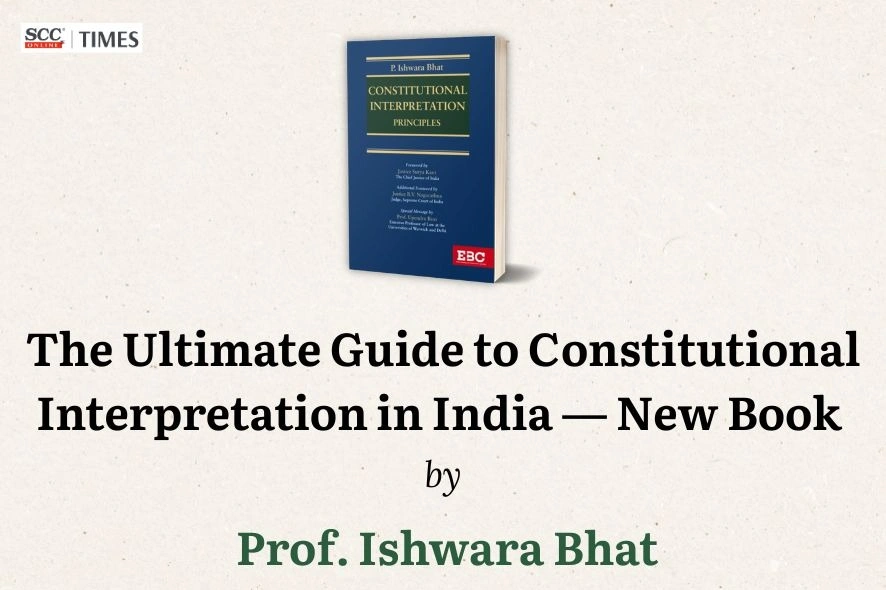
EBC is proud to announce the release of a new book — Prof. (Dr) P. Ishwara Bhat’s Constitutional Interpretation: Principles. This book is a valuable treatise on the subject of Constitutional Law and provides a comprehensive insight into all the principles of constitutional interpretation with special reference to India. It systematically presents the doctrines, theories, and principles developed by the judiciary for interpreting the Constitution, supported by leading case laws, academic views, and comparative constitutional perspectives. This book examines internal and external aids to interpretation, text-based, structural, and value-based approaches, and the expanding toolkit of constitutional interpretation in light of transformative constitutionalism. It identifies and analyses both traditional tools such as textualism and doctrinalism, and emerging approaches like structuralism, pragmatism, consequentialism, moral reading, feminism, contextualism, and eclecticism.
Why you should buy this book
This book stands out as a definitive and comprehensive guide to constitutional interpretation in India. Its key strengths include:
-
An exclusive and exhaustive treatise devoted entirely to constitutional interpretation in the Indian context.
-
A systematic compilation and classification of all major doctrines and principles in a single, authoritative volume.
-
Comprehensive coverage of both traditional and contemporary interpretative approaches, including textual, structural, purposive, moral, pragmatic, and contextual methods.
-
Extensive analysis of case law, featuring landmark and influential decisions of the Supreme Court of India.
-
Valuable comparative constitutional perspectives, incorporating insights from leading foreign jurisdictions.
-
A clear and thoughtful distinction between statutory interpretation and constitutional interpretation, enhancing conceptual clarity for readers.
Structure of the book
This book is divided into 6 parts. A short description of the parts has been listed below
-
Part I of this book introduces the foundations of constitutional interpretation by addressing what it is, why it matters, who interprets the Constitution, and how interpretation is undertaken, including the relevance of statutory rules, interpretive strategies, internal and external aids, and constitutional theories.
-
Part II (Culture, History, and External Aids) examines how cultural values, constitutional history, original intent, Constituent Assembly Debates, international law, foreign precedents, scholarly resources, and ancient interpretive methods like Mimamsa Rules inform constitutional meaning.
-
Part III (Text-Based Interpretation) focuses on the constitutional text as the starting point of interpretation, analysing canons and presumptions, internal aids such as the Preamble and DPSPs, doctrines relating to unconstitutionality, and balancing techniques like reading down, reading in, and prospective overruling.
-
Part IV (Structural Interpretation) explores how constitutional structure and relationships—among institutions, levels of government, and rights—shape interpretation, with emphasis on federalism, separation of powers, harmonious construction, and the basic structure doctrine.
-
Part V (Value-Based Interpretation) of the book concentrates on approaches grounded in constitutional spirit and values, including purposive, progressive, consequentialist, moral, and feminist interpretations, highlighting their role in expanding rights and addressing complex social issues.
-
Part VI (Other and Composite Approaches) of the book discusses doctrinalism, pragmatism, contextualism, and pluralist/eclectic methods, underscoring the judiciary’s preference for a multi-modal, case-specific combination of interpretive tools, followed by a concluding synthesis of their contribution to constitutional law.
About the author
Prof. (Dr) P. Ishwara Bhat is a former Professor of Law, University of Mysore. He was the Vice-Chancellor of Karnataka State Law University, Hubballi and of the West Bengal National University of Juridical Sciences, Kolkata. He has an LL D degree from the National Law School of India University, Bangalore, and LL M, MA and Ph D from the University of Mysore, Karnataka. He was Fulbright-Nehru Visiting Scholar for teaching NPO law in Catholic University of America, Washington DC, and Shastri Visiting Scholar at Queen’s University, Kingston, Canada. He worked on language rights under the Shastri Faculty Research Award at York, Toronto and Ottawa Universities, Canada. He has 45 years of teaching and research experience.
His publications include authored volumes such as Idea and Methods of Legal Research (OUP, 2019); Non Profit Voluntary Organisations Law (EBC, 2018); Fundamental Rights: A Study of Their Interrelationship (ELH, 2004), in addition to the second edition of Law and Social Transformation in India (EBC, 2022). He has produced edited volumes, such as Natural Resources Law (EBC, 2016); DD Basu’s Limited Government and Judicial Review (LexisNexis, 2015); Inter-State and International Water Disputes (EBC, 2013); Constitutionalism and Constitutional Pluralism (LexisNexis, 2013); and Legal Education (MPP House, 2025). He has edited five law books in Kannada and authored a book on “Disqualification of Members, Office of Profit and Anti-Defection Law” in Kannada (Karnataka Institute of Legal and Parliamentary Reforms, 2025). He has also published 150 research articles in various scholarly law journals and books. He has guided 22 scholars for Ph D and handled several research projects. He is the Editor-in-Chief of Vidya Vikas Law Journal. In view of his academic contribution, the Capital Foundation Society of India has conferred upon him Prof. Upendra Baxi National Legal Research Award in 2020.
Appreciation for the book
This book has received praise from all nooks and corners of the country. Some of the noteworthy reviews have been summarised below:
Justice Surya Kant, Chief Justice of India appreciates Prof. Ishwara Bhat’s book as a rare and rigorous work of constitutional scholarship that comprehensively examines all major doctrines, methods, and arguments of constitutional interpretation and synthesises them with clarity and persuasive reasoning. He commends the author for combining deep theoretical analysis with comparative perspectives from jurisdictions such as the United States, Canada, and Australia, and for critically engaging with Indian case law. Emphasising that constitutionalism runs as the book’s guiding thread, Justice Surya Kant notes that the work meaningfully connects constitutional interpretation with people’s welfare, aspirations, and participation, and regards it as highly valuable for the legal profession, students, and the wider public, particularly in the context of reflecting on 75 years of the Indian Constitution.
Upendra Baxi, Professor Emeritus warmly praises Prof. Ishwara Bhat’s book as an encyclopaedic, ambitious, and deeply thoughtful contribution to the understanding of constitutional judicial review, commending its sensitive integration of analytic, sociological, normative, and interpretive dimensions. He appreciates the book’s rich exploration of multiple methods of constitutional interpretation—text, history, structure, purpose, morality, precedent, context, and foresight—treating them not as competing silos but as mutually reinforcing elements of a comprehensive constitutional vision. Baxi applauds Bhat for resisting narrow originalism, creatively engaging with constitutional history and Constituent Assembly Debates, and adopting contextual and purposive approaches that enable constitutional values to respond to changing social realities. He further values the work’s comparative breadth, philosophical depth, engagement with both Western thinkers and Indian Å›Ästric traditions, and its insistence on “responsible” and socially responsive interpretation, ultimately describing the book as a “treasure trove” and a gallant, intellectually generous work that significantly enriches constitutional scholarship.
Justice B.V. Nagarathna, Judge, Supreme Court of India praises Prof. P. Ishwara Bhat’s book as a comprehensive and scholarly treatise on constitutional interpretation, highlighting its importance in strengthening constitutional jurisprudence and scholarship. She commends the work for systematically presenting constitutional doctrines, their evolution, comparative perspectives, and internal and external interpretive aids, while emphasising an integrated use of text, history, structure, purpose, precedents, and ethos. She appreciates the book’s advocacy of multimodal interpretive approaches—such as structuralism, purposivism, progressivism, moral and contextual interpretation—treating constitutional interpretation as a core expression of constitutionalism rather than an extension of statutory interpretation. Justice Nagarathna concludes that the book is a timely and valuable contribution that will benefit judges, lawyers, students, researchers, and readers in deepening constitutional understanding and fostering a healthy constitutional culture.
Who the book is for?
This book is an indispensable resource for anyone seriously engaged with constitutional law—whether in practice, academia, or advanced study. This book is for:
-
Judges and legal practitioners — to deepen understanding of constitutional doctrines and interpretive methods used in constitutional adjudication.
-
Law students and judicial aspirants — especially those studying constitutional law, preparing for judiciary exams, LL.M., or competitive legal examinations.
-
Legal academics and researchers — as a comprehensive reference on theories, principles, and comparative perspectives in constitutional interpretation.
-
Senior advocates and constitutional law specialists — for advanced doctrinal analysis and scholarly insight into evolving interpretive approaches.
-
Policy makers and legal scholars — to understand how constitutional interpretation shapes governance and public policy.
-
University and law libraries — as an essential reference volume for constitutional law collections.
Conclusion
Constitutional Interpretation: Principles by Prof. (Dr) P. Ishwara Bhat stands as a definitive and authoritative contribution to Indian constitutional scholarship. Bringing together decades of judicial evolution, scholarly insight, and comparative perspectives, the book offers a comprehensive and systematic exploration of the doctrines, tools, and philosophies that shape constitutional interpretation. Its balanced engagement with traditional principles and contemporary interpretive approaches makes it an indispensable resource for judges, practitioners, academics, and students alike. By illuminating the dynamic relationship between constitutional text, values, and societal transformation, this work significantly enriches constitutional discourse and will serve as a foundational reference for years to come.
A copy of the book can be bought at https://shorturl.at/aWj7h