
Disclaimer: This has been reported after the availability of the order of the Court and not on media reports so as to give an accurate report to our readers.
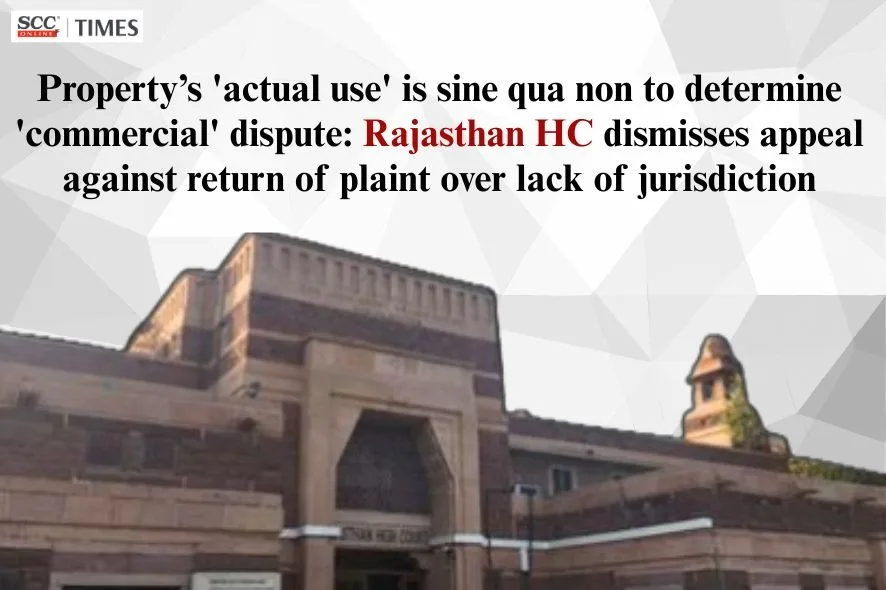
Rajasthan High Court: While considering an appeal filed under Order 43 Rule 1(a), Civil Procedure Code, 1908 (CPC) challenging the order passed by the Additional District Judge wherein the plaint was returned to be filed before the Commercial Court of competent jurisdiction, a Single Judge Bench of Sanjeet Purohit, J., held that the “actual use” of the property for trade or commerce is the sine qua non for qualifying a dispute as “commercial” in nature.
The Court dismissed the appeal and held that no error was committed by the trial court in holding that it lacked jurisdiction to entertain the suit for specific performance of the said agreement to sell.
Background
In the case at hand, the dispute involved an agreement to sell dated 22 February 2024 for two shops (suit premises) from which the appellants were conducting business as tenants for over 10 years. The respondents entered into the agreement to sell for Rs 33,00,000 of which Rs 3,00,000 were paid in advance, with the balance payable on execution and registration of the sale deed.
As per the agreement, respondents were to execute the sale deed within six months, however failed to do so. The appellants issued a legal notice on 23 September 2024, which was refused by the respondents. The appellants then filed a suit for specific performance and sought mandatory and prohibitory injunctions.
The respondents filed an application under Order 7 Rule 11 and Section 151 CPC, challenging the maintainability of the suit and the trial court held that suit could not be tried by a civil court for specific performance as suit of an agreement relating to immovable property used for trade qualifies as a commercial dispute. Aggrieved, the appellant approached the High Court.
Issue, Analysis and Decision
The Court stated that the main issue involved in the matter at hand was as to whether a dispute arising out of an agreement to sell concerning property which was being used for trade and business qualifies as a commercial dispute under section 2(1)(c)(vii), Commercial Courts Act, 2015 (Commercial Courts Act).
Considering Section 2(1)(c)(vii), Commercial Courts Act, the Court stated that any dispute arising out of an agreement relating to immovable property which is being used exclusively in trade and commerce will constitute a commercial dispute. Thus, the Court stated that the only issue which was to be determined was whether the suit premises, that is, the two shops, for the sale of which the parties entered into the agreement to sell, dated 22 February 2024, could have been used exclusively for trade or commerce.
The Court referred to Ambalal Sarabhai Enterprises Ltd. v. K.S. Infraspace LLP (2020) 15 SCC 585 and Vasu Healthcare (P) Ltd. v. Gujarat Akruti TCG Biotech Ltd. 2017 SCC OnLine Guj 724 and observed that “the ‘actual use’ of the property for trade or commerce is the sine qua non for qualifying a dispute as ‘commercial’ in nature”.
The Court held that the trial court was perfectly justified in concluding that the matter was a commercial dispute, and the same must be adjudicated by Competent Commercial Court. Further, the Court reiterated that at the stage of Order 7 Rule 10, the Court is required to consider only the averments made in the plaint and the documents filed by plaintiff. The Court perused the records and highlighted that appellants admitted in the plaint that they were using the suit premises for the purposes of their trade and commerce for more than past 10 years. It was further admitted that when the parties entered into the said agreement to sell in respect of the suit premises, appellants were in possession of the shops as tenants and were using the same even then for their trade and commerce.
Thus, the acid test as laid down in Ambalal Sarabhai (supra) that the property to which the agreement related must “actually be used” and not “likely to be used” stood satisfied. The Court further stated that there remained no doubt that the dispute concerning the specific performance of the agreement relating to sale of suit premises was a commercial dispute and should be adjudicated by Competent Commercial Court. Hence, the Court observed that the trial court rightly returned the plaint to appellants to file the same before the Competent Commercial Court.
The Court stated that the appellants failed to make out a case that would warrant the interference of the Court and the trial court committed no error in holding that, “It did not have jurisdiction to entertain the suit for specific performance of the said agreement to sell and in returning the plaint, in exercise of its power under Order 7 Rule 10 CPC, to be presented before competent commercial Court”. Thus, the Court dismissed the appeal at hand.
[Mohsin Samdani v. Sajjad Hussain Damami, 2026 SCC OnLine Raj 1376, decided on 29-1-2026]
Advocates who appeared in this case:
For the Appellants: Rakesh Kumar Chota
For the Respondents: Tabish Samdani