
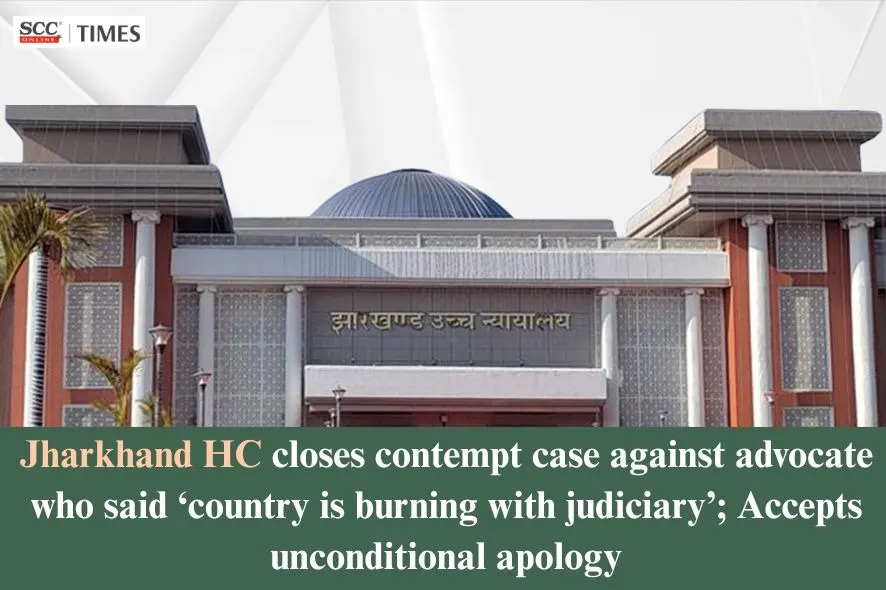
Jharkhand High Court: While hearing suo motu criminal contempt proceedings against an advocate (contemnor), the five-Judge Bench of M.S. Sonak*, CJ., Sujit Narayan Prasad, Rongon Mukhopadhyay, Ananda Sen and Rajesh Shankar, JJ., observed that the contemnor’s utterances and conduct during judicial proceedings were indeed contemptuous. At the same time, the Court held that his subsequent unconditional apology, coupled with his long-standing career and the Supreme Court’s request to consider the apology sympathetically, justified acceptance of the apology. Accordingly, the Court dropped the contempt proceedings, while cautioning that greater restraint must be exercised in future.
Background
The matter arose from an incident on 16 October 2025 in a courtroom, where the contemnor interrupted proceedings, used intemperate language, and remarked that “the country is burning with the judiciary” and asked the Judge “not to cross his limits”. A video of the incident subsequently went viral, prompting the Full Bench to register a suo motu criminal contempt case.
At the outset, the contemnor expressed no remorse. However, he later filed an interim reply and a supplementary affidavit tendering an unconditional apology. He contended that his statements were spontaneous reactions made under emotional distress and were not intended to scandalise the Court. He clarified that his remarks had been misinterpreted, retracted the objectionable expressions, and emphasised his respect for the judiciary. He prayed that the Court consider his long unblemished career, the emotional circumstances surrounding the incident, and his unconditional apology to drop the proceedings.
The Supreme Court, by order dated 23 January 2026, recorded that the contemnor was extremely repentant and requested the Court to consider his apology sympathetically. Pursuant to this, the contemnor filed a supplementary affidavit on 5 February 2026, once again tendering an unconditional apology.
Analysis and Decision
The Court, upon due consideration of the pleas, transcript, the video clip and the law on the subject, accepted the contemnor’s unconditional apology. The Court highlighted that an advocate with over 40 years of legal practice is expected to show greater restraint, if not circumspection, as he is as much an officer of the Court as the Judge presiding over it. Therefore, his utterances and conduct in the Court are not directed only to the Presiding Officer but to the institution itself. The Court noted that he cannot afford to exhibit disrespect or speak words or otherwise conduct himself to scandalise or tend to lower the authority of any court.
The Court highlighted that on 17 October 2025, the contemnor had stated he had no remorse or regret whatsoever which harmed the institution. However, the Court also noted that in subsequent replies and affidavits, the contemnor expressed regret, retracted his statements, and tendered an unconditional apology.
While the Court did not condone or overlook the contemnor’s conduct and utterances, it observed that the institution’s shoulders are broad enough not to be unduly affected by them. Therefore, the Court was satisfied that this was a matter in which, while it did not approve of the contemnor’s utterances and conduct in the Court, it must take a sympathetic and lenient view of the matter.
The Court emphasised that the apology was tendered at a sufficiently early stage of the contempt proceedings, and even in the interim reply, the contemnor expressed his regrets and acknowledged that some of his utterances must have crossed the limits expected of an officer of the Court. The Court further referred to Anil Panjwani, In re, (2003) 7 SCC 375, wherein the Supreme Court did not condone or overlook the contemnor’s objectionable conduct, namely, the scurrilous and scandalous statements made in his affidavit. However, the Supreme Court took a sympathetic and lenient view towards him because he offered a genuine, albeit belated, apology with folded hands, expressing sincere remorse.
Therefore, having considered the facts, circumstances and the dicta of the Supreme Court, the Court accepted the contemnor’s apology and dropped the contempt proceedings. The Court emphasised that this was in the fond hope and expectation that the contemnor, a legal practitioner in the Court who has practised for more than four decades, will, in future, display restraint and not indulge in any misadventure of scandalising or lowering the authority of this institution, or otherwise interfere with or obstruct the administration of justice in any manner.
Ultimately, the Court disposed of the suo motu contempt petition. The Court further observed that the interim applications, if any, did not survive and were accordingly disposed of.
[Court on its Own Motion v. Mahesh Tewari, 2026 SCC OnLine Jhar 215, decided on 16-2-2026]
*Judgment authored by: M.S. Sonak, Chief Justice, Jharkhand High Court
Advocates who appeared in this case:
For the Opposite Party: Party-in-Person