
Disclaimer: This has been reported after the availability of the order of the Court and not on media reports so as to give an accurate report to our readers.
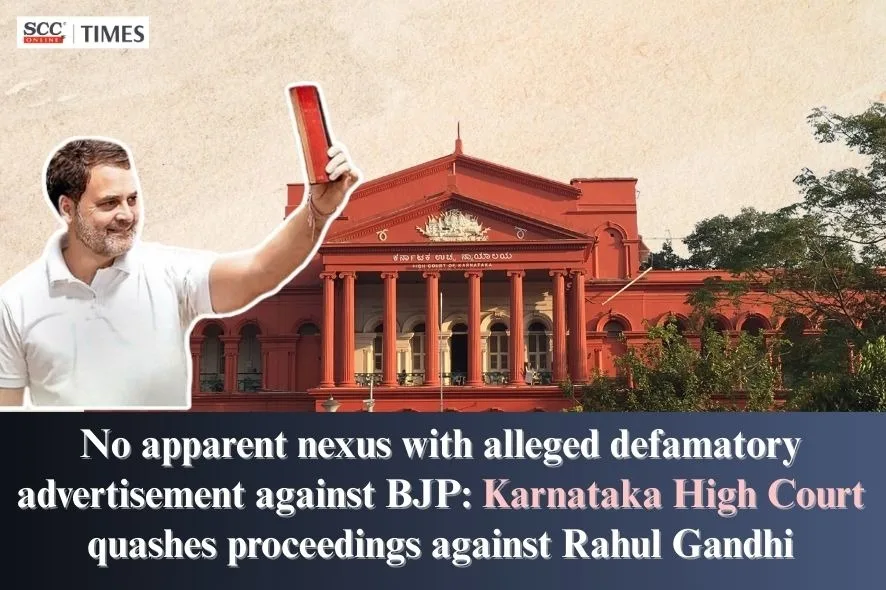
Karnataka High Court: In a criminal petition filed by Rahul Gandhi, the leader of Opposition, under Section 482 of the Criminal Procedure Code 1973 (‘CrPC’) wherein quashing of proceedings against him for alleged offences punishable under Sections 400 and 500 of the Penal Code, 1860 (‘IPC’) pending in XLII Additional Chief Judicial Magistrate’s file, a Single Judge Bench of S Sunil Dutt Yadav, J., stated that except for the photograph, he had no other apparent nexus with the defamatory advertisement against the complainant-Bharatiya Janata Party (‘BJP’).
Accordingly, the Court quashed the proceedings against Rahul Gandhi.
Background
In the present case, the BJP filed complaint under Sections 190 and 200 CrPC alleging that Karnataka Pradesh Congress Committee, which is a part of Indian National Congress, , the President of the Karnataka Pradesh Congress Committee, and Rahul Gandhi, the former Vice President of Indian National Congress had conspired and issued an advertisement, in main stream newspapers, on 5-5-2023 by making reckless defamatory imputations against the BJP.
It was further stated that the allegations made in the advertisement made a clear reference to the time of 2019 to 2023 which indicated that the reference was made against the BJP which tarnished its image.
The Trial Court held that BJP could be construed to be a ‘person’. Aggrieved by it, Rahul Gandhi approached the High Court.
Issues, Analysis and Decision
The Court stated that to initiate proceedings for defamation, it is essential that proceedings should be initiated by “some person aggrieved“. The Court reiterated that in absence of such requirement, “proceedings at the instance of any other person would render the proceedings void”.
The Court took into account the issue as to whether the BJP could be the person aggrieved requires recording of a finding. The Court stated that the complainant before the Trial Court is BJP represented by its State Secretary, BJP Karnataka, and the said entity for all purposes was held out to be the person aggrieved. On perusal of complaint, the Court noted that complainant was the National party. The Court stated that the complaint indicated that its State Unit, the Government formed by it, and the BJP have been defamed. However, the complainant who brought the legal grievance before the Court was the National Party, that is, the BJP. Thus, the complaint ought to be filed by the duly authorized representative of the BJP. However, the letter of authorization was issued by the President of the State Unit to its Secretary of the State Unit, and such authorization could not be accepted as legal authorization to represent the BJP as a National Party.
Further, the Court stated that there was no material to indicate that the BJP had authorized the President of the Karnataka Unit to initiate proceedings. Thus, the Court held that “the complainant is not represented by a competent person and in the absence of which the aggrieved person being represented by an incompetent person vitiates the proceedings.”
Regarding the role of Rahul Gandhi in publication of the advertisement, the Court held that the advertisement indicated that except for his photograph, there was no other apparent nexus of him with the advertisement. The Court stated that “In an action which seeks to fasten criminal liability, it must be demonstrated that the imputation made must be at the instance of a person who has mens rea to defame.” The Court further stated that the said requirement was absent in Rahl Gandhi’s case, which is why the reliance on the advertisement by itself could not lead to the assertion that it was published by him “with the requisite intention to defame”.
The Court stated that Rahul Gandhi would have been a leader of the party but did not hold any position in the organizational hierarchy as on the relevant date as the Memo dated 11-2-2025 specifically made out that he was neither the President nor the Vice President of the Indian National Congress as on the date of advertisement. Thus, a mere photograph on the advertisement would not be sufficient to indicate that the advertisement was at the instance of Rahul Gandhi when Section 499 IPC clearly stipulates that the person must have requisite mens rea.
Regarding the compliant with respect to Rahul Gandhi’s tweet, he had tweeted the advertisement along with certain additional remarks allegedly referring to BJP, the Court stated that strangely the text of the said tweet was not marked along with other documents while sworn statement was recorded nor any Section 65-B (Evidence Act, 1872) certificate produced in requisite format. Thus, the Court held that without the tweet, the advertisement by itself could not lead to any presumption of Rahul Gandhi having defamed the BJP.
The Court stated that “Insofar as the offence of defamation as regards an entity, Explanation 2 to Section 499 IPC does indicate that there could be defamation of an entity such as the company or an association or collection of persons.” The Court stressed that an imputation that ‘party X’ is corrupt, is by itself defamatory and the entity which is alleged to be corrupt could be the political party, however, where the imputation made is against certain individuals or class of persons in the entity, then the person aggrieved would be such individuals or class of persons within the larger entity who have been defamed.
Further, the Court stated that “Where a functionary, such an office bearer of the party, is defamed, then such functionary would be the aggrieved person. In the present case, the imputation itself is by way of innuendo, and such imputation is sought to be stretched to the party. However, sans the tweet the advertisement by itself makes no reference to the party but rather makes an imputation to the functionaries mentioned in the advertisement. The reference that is made in the advertisement is to constitutional functionaries and Government employees being beneficiaries and to the irregularities in Government Schemes. None of the persons or entities referred to above are before the Court.” The Court, thus, held that the aggrieved person in the advertisement factually could not be the political party.
The Court further stated that there had been a series of procedural lapses since there was no enquiry under Section 202 CrPC which is mandated where the accused is outside the territorial jurisdiction of the Court. Considering that Rahul Gandhi resided outside the territorial limits of the Court, the Court observed that non-compliance of Section 202 CrPC procedure prejudiced him and revealed a very casual approach of BJP in not insisting for such enquiry before summons were issued to him. The Court held that while issuing summons, Courts “ought to apply its mind to ensure that the consequence of issuing process to an accused and thereby making him a part of the prosecution of the complaint cannot be done casually”. When issuing process, the Court should make up its mind that at least a case is made out against the accused, on the face of it. The Court observed that in the case at hand, the material before the Magistrate consisted only of the advertisement and based on such material, no case was made out against Rahul Gandhi.
The Court stated that BJP would contend that Rahul Gandhi’s tweet was found in the file and would be marked at a subsequent stage, however, such explanation would not cure the legal defect of not having the tweet on record when process was issued to him. Thus, the Court allowed the petition by quashing proceedings against Rahul Gandhi and stated that the continuance of the proceedings would amount to an abuse of the legal process.
[Rahul Gandhi v. Bharatiya Janata Party, 2026 SCC OnLine Kar 779, decided on 17-2-2026]
Advocates who appeared in this case :
For the Petitioner: Shashikiran Shetty, Senior Advocate for Nishit Kumar Shetty, Advocate, Anishka Vaishnav, Advocate and Harsha G.L., Advocate
For the Respondent: Vinod Kumar M., Advocate