
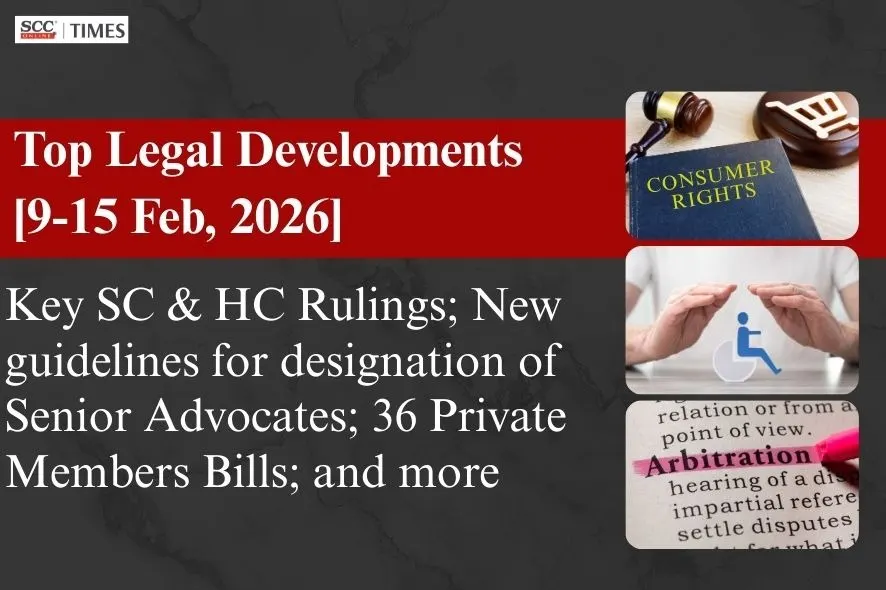
This roundup of weekly legal developments India covers the most significant Supreme Court and High Court rulings, including consumer compensation, gratuity, disability pension arrears, etc. It also highlights major legislative developments such as the introduction of 36 Private Members Bills in the Rajya Sabha, key administrative directives, and other important legal and policy updates from across India.
SUPREME COURT HIGHLIGHTS OF THE WEEK
Arbitration| Section 29-A doesn’t mandate automatic substitution of Arbitrator; Order terminating mandate set aside
In Viva Highways Ltd. v. M.P. Road Development Corporation Ltd.1, the Madhya Pradesh High Court had earlier terminated the mandate of the existing arbitrator and directed appointment of a new one, but the Division Bench of Sanjay Kumar and Alok Aradhe, JJ., set aside the order, holding that Section 29-A of the Arbitration and Conciliation Act, 1996 does not mandate automatic substitution of an arbitrator. Read Arbitrator’s automatic substitution case here
Consumer Dispute| ₹2 Crores for faulty haircut? Supreme Court ‘Trims’ Compensation to ₹25 Lakh
In ITC Limited v. Aashna Roy, 2026 SCC OnLine SC 168, the Supreme Court restricted compensation from ₹2 crores to ₹25 lakh in a consumer dispute over a faulty haircut at a five-star hotel salon, holding that compensation must be based on reliable and proved evidence, not conjecture or unverified material, and modifying the order of the National Consumer Disputes Redressal Commission accordingly. Read Faulty Haircut Case here
Disability Pension Arrears| Disability pension arrears can’t be restricted to three years once broad banding entitlement stands judicially settled
In Union of India v. SGT Girish Kumar2, the Supreme Court held that ex-servicemen entitled to disability pension with broad banding benefits cannot have arrears restricted to three years. A Division Bench of Pamidighantam Sri Narasimha and Alok Aradhe, JJ., directed payment of arrears from 1-1-1996 or 1-1-2006, as applicable, with 6 per cent interest, setting aside the Tribunal orders limiting arrears. Read Disability pension arrears case here
Gratuity| Section 2(e) of Payment of Gratuity Act doesn’t apply to Central Govt. employees holding Civil Posts
In N. Manoharan v. Administrative Officer3, the Supreme Court upheld the Madras High Court’s judgment, holding that Section 2(e) of the Payment of Gratuity Act, 1972 does not apply to Central Government employees holding civil posts, including those at the Heavy Water Plant, Tuticorin, who are governed by the CCS (Pension) Rules, 1972, and are therefore not entitled to claim gratuity under the Act. Read Gratuity exclusion case here
MAJOR HIGH COURT RULINGS THIS WEEK
Administrative Diligence| SSC rapped for serious lapses in administration of CGLE question papers and answer keys
In Devyanshu Suryavanshi v. Staff Selection Commission, 2026 SCC OnLine Del 443, the Delhi High Court expressed concern over serious lapses in the administrative diligence of the Staff Selection Commission in conducting the Combined Graduate Level Examination, 2024, while hearing writ petitions challenging orders of the Central Administrative Tribunal. However, finding no patent illegality or perversity in the impugned orders, the Court declined interference and dismissed the petitions. Read CGLE paper case here
Citizenship Law| Born in India = Citizen by Birth; Passport Relief granted to Tibetan-origin woman
In Yangchen Drakmargyapon v. Union of India4, the Delhi High Court held that a Tibetan-origin woman born in India in 1966 is an Indian citizen by birth under Section 3(1)(a) of the Citizenship Act, 1955, and directed issuance of her Indian passport. Read Tibetan woman passport case here
Education Law| “Humiliating, would cast a permanent scar on his character”; Direction to student to display placard saying he won’t misbehave with girls quashed
In X v. Chairman U.G.C.5, the Allahabad High Court quashed the direction requiring a student to stand with a placard pledging not to misbehave with girls, holding that such a humiliating punishment would cast a permanent scar on his character. Read Student placard case here
Examination Evaluation| Examiner entitled to correct/re-evaluate marks “at the first blush”; plea challenging DJSE-2023 evaluation process dismissed
In Prerna Gupta v. Registrar General of Delhi High Court, 2026 SCC OnLine Del 459, the Delhi High Court dismissed a challenge to the DJSE-2023 evaluation process, holding that an examiner is entitled to correct or re-evaluate marks at the initial stage, and in the absence of mala fide, bias, or material error, judicial interference is unwarranted. Read DJSE-2023 evaluation case here
Executing Court| Executing Court should execute decree without imposing onerous condition
In Aggarwal Sons v. Union of India, 2026 SCC OnLine P&H 949, the Punjab and Haryana High Court held that an Executing Court must execute the decree as it stands and cannot impose onerous conditions such as furnishing a bank guarantee while directing release of the deposited amount. Read Executing decree case here
Human Rights| “Sanitation is a Basic Human Right under Article 21”; Adequate Toilets in Mumbai Slums ordered
In Chetan Samajik Pratishthan v. Municipal Corpn., Greater Mumbai, 2026 SCC OnLine Bom 919, the Bombay High Court held that access to adequate toilets and sanitation in slums is a basic human right under Article 21, directing the municipal corporation to provide and maintain facilities proportionate to the population. Read Sanitation rights case here
Internal Complaints Committee| Bar Association not ’employer’ under POSH Act; Internal Complaint Committee’s report on alleged harassment set aside
In X v. Kollam Bar Assn., 2026 SCC OnLine Ker 1199, the Kerala High Court held that a Bar Association is not an ‘employer’ under the Sexual Harassment of Women at Workplace (Prevention, Prohibition and Redressal) Act, 2013 and therefore cannot constitute an Internal Complaints Committee under Section 4 of the Act. Consequently, the Court set aside the ICC’s report on the alleged sexual harassment. Read Bar Association POSH case here
Lawyers’ Safety| Protective directives issued for lawyers, including Round-the-Clock Security, Bar Council Inquiry, Court Security Arrangements, etc
In Court on its Own Motion v. State (NCT of Delhi)6, the Delhi High Court issued protective, investigative, and corrective directives, including round-the-clock security, Bar Council inquiry, and enhanced court security measures, following a reported incident affecting the safety of practising lawyers and the dignity of court proceedings. Read Lawyer’s safety directives case here
Maintenance| Permanent alimony does not absolve husband’s sacrosanct duty of financial support; Rs 24,000 maintenance upheld under S. 125 CrPC
In X v. Y, 2026 SCC OnLine Jhar 206, the Jharkhand High Court upheld Rs 24,000 monthly maintenance under Section 125 CrPC, observing that permanent alimony does not absolve the husband’s fundamental duty of financial support to his wife. Read Permanent alimony here
Medical Termination of Pregnancy Rights| Abortion rights extended to unmarried women up to 24 weeks; wide circulation of Supreme Court ruling across State authorities directed
In ABC v. State of Maharashtra7, the Bombay High Court held that unmarried women are entitled to medical termination of pregnancy up to 24 weeks, directing wide circulation of the Supreme Court’s ruling to State authorities and emphasising reproductive autonomy, dignity, and privacy under Article 21. Read Unmarried women abortion rights case here
POCSO| Acquittal upheld; victim’s inconsistent and untrustworthy statements highlighted
In State of Karnataka v. X., 2026 SCC OnLine Kar 561, the Karnataka High Court upheld the acquittal of the accused, observing that the victim’s inconsistent and untrustworthy statements, along with contradictions between oral and medical evidence, failed to establish minority or prove sexual assault. Read POCSO Inconsistency case here
Public Prosecutor| Public Prosecutor has no independent authority to seek police remand in absence of investigative agency’s request
In State (UT of J&K) v. Dhanwanter Singh, 2026 SCC OnLine J&K 62, the Jammu & Kashmir and Ladakh High Court held that a Public Prosecutor has no independent authority to seek police remand in the absence of a request from the investigating agency, with the Single Judge Bench of Sanjay Parihar, J., dismissing the criminal revision petition. Read Public Prosecutor’s authority case here
Resignation & Voluntary Retirement| Resignation on medical grounds entails forfeiture of service; distinction between resignation and voluntary retirement clarified
In D. Kaliyamoorthy v. State of T. N.8, the Madras High Court held that resignation, even on medical grounds, entails forfeiture of past service and cannot be equated with voluntary retirement, clarifying the distinct legal consequences under the Tamil Nadu Pension Rules, 1978. Read Resignation on medical grounds case here
Trade Mark| “Kerly Impasse” in ‘FIELDMARSHAL’ Trademark Dispute resolved; prior user prevails over dormant registration held
In Thukral Mechanial Works v. PM Diesel Pvt. Ltd., 2026 SCC OnLine Del 445, the Delhi High Court held that prior user prevails over a dormant registered trademark, resolving the “Kerly impasse” by recognising that statutory registration cannot defeat an action for passing off where the plaintiff establishes prior goodwill through sustained use. Read ‘FIELDMARSHAL’ Trademark Dispute case here
TRIBUNAL UPDATES OF THE WEEK
Carry Forward of Losses| Carry forward of losses cannot be denied once return is validly filed under S. 139(1) of Income Tax Act
In Avalon Infrastructures (P) Ltd. v. CIT9, the Income Tax Appellate Tribunal, Delhi held that carry forward of losses cannot be denied once the return has been validly filed and accepted under Section 139(1) of the Income Tax Act, 1961, overruling the CIT’s failure to consider such losses. Read here
THIS WEEK’S KEY LEGISLATIVE UPDATE
36 Private Members Bills introduced in Rajya Sabha| On 6-2-2026, the Rajya Sabha saw the introduction of 36 Private Members Bills, including 25 new bills and 11 amendments covering a wide range of subjects from airline passenger rights, virtual courts, and AI regulation in healthcare to environmental protection, census enforcement, food safety, and temple governance. These Bills, if passed by both Houses and assented to by the President, could lead to significant legislative changes. Read More on Private Members Bills in Rajya Sabha 2026
OTHER DEVELOPMENTS OF THIS WEEK
NEWS
-
Supreme Court issues new guidelines for designation of Senior Advocates
-
8th ICC India Conference on International Arbitration 2026 in New Delhi
OP.ED
-
Community Service as a Sentencing Alternative: Towards a Reformative and Restorative Criminal Justice System in India by Amir Suhail, Additional Chief Judicial Magistrate, Bareilly, Uttar Pradesh
-
Ecological Concerns in India’s Green Credit Programme: A Critical Analysis of Tree Plantation Modalities by Shashank Pandey, Lawyer
-
Reassessing the Formulae for Computing the Damages Incurred Due to the Prolongation of Project by Rituparna Chand, Practising Advocate, Delhi
-
Patent Pools in Action: Via Licensing Alliance by Uttam Kumar Gupta, LLM 2nd year, Rajiv Gandhi School of Intellectual Property Law, IIT Kharagpur
-
A Shrinking Realm of Substantive Justice by Amita Singh, Distinguished Visiting Professor NUJS
KNOW THY JUDGE
-
Supreme Court of India: Justice Dipankar Datta’s committed journey and notable decisions
-
Chief Justice Surya Kant: Journey from bustling town of Hisar to the Supreme Court of India
Also Read:
1. Civil Appeal No. 2026 of 2026 (Arising out of SLP (C) No. 38327/2025)
2. Civil Appeal Nos. 6820-6824 of 2018
3. Civil Appeal Nos. of 2026 @ SLP (C) Nos. 22628—22637 of 2024
4. W.P.(C) 16380/2024
5. Special Appeal Defective No. 80 of 2026
6. W.P.(C) No. 1917 of 2026
7. Writ Petition No. 9782 of 2022
8. WP No. 39583 of 2015
9. ITA No.8994 of 2025