
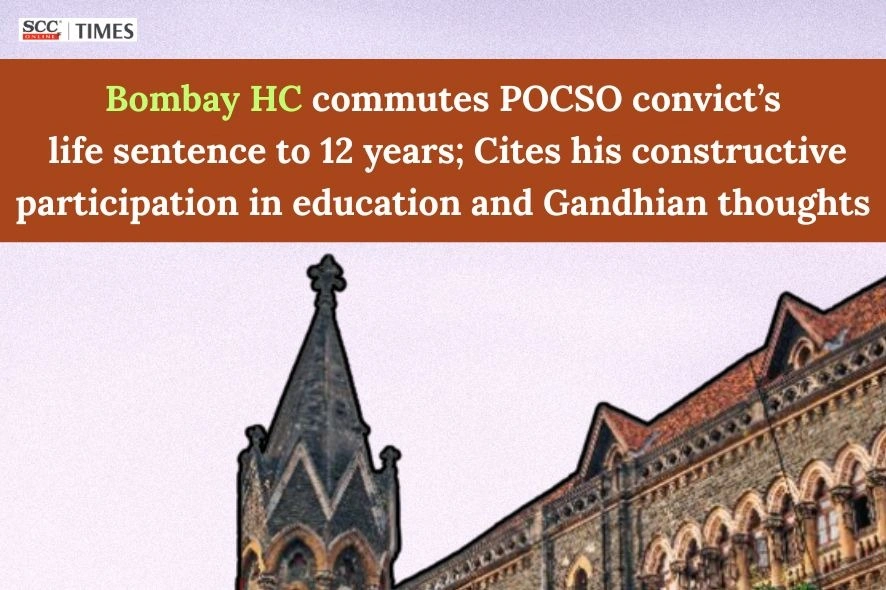
Bombay High Court: While considering a criminal appeal under Section 374 of the Criminal Procedure Code, 1973 (‘CrPC’), the Division Bench of Sarang V. Kotwal and Sandesh D. Patil*, JJ., affirmed the conviction of the appellant under Section 376 of the Penal Code, 1860 (‘IPC’) and Section 6 of the Protection of Children from the Sexual Offences Act, 2012 (‘POCSO Act’) for aggravated penetrative sexual assault on a minor child. The Court, however, modified the sentence, reducing it from life imprisonment to twelve years rigorous imprisonment. The Court emphasised that although the offence was grave, mitigating circumstances such as the young age of the accused, absence of criminal antecedents, and his constructive activities during custody warranted leniency in sentencing.
Background:
On 09-12-2016, the minor victim, aged about four years, was sent by her mother to fetch water from a neighbour’s house. At that time, the accused, who was present in the house, called the child inside and committed aggravated penetrative sexual assault by forcing her to take his private part in her mouth. The frightened victim immediately narrated the incident to her mother, who informed her father, and a complaint was lodged with the police.
During trial, the prosecution examined fourteen witnesses, including the victim, her parents, and the investigating officers. The victim gave a clear and consistent account of the incident, identifying the accused, and her testimony was corroborated by her mother and father.
The defence contended that discrepancies existed in the timing of the FIR, that no independent witnesses were examined, that the doctor was not called to testify, and that panch witnesses did not corroborate the case. It was argued that the prosecution had failed to prove the charges beyond reasonable doubt.
Conversely, the prosecution and counsel for the victim submitted that the testimony of a five-year-old child was natural, immediate, and trustworthy, with no reason for her to fabricate such a serious allegation. They maintained that the evidence was consistent, reliable, and sufficient to sustain conviction.-year-old child was natural, immediate, and trustworthy, with no reason for her to fabricate such a serious allegation. They maintained that the evidence was consistent, reliable, and sufficient to sustain conviction.
Analysis and Decision:
The Court emphasised that the prosecution had proved its case beyond reasonable doubt as far as offences under Section 376 IPC and Section 6 of the POCSO Act are concerned. The Court affirmed the judgment of the Trial Court that the accused had committed offences under Section 376 IPC and Section 6 of the POCSO Act. The Court, however, noted that the accused was only 20 years of age at the time when the offence took place, as reflected in the FIR, and was not released on bail even during Covid-19.
Moreover, the Court observed that he has been continuously in custody since his arrest in December 2016, i.e., for more than nine years, and that there are no criminal antecedents against him. By examining the records produced by various authorities, the Court noted that the accused had appeared for examinations, one such certificate being issued by Tilak Maharashtra Vidyapeeth, Pune, certifying that he had participated in the programme for analysis of the books.
It was further highlighted that a second certificate was issued by Ramchandra Pratishthan, Mumbai, certifying that he had participated in an essay competition, and a third certificate was issued by Mumbai Sarvodaya Mandal for studying the thoughts of Mahatma Gandhi, where he had successfully participated and passed the examination.
Taking these factors cumulatively, the Court showed leniency in sentencing while maintaining the gravity of the offence. The Court held that a sentence of twelve years would meet the ends of justice, thereby reducing the punishment from life imprisonment to twelve years rigorous imprisonment, along with fine and compensation as directed by the Trial Court.
The Court, thus, affirmed the conviction of the accused under Section 376 IPC and Section 6 of the POCSO Act, as recorded in the judgment of the Special Judge on 07-12-2020. However, the Court set aside the sentence of life imprisonment and instead imposed twelve years of rigorous imprisonment along with a fine of Rs 1,000 under Section 6 of the POCSO Act, with a default sentence of one month’s simple imprisonment.
Lastly, the Court maintained the compensation of Rs 25,000 awarded to the victim under Section 33(8) of the POCSO Act and directed that the accused be granted set-off for the period already spent in custody under Section 428 CrPC. The Court further ordered that a copy of the judgment be provided to the accused free of cost in accordance with Section 363(1) CrPC.
With these directions and modifications, the appeal was partly allowed and disposed of, and the connected interim application was also accordingly disposed of.
[Kalamuddin Mohammad Isteyar Ansari v. State of Maharashtra, 2026 SCC OnLine Bom 983, decided on 02-02-2026]
*Judgment authored by: Justice Sandesh D. Patil
Advocates who appeared in this case:
For the Appellant: O.P. Lalwani with Kunda Gaikwad, Gypson John, Suraj Kunchikorve and Riya John i/b Rajesh Sakhare, Advocates
For the Respondents: Kranti Hiwrale, A.P.P., Shraddha Sawant, Appointed Advocate
Buy Protection of Children from Sexual Offences Act, 2012 HERE
Buy Code of Criminal Procedure, 1973 HERE
Buy Penal Code, 1860 HERE