
Disclaimer: This has been reported after the availability of the order of the Court and not on media reports so as to give an accurate report to our readers.
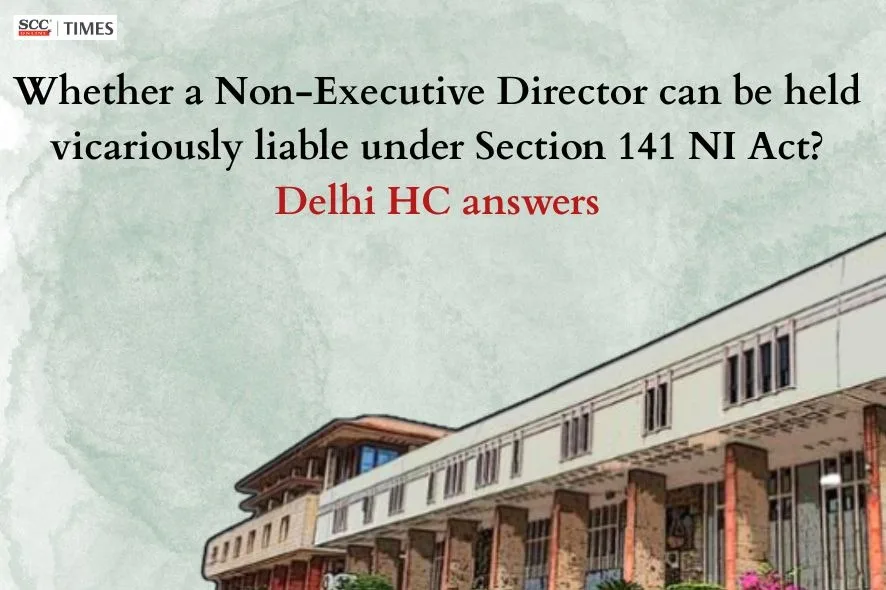
Delhi High Court: In a petition was filed under Section 482 CrPC seeking quashing of criminal complaint under Sections 138 and 141 of the Negotiable Instruments Act, 1881 (NI Act), and the Summoning Order dated 04-10-2018 whereby the petitioner was summoned as Director of the accused company, a Single-Juge Bench of Neena Bansal Krishna,* J., set aside the summoning order against the petitioner and held that mere designation as Non-Executive Director without specific averments cannot attract vicarious liability under Section 141 NI Act.
In the instant matter, the respondent (complainant company), sanctioned a loan of Rs. 35,00,00,000/- to the accused company vide Sanction Letter dated 23-03-2016. The loan was repayable in 24 months with quarterly interest payments. It was alleged in the complaint that Accused 2 and 3 were Directors and Accused 4 and 5 were authorised signatories.
The accused company executed a Facility Agreement dated 23-03-2016 and other documents. Towards repayment of principal and interest, three cheques were issued. These cheques were signed by the authorised signatories of the company and were allegedly issued “with the consent connivance and knowledge of the other Accused persons.” Upon presentation, all cheques were dishonoured on account of “Account Closed.”
A legal notice dated 09-08-2018 demanding Rs. 36,27,50,000/- was issued and served. No payment was made, leading to the filing of the complaint under Section 138 NI Act. The petitioner, arrayed as Accused 3, was summoned as a Director. She contended that she was a Non-Executive Director and had no role in day-to-day affairs of the company.
The core issue before the Court was whether a Non-Executive Director, against whom only general averments were made, could be fastened with vicarious liability under Section 141 of the NI Act.
The Court stated that Section 141 NI Act is a penal provision which creates vicarious liability where the offence is committed by a company and must be strictly construed. The Court relied on S.M.S. Pharmaceuticals Ltd. v. Neeta Bhalla, (2005) 8 SCC 89, where the Supreme Court held that “mere designation as a Director is not sufficient; specific role and responsibility must be established in the Complaint” and N.K. Wahi v. Shekhar Singh, (2007) 9 SCC 481, where it was observed that “there must be a specific allegation in the Complaint as to the part played by the alleged Directors in the transaction.”
Further, with respect to Non-Executive Directors, the Court relied upon Pooja Ravinder Devidasani v. State of Maharashtra, (2014) 16 SCC 1, where it was held that “to attract liability under section 141 of the NI Act, the accused must have been actively in-charge of the company’s business at the relevant time. Mere directorship does not create automatic liability under the Act. The law has consistently held that only those who are responsible for the day-to-day conduct of business can be held accountable.”
The Court examined the complaint and found that no specific role was attributed to the petitioner beyond general statements that the petitioner looked after day-to-day affairs, the cheques were signed by authorised signatories, not by the petitioner and the complaint did not disclose any act, communication, or document linking her to operational management. The Court noted that “mere bald assertion that the Petitioners were responsible for day to day affairs, is not enough to attract provisions of N.I. Act unless it is explained as to how and in what manner Petitioners are in charge of and responsible for conduct of the business of the Company.”
The Court further noted that the DIR-12 form reflected that the petitioner was categorised as a “Non-Executive Director.” The Court held that Non-Executive Directors, including Independent Directors, are typically not involved in the day-to-day operations of the Company, which further limits the scope of their potential liability.
The Court further held that in view of Section 149(12) of the Companies Act, 2013, liability of Non-Executive Directors arises only where acts are attributable to them through knowledge, consent, connivance, or lack of due diligence and in the present case no such material existed in the complaint.
The Court held that the complaint failed to disclose specific averments demonstrating that the petitioner was in charge of and responsible for the conduct of business at the time of commission of offence. The petitioner, being a Non-Executive Director with no specific role attributed, could not be held vicariously liable under Section 141 NI Act.
The Court allowed the petition and set aside the Summoning Order dated 04-10-2018 qua the petitioner.
[Praveen Singh v. Religare Finvest (P) Ltd., 2025 SCC OnLine Del 10832, Decided on 21-11-2025]
*Judgment by Justice Neena Bansal Krishna
Advocates who appeared in this case:
Mr. Akshay Bhandari, Mr. Anmol Sachdeva, Mr. Kushal Kumar and Ms. Megha Saroa, Counsel for the Petitioner
Mr. Sanjeev Kumar Sharma, Ms. Sanya Sud and Mr. Raahul Sharma, Counsel for the Respondent 1