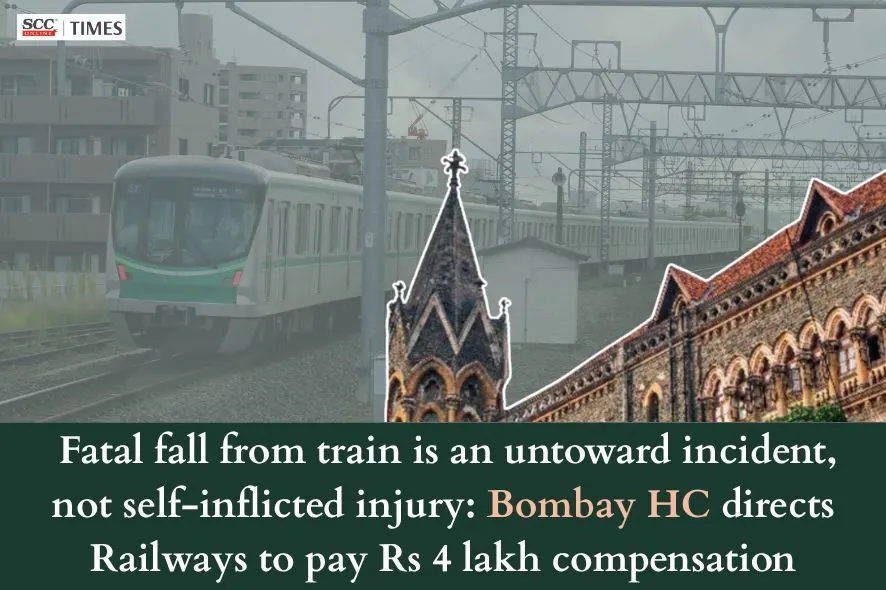
Bombay High Court: While deciding whether a fatal fall while travelling on a train is an ‘untoward incident’, or whether it was a ‘self-inflicted injury’ disentitling compensation, a Single Judge Bench of Jitendra Jain, J., set aside the Tribunal’s order and held that fatal fall from a train was an ‘untoward incident’ and not a self-inflicted injury. The Court directed Railways to pay statutory compensation emphasising that mere assertions that the passenger was ‘trying to alight’ from a moving train, unsupported by examined eyewitnesses or expert evidence, could not convert an accidental fall into a self-inflicted injury.
Background
On 4-4-2011, the deceased fell between Virar and Nalasopara stations while travelling from Navsari to Borivali by an express train. A co-passenger informed the guard, the train was stopped, and the body was pulled out from the wheels of the compartment. A valid ticket was found on the body, establishing that the deceased was a bona fide passenger. The Railway Claims Tribunal (‘Tribunal’) rejected the compensation claim, proceeding on the guard’s communication to the station master that the co-passenger had told the deceased was trying to alight from the moving train and got entangled in the wheel. The Tribunal concluded the death was a ‘self-inflicted injury’ and not an ‘untoward incident’. The appellants challenged that Tribunal’s order, to which the respondent submitted that the matter be remanded to the Tribunal for fresh evidence.
Analysis and Decision
The Court noted that the deceased was a bona fide passenger, as a valid ticket was recovered from the body. The Court observed that neither the co-passenger nor the guard was examined before the Tribunal, and therefore, much credence could not be given to their statements. The Tribunal’s reasoning was unsustainable because the Railways failed to examine the co-passenger or the guard and did not even lead expert evidence to show that a person falling from a moving train could not get entangled in its wheels.
The Court further noted that there was no eyewitness to the deceased allegedly alighting from the moving train. The Court opined that when a person fell while alighting from a moving train, the body might be found away, but it was also possible that the body might get entangled in the wheels of the same train, and observed that it could only be certified by an expert how the body got entangled in the wheels. The Court emphasized the settled position that in matters governed by beneficial legislation, the benefit of doubt should go in the person’s favour who has met with the accident.
The Court referred to Bala Pujari v. Union of India, 2025 SCC OnLine Ori 5163, wherein it was held that it is a judicially recognised matter of common occurrence that a passenger who falls from a moving train may subsequently be dragged or run over either by the same train or by another passing train. The subsequent aggravation of injuries does not alter the intrinsic character of the initial mishap as an accidental fall. The Court also relied on Union of India v. Rina Devi, (2019) 3 SCC 572, where it was observed that mere negligence of any particular degree cannot be treated as ‘self-inflicted injury’, and that death or injury in the course of boarding or deboarding a train falls within the ambit of an ‘untoward incident’.
On the respondent’s request for remand, the Court noted that the accident took place in April 2011 and that the appeal was being decided in January 2026. After nearly 15 years, a remand for fresh evidence would be counterproductive. The Court opined that no second inning should be allowed without justification when in the first round, no evidence could be laid by the Railways. Based on the Railways’ failure to examine important witnesses, the fact that the deceased died while travelling in the train and that he had a valid ticket, the Court observed that the case at hand could not be treated as a death by ‘self-inflicted injury’.
Accordingly, the Court quashed and set aside the Tribunal’s order dated 29-9-2014, and directed that the applicants make an application to the respondent for compensation of Rs 4 lakh with interest at 6% per annum from the date of the accident till the date of payment, subject to a cap of Rs 8 lakh, which was to be remitted to the appellants’ bank accounts in eight weeks.
[Vasanti Parsottam Patel v. Union of India, 2026 SCC OnLine Bom 277, decided on 27-1-2026]
Advocates who appeared in this case:
For the Appellants: Avadhut P. Bidaye.
For the Respondent: Suresh Kumar