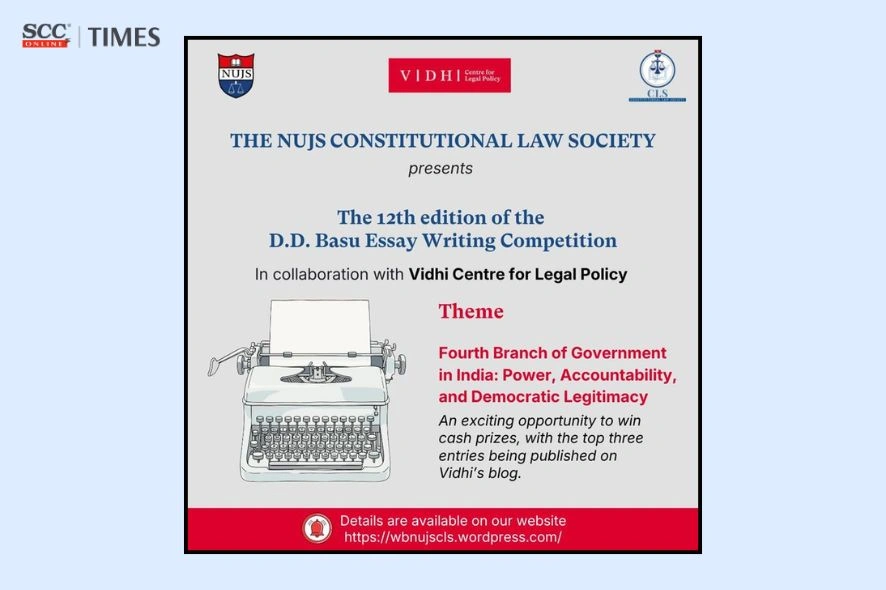
Organised by: The Constitutional Law Society, in collaboration with, The Vidhi Centre for Legal Policy
Theme: “Fourth Branch of Government in India: Power, Accountability, and Democratic Legitimacy”
This edition focuses on the idea of the Fourth Branch of Government, highlighting contemporary constitutional governance, particularly the role of independent constitutional and statutory bodies, regulatory institutions, questions of institutional design, and democratic accountability. The indicative list of sub-themes allows for a wide range of doctrinal, theoretical, and comparative analyses.
Indicative list of sub-themes under the broad theme of the Essay Competition:
-
Judicial Recognition and Limits of Fourth Branch in India
-
Balancing Autonomy and Accountability of Fourth Branch Institutions
-
Public Accountability of Fourth Branh Institutions
-
Independence and Executive Control of Tribunals and Statutory Bodies
-
Rethinking Institutional design for the Fourth Branch in India
In fond memory of Eminent jurist and lawyer, Shri Durga Das Basu (1910-1997)
Dr Basu was a distinguished Judge of the Calcutta High Court. He was also a member of the Union Law Commission. His commentary on the Constitution of India, written over twenty years ago, is still used extensively as the primary treatise on constitutional law across India. Dr Basu was awarded the Padma Bhushan (1985), National Citizen’s Award (1991) and was also honoured with an Honorary Fellowship of Asiatic Society, Calcutta (1994). He has authored some of the most authoritative and reputed works on the Constitution of India. Every year, contemporary topics of constitutional significance are chosen for the Competition. The themes in the previous years have ranged from the right to protest within the ambit of Part III of the Constitution to the use of constitutional power to disqualify a person from contesting democratic elections.
ABOUT THE CONSTITUTIONAL LAW SOCIETY:
The Constitutional Law Society (‘CLS’) is an academic society constituted in 2012 by interested students and our erstwhile faculty advisor, the former Vice-Chancellor, to assist in understanding Constitutional Law. Its objective is to further knowledge and create a supportive environment for academic discussions and thoughts about constitutional matters. The CLS has successfully organised several events, including quizzes, mock parliaments, and discussions by eminent scholars on topics of constitutional law of contemporary as well as historical relevance. In the past, we have hosted luminaries in the field, such as K.K. Venugopal, Upendra Baxi, and Catherine MacKinnon, among others.
ABOUT VIDHI CENTRE FOR LEGAL POLICY:
The Vidhi Centre for Legal Policy is an independent, not-for-profit think tank dedicated to improving governance and creating better laws for the public good through high-quality, peer-reviewed legal research. Since its establishment, Vidhi has worked closely with the Government of India, state governments, and public institutions to inform policymaking, draft legislation, and drive impactful reforms. Its contributions include significant work on the bankruptcy ecosystem, the data protection bill, and repealing discriminatory laws, among others. Guided by values of non-partisanship, research excellence, and independence, Vidhi continues to shape the legal and policy landscape in India.
ABOUT THE ESSAY COMPETITION:
This competition provides a platform for participants to analyze these intricacies, explore the historical and legal contexts, and propose innovative reforms. By encouraging scholarly engagement, the competition seeks to contribute to the broader discourse on strengthening India’s democratic processes and fostering meaningful legal and policy advancements. Indicative sub-themes on the topic will be shared soon.
COMPETITION RULES:
-
The Competition is open to all undergraduate students of law colleges/departments of law of all Universities pursuing the 5-year-course or the 3-year-course. Co-authorship (of a maximum of two authors) is allowed. The co-authors may be students of different universities. There can be multiple participants from the same university.
-
Authors are encouraged to narrow down the broad theme by selecting a specific aspect within its realms to focus on for a more in-depth analysis.
-
The Competition does not include any registration fees.
-
All essay submissions shall undergo a strict online plagiarism check. Special consideration will be placed upon originality, applicability and feasibility of the arguments/ suggestions made in the essay and the depth of research.
-
All teams/ participants must send electronic copies by 11:59 PM on February 28, 2026. The submission of the essay has to be made by filling the form attached here.
-
No identification marks should be found on any part of the submissions. It is the responsibility of each Team to ensure that the “.docx” copy of the submission can be opened legibly with an edition of Microsoft Office 2007 or later, and the “.pdf” copy of the submission can be opened legibly with Adobe Acrobat Reader.
PRIZES TO BE AWARDED:
-
First place: INR 25,000 and a merit certificate.
-
Second place: INR 15,000 and a merit certificate.
-
Third place: INR 10,000 and a merit certificate.
-
The top 3 winning entries will be published as blog posts on Vidhi’s website.
FORMATTING SPECIFICATIONS:
-
Font: Times New Roman
-
Font Size: 12
-
Spacing: 1.5
-
Margin: One inch on all sides
-
Paper size: A4
-
Minimum Word Limit — 3000, Maximum word Limit — 5000 (excluding footnotes, speaking footnotes should be avoided).
-
Citations are mandatory and should be in the form of footnotes following a uniform format. The NUJS Law Review Standard of citation must be adhered to.
For any queries or clarifications, please email us at cls@nujs.edu with the subject of the email as “Clarifications – DD Basu Essay Writing Competition.”