
Disclaimer: This has been reported after the availability of the order of the Court and not on media reports so as to give an accurate report to our readers.
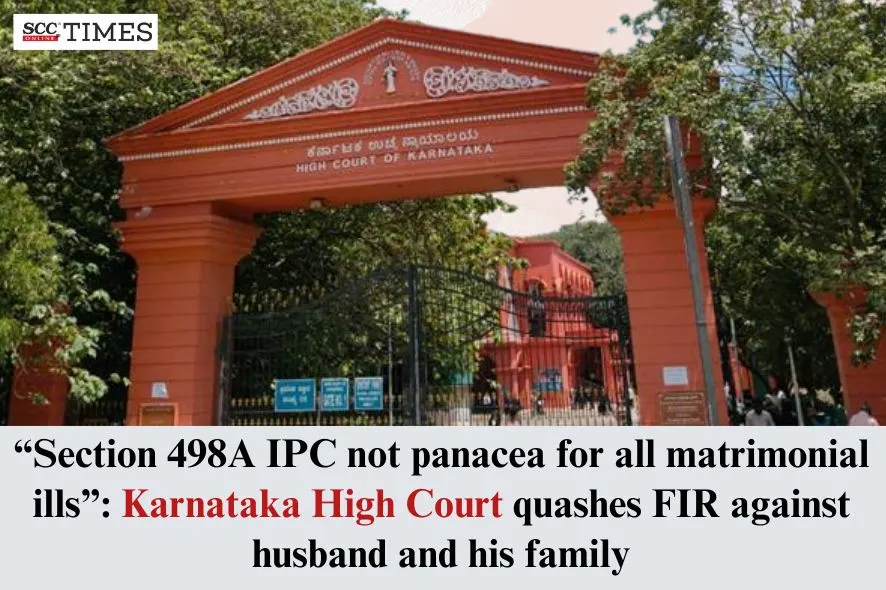
Karnataka High Court: While considering a petition filed under Section 482 of the Criminal Procedure Code 1973 (‘CrPC’) where quashing of FIR, against the Petitioner 1-husband and his family, under Sections 498-A and 504 of the Penal Code 1860 (‘IPC’) and Sections 3 and 4 of the Dowry Prohibition Act 1961 (‘DP Act’) was sought, a Single Judge Bench of M. Nagaprasanna, J., held that Section 498A of the IPC is not a panacea for all matrimonial ills, it is a targeted provision meant to address grave cruelty, conduct so willful and pernicious so as to imperil life, limb or mental health or even harassment tethered to unlawful demands of dowry.
Hence, the Court quashed the said FIR and stated that Section 498A of the IPC did not criminalize incompatibility, nor did it punish imperfect marriages.
Background
The husband and Respondent 2-wife got married in August 2017. The husband was already working in the United States of America (‘USA’) and post marriage, he took his wife to stay there. Two children were born from their wedlock.
In January 2023, when the wife returned to India, she registered complaint for offences punishable under Sections 34, 498A, 504 of IPC not only against her husband but also against the father-in-law, mother-in-law and brother-in law stating that they allegedly harassed her over telephone.
Analysis and Decision
The Court perused the complaint and noted that it revealed grievances such as dietary restrictions, expectations regarding attire, allocation of household responsibilities, disagreements over television preferences laced with a statement that the husband treated the wife as his servant. The Court held that even if accepted at face value, the said allegations, portrayed a portrait of marital discord, but fell woefully short of depicting the statutory cruelty contemplated under Section 498A of the IPC.
Considering that the complaint stated that the husband stopped receiving calls and he called his brother and parents to come and stay with him in the USA, the Court held that it was an abuse of the process of law, as minor skirmishes that happened in the family between the husband and the wife were projected to become a crime for offences punishable under Section 498A or 504 of the IPC. The Court stated that it was shocking as to how without any preliminary inquiry as directed by the Supreme Court in Lalita Kumari v. State of Uttar Pradesh (2014)2 SCC 1, the complaint was even registered, by the jurisdictional police and above all, the husband was stopped from moving away from the shores of the nation on frivolous allegations on account of issuance of Look Out Circular.
The Court further stated that Section 498A of the IPC did not criminalize incompatibility, nor does it punish imperfect marriages. The provision is not a panacea for all matrimonial ills, it is a targeted provision meant to address grave cruelty, conduct so willful and pernicious so as to imperil life, limb or mental health or even harassment tethered to unlawful demands of dowry. The Court opined that the said complaint was conspicuously bereft of such particulars. There was neither an allegation of demand of dowry nor any conduct of such severity as would shock the conscience or satisfy the statutory threshold.
The Court stated that the judicial precedent underscored that criminal law must not be permitted to degenerate into an instrument of oppression or personal vengeance. The inherent powers of the High Court under Section 482 of the CrPC (Section 528 of the BNSS) exist precisely to prevent such abuse and to secure the ends of justice.
The Court further stated that more disquieting was that the indiscriminating roping in of the parents-in-law and brother-in-law, despite their residence in India, while the marital life was largely lived abroad. The Court highlighted that the Supreme Court has cautioned against the “very tendency of transforming a matrimonial dispute into a criminal dragnet ensnaring every member of the husband’s family”.
The Court stated that such prosecutions founded on vague and omnibus allegations or even the complaints so registered on omnibus allegations, do not advance justice but corrode it. Further, the Court stressed that the allegations in case at hand, even at their highest, did not constitute the alleged offence, they were inherently improbable. Thus, the Court opined that the continuation of investigation would serve no purpose other than to prolong harassment, stigmatize the petitioners and squander the precious time of criminal Courts.
The Court stated that issuance of Look Out Circular against the husband on allegations so tenuous, would only compound injustice. Thus, permitting the criminal process to lumber forward would be to allow law to become a weapon rather than a remedy. The Court stated that it deemed appropriate to obliterate the very registration of crime against the petitioners, to prevent it becoming an abuse of the process of the law and resulting in miscarriage of justice.
Hence, the Court allowed the petition and quashed the FIR against the petitioners.
[Abuzar Ahmed v. State of Karnataka, 2026 SCC OnLine Kar 54, decided on 8-1-2026]
Advocates who appeared in this case:
For the Petitioner: Syed Khaleel Pasha, Advocate
For the Respondent: B. N. Jagadeesha, Addl. SPP, Naveed Ahmed, Advocate and H. Shanthi Bhushan, DSGI
Buy Code of Criminal Procedure, 1973 HERE

Buy Penal Code, 1860 HERE