


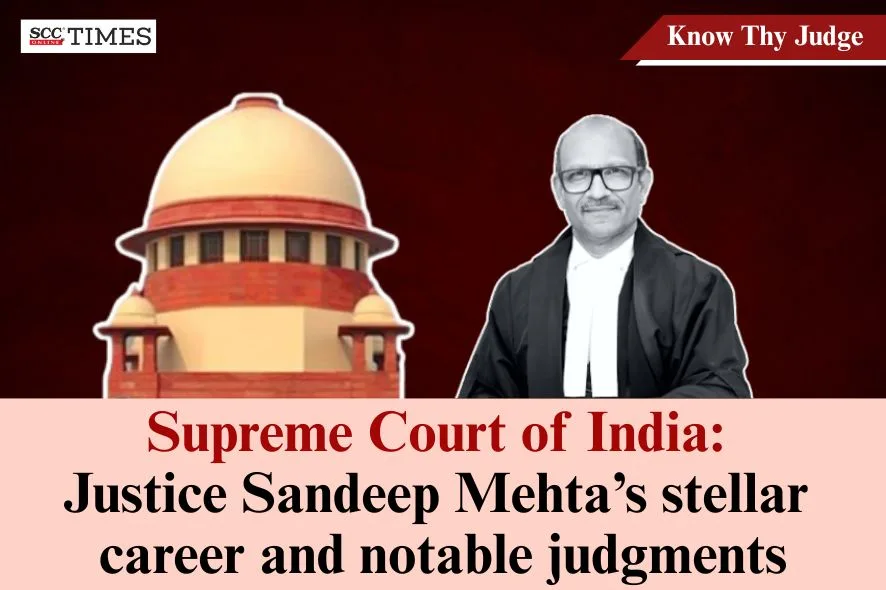
Born on 11-01-1963, Justice Sandeep Mehta took oath as the Supreme Court Judge on 9-11-2023. He previously served as the Chief Justice of Gauhati High Court. The Supreme Court Collegium recommended appointment of Justice Sandeep Mehta, Chief Justice of Gauhati High Court, as the Supreme Court Judge on 6-11-2023 and soon, the same received clearance from the Central Government.
Justice Sandeep Mehta’s Career Trajectory1
Justice Mehta enrolled with the Bar in 1986, joined as the member of Bar Council of Rajasthan in 2003 and remained one till his elevation to the Bench in 2011. He has practiced in Trial Courts, High Courts as well as the Supreme Court. Justice Mehta has also been the Vice-Chairman and Chairman of Bar Council of Rajasthan during 2004-05; 2009 and 2010 respectively. He has been Counsel for three Judicial Enquiry Commissions headed by retired as well as sitting Judges of the High Court.
He was elevated as the Additional Judge of Rajasthan High Court in 2011. The Supreme Court Collegium in its resolution dated 07-02-2023 recommended the appointment of Justice Sandeep Mehta, as the Chief Justice of the Gauhati High Court and specified that, Rajasthan High Court is unrepresented among the Chief Justices of the High Courts. The Resolution also stated that previously, Justice K. Vinod Chandran had been recommended as Chief Justice of the Gauhati High Court but was recommended as Chief Justice of the High Court of Judicature at Patna through a separate resolution. Subsequently, the Ministry of Law & Justice, Government of India, notified the appointment of Justice Sandeep Mehta, as the Chief Justice of Gauhati High Court on 12-02-2023.
The Supreme Court Collegium recommended appointment of Justice Sandeep Mehta as the Supreme Court Judge on 6-11-2023 and he took oath on 9-11-2023. Justice Sandeep Mehta will be retiring on 10-01-2028.
Notable Judgments by Justice Sandeep Mehta
While considering this matter revolving around sexual assault of a 4-year-old-girl (child victim) which was found to be “enveloped in layers of investigative apathy and procedural infirmities”, the Division Bench of Vikram Nath and Sandeep Mehta*, JJ., opined that a more structured and uniform practice must be adopted to enhance the legibility of criminal judgments. Accordingly, to ensure a systematic presentation of evidence that enables efficient appreciation of the record, the Court issued effective directions to all Trial Courts with the aim to institutionalize a standardized format for cataloguing witnesses, documentary evidence, and material objects, in order to facilitate better comprehension and immediate reference for all stakeholders, including the Appellate Courts. [Manojbhai Jethabhai Parmar (Rohit) v. State of Gujarat, 2025 SCC OnLine SC 2803]
While considering a petition seeking exhaustive directions for providing appropriate legal framework and facilities to persons with Disabilities (PwD) who are undergoing incarceration in the prisons either as undertrials or convicts, the Division Bench of Vikram Nath and Sandeep Mehta*, JJ., issued another set of directions in addition to salutary directions issued in L. Muruganantham v. State of T.N., 2025 SCC OnLine SC 1444, which shall also be read in conjunction with the mandate of L. Muruganantham judgment. [Sathyan Naravoor v. Union of India, 2025 SCC OnLine SC 2738]
While considering this petition filed by Mission Accessibility seeking inter alia, the modification of the timeline for scribe registration in the Civil Services Examination conducted by Union Public Service Commission and for permitting the use of laptops equipped with Screen Reader Software along with accessible digital question papers for eligible candidates; the Division Bench of Vikram Nath and Sandeep Mehta*, JJ., issued necessary directions to ensure that decisions taken by the UPSC are effectively translated into action and the rights of candidates belonging to the Persons with Benchmark Disability/Persons with Disability (PwBD/PwD) category are fully safeguarded. [Mission Accessibility v. Union of India, 2025 SCC OnLine SC 2635]
In furtherance of the directions passed by the Court in City Hounded by Strays, Kids Pay Price, In re, (2025) 9 SCC 1, the 3-Judge Bench of Vikram Nath, Sandeep Mehta* and N.V. Anjaria, JJ., perused the compliance affidavits filed by the States and Union Territories pursuant to this Court’s earlier directions; and deemed it fit to modify, the directions issued by the High Court of Judicature for Rajasthan at Jodhpur in Suo Moto v. Union of India, 2025 SCC OnLine Raj 3831 and issued further directions in respect of institutional areas, including educational establishments, hospitals, sports complexes, and other public spaces such as railway stations and bus depots, where incidents of dog-bite attacks continue to be reported with alarming frequency, raising a cause of grave concern and requiring emergent remedial measures. [In Re: “City Hounded by Strays, Kids Pay Price”, 2025 SCC OnLine SC 2371]
While considering an appeal urging the Court to uphold and advance the constitutional vision of an inclusive society that recognizes every individual, regardless of their disability, as an equal participant in the nation’s framework, the Division Bench of Vikram Nath and Sandeep Mehta*, JJ., gave the following directions: The Court directed a nationwide monitoring of all State-run care institutions housing persons with cognitive disabilities to be distributed across different regions of the country for greater reach and oversight so as to be effective. The monitoring shall also extend to examining the implementation of the RPwD Act. To undertake this task, the Court directed that the monitoring be undertaken under the name and style of the “Project Ability Empowerment” and which shall be undertaken by eight National Law Universities each covering specific States and/or Union Territories. The Court further opined that National Law Universities and Advisory Group Expert Panel undertaking the “Project Ability Empowerment” shall pay particular attention to the following key areas, to guide the scope of their compilation(s) and recommendation(s). [Reena Banerjee v. State (NCT of Delhi), 2025 SCC OnLine SC 1966]
While deciding this appeal arising from an order passed by Allahabad High Court by which the High Court had dismissed the appellant’s petition seeking quashment of summoning order, the Division Bench of J.B. Pardiwala and Sandeep Mehta, JJ., laid down certain steps which must be followed to determine the veracity of a prayer for quashing, raised by an accused by invoking the power vested in the High Court under Section 482 of the CrPC. [Pradeep Kumar Kesarwani v. State of U.P., 2025 SCC OnLine SC 1947]
While considering this appeal challenging Andhra Pradesh High Court’s decision to not transfer the investigation on the appellant’s 17-year-old daughter’s tragic death to the CBI; the Division Bench of Vikram Nath and Sandeep Mehta*, JJ., reflecting upon the underlying societal issue of growing crisis of student suicides in the context of contemporary education, issued comprehensive Guidelines for preventive, remedial, and supportive framework for mental health protection and prevention of suicides by students across all educational institutions. [Sukdeb Saha v. State of A.P., 2025 SCC OnLine SC 1515]
The appellant, a Judicial Officer of the District Judge Cadre in the judicial services of the State of Rajasthan, approached this Court to challenge the strictures passed against him in order dated 3-5-2024 (‘the impugned order’) by the Rajasthan High Court (‘the High Court’). The 3-Judges Bench of Vikram Nath, Sanjay Karol, and Sandeep Mehta*, JJ., opined that the strictures and/or the scathing observations were made to the detriment of the appellant as he was not provided with any opportunity of explanation, thus, the same were set aside. The Court opined that every High Court in the country should consider incorporating a provision in the respective High Court Rules and/or Criminal Side Rules which would impose an obligation on the accused persons to make disclosures regarding his/her involvement in any other criminal case(s) previously registered. [Kaushal Singh v. State of Rajasthan, 2025 SCC OnLine SC 1473]
While considering this appeal filed by the victim challenging the grant of bail to Respondent 2, who during her tenure as Superintendent of Uttar Raksha Grih, was accused of sex trafficking helpless women who resided in that protection home; the Division Bench of Vikram Nath and Sandeep Mehta*, JJ., lamented that the present case was clearly of one where the person put in the role of a saviour has turned into a devil. Observing that allegations against Respondent 2 had shaken the Court’ conscience. “Grant of bail to the person accused of such grave offences without assigning reasons shakes the conscience of the Court and would have an adverse impact on the society”. Therefore, exercising extraordinary jurisdiction under Article 136 of the Constitution, the Court cancelled the bail granted to Respondent 2. [X3 v. State of Bihar, 2025 SCC OnLine SC 1490]
In an appeal filed by a person with a benchmark disability (‘PwBD’) who belongs to the reserved category of Scheduled Caste and aspires for admission to the MBBS UG course, the Division Bench comprising Vikram Nath and Sandeep Mehta*, JJ., while setting aside the impugned order, directed that the appellant to be allocated a seat in the MBBS UG course for 2025, against the Scheduled Castes PwBD quota, at the All-India Institute of Medical Sciences, New Delhi (‘AIIMS, New Delhi’), in the forthcoming academic session. [Kabir Paharia v. National Medical Commission, 2025 SCC OnLine SC 1025]
In an appeal filed by the convict against the judgment passed by the Allahabad High Court, wherein the Court affirmed the conviction order of the Trial Court, for the offences punishable under Sections 376(2)(f) and 376(2)(i) of the Penal Code, 1860 and Sections 3 read with Section 4 of Protection of Children from Sexual Offences Act, 2012, (‘POCSO Act’) the division bench of Vikram Nath and Sandeep Mehta* , JJ. clarified that when the alleged acts or omissions constitute offence both under the IPC and the POCSO Act then, the law which prescribes the punishment of greater degree would have to be applied. Hence, it viewed that conviction for the offences punishable under Sections 376(2)(f) and 376(2)(i) of IPC and Section 3 read with Section 4 of POCSO Act was wholly justified. However, the High Court erred while directing that the convict would have to serve life imprisonment for remainder of his natural life as provided under Sections 376(2)(f) and 376(2)(i) of IPC. [Gyanendra Singh v. State of U.P., 2025 SCC OnLine SC 517]
In an appeal filed against the order passed by the Delhi High Court, wherein the Court affirmed the District Court’s decision to declare the appellant’s application for making of the award as premature because it was filed before the commencement of the limitation period for filing objection against the award, the division bench of Pamidighantam Sri Narasimha* and Sandeep Mehta, JJ. set aside the impugned order and directed the District Judge to take up and dispose of the matter as expeditiously as possible, preferably within a period of five months from the date of receipt of this judgment. The Court reaffirmed that the date of receiving the copy of the award is not the relevant trigger for limitation, but rather the point at which the party becomes aware of its availability. [Krishna Devi v. Union of India, 2025 SCC OnLine SC 24]
While considering the instant appeal revolving around Section 14 of the Hindu Succession Act, 1956, the Division Bench of P.S. Narasimha and Sandeep Mehta, JJ., noted that there are many decisions which are not only inconsistent with one another on principle but have tried to negotiate a contrary view by distinguishing them on facts or by simply ignoring the binding decision. Hence the Court was of the view that there must be clarity and certainty in the interpretation of Section 14 of the Hindu Succession Act. Therefore, the Court directed the Registry to place the instant order along with appeal paper book before the Chief Justice of India for constituting an appropriate larger bench to reconcile the principles laid down in various Supreme Court decisions concerning Section 14 and for restating the law on the interplay between sub-clauses (1) and (2) of Section 14. [Tej Bhan v. Ram Kishan, 2024 SCC OnLine SC 3661]
Supreme Court upholds land acquisition for Yamuna Expressway; Justifies Invocation of Urgency Clause
In batch of appeals arising out of the land acquisition proceedings initiated by State of Uttar Pradesh for planned development in the District Gautam Budh Nagar, Uttar Pradesh, through Yamuna Expressway Industrial Development Authority (‘YEIDA’) by invoking ‘urgency provisions’ incorporated in Sections 17(1) and 17(4) of the Land Acquisition Act, 1894, (‘the Act’), the division bench of BR Gavai and Sandeep Mehta* , JJ. justified the State’s decision to invoke the urgency provisions under Sections 17(1) and 17(4) of the Act, allowing the acquisition to proceed without the usual hearing of objections under Section 5-A of the Act and upheld the land acquisition proceedings. [Kali Charan v. State of U.P., 2024 SCC OnLine SC 3472]
In an appeal filed against the judgment passed by the Allahabad High Court, wherein the Court set aside the judgment dated 05-06-2015 passed by the State Public Services Tribunal, whereby, the Tribunal had allowed the Claim Petition preferred by the appellant, the division bench of PS Narasimha and Sandeep Mehta, JJ. set aside the impugned judgment and restored the order rendered by the Public Service Tribunal and reiterated that recording of evidence in a disciplinary proceeding proposing charges of a major punishment is mandatory, and mere production of documents is not enough, contents of documentary evidence have to be proved by examining witnesses. [Satyendra Singh v. State of U.P., 2024 SCC OnLine SC 3325]
In a civil appeal against the judgment passed by Madras High Court, whereby the Court reversed the judgment passed by the Central Administrative Tribunal, rejecting the Original Application, challenging the proposed action of revision and fixation of appellants seniority in the Engine Factory, the division bench of Sandeep Mehta and R. Mahadevan, JJ. while upholding the impugned judgment viewed that the subsequent Government Order dated 4-08-2015 cannot be read as a clarification and therefore cannot be made applicable retrospectively. The said GO has substantively modified the position governing seniority in the Industrial Establishments by reviving the earlier OM, and supersedes the orders/circulars, which were holding the field over more than a decade. Therefore, giving retrospective effect to the GO dated 4-08-2015 would have catastrophic effect on the seniority of the entire cadre. [V. Vincent Velankanni v. Union of India, 2024 SCC OnLine SC 2642]
In a civil appeal filed by New Delhi Municipal Council (‘NDMC’) and Delhi Sikh Gurdwara Management Committee (‘DSGMC’) against a judgment passed by the Delhi High Court, wherein the Court directed NDMC to reimburse the pay and perquisites including the pension and other benefits accruing to the staff of the school and then to recover the same from DSGMC, the division bench of Hima Kohli and Sandeep Mehta*, JJ. held that NDMC would not be liable for absorption and payment of benefits to the excess staff of the school run by the DSGMC on account of the closure of the school done by the DSGMC without the prior approval of the NDMC. [NDMC v. Manju Tomar, 2024 SCC OnLine SC 2272]
While deliberating over the instant appeal challenging Delhi High Court’s decision to uphold Central Administrative Tribunal’s (CAT) decision to allow respondent’s application challenging the denial of promotional benefits to him, the Division Bench of Sandeep Mehta* and R. Mahadevan, JJ., held that the disciplinary/criminal proceedings can be said to be initiated against a government employee only when a charge memo is issued to the employee in a disciplinary proceeding or a charge-sheet for a criminal prosecution is filed in the competent Court. The sealed cover procedure is to be resorted to only after issuance of the charge-memo/charge-sheet is issued. The pendency of investigation and grant of prosecution sanction will not be sufficient to enable the authorities to adopt the sealed cover procedure. [Union of India v. Doly Loyi, 2024 SCC OnLine SC 2613]
While considering the instant appeal revolving around a contentious finding whereby, the car driver, was held jointly responsible for causing the accident along with the driver/owner of the offending truck leading to the claims of the appellant & dependents of the deceased-passengers being deducted by 50% on the principle of contributory negligence; the Division Bench of P.S. Narasimha* and Sandeep Mehta, JJ., held that the finding was perverse in law. The Court further held that finding of the MACT and Karnataka High Court, which reduced the claims of the legal heirs of the deceased and the injured, other than the legal heirs of the driver, was also invalid in the eyes of law. The Court further found that the contributory negligence of the car driver was vicariously applied to the passengers to reduce the compensation, which is prima facie illegal and impermissible. [Sushma v. Nitin Ganapati Rangole, 2024 SCC OnLine SC 2584]
While considering the instant appeal wherein the order by the Bihar Government directing reduction in the pay scale and recovery of excess recovery of excess amount and the order of Patna High Court upholding the same, was challenged by the appellant; the Division Bench of Sandeep Mehta* and R. Mahadevan, JJ., opined that that any decision taken by the State Government to reduce an employee’s pay scale and recover the excess amount, cannot be applied retrospectively and that too after a long time gap. The Court further stated that any step of reduction in the pay scale and recovery from a government employee would be like a punitive action because the same has drastic civil and evil consequences. [Jagdish Prasad Singh v. State of Bihar, 2024 SCC OnLine SC 1909]
In a civil appeal against Rajasthan High Court’s Division Bench decision whereby, the appeal against decision of the Single Judge for upholding the Civil Court’s decision as to widow wife’s right to be maintained from the suit property of the Hindu family, was dismissed, the Division Bench of BR Gavai and Sandeep Mehta*, JJ. allowed the appeal and set aside the impugned decisions. The Bench reiterated that for establishing full ownership on the undivided joint family estate under Section 14(1) of the Succession Act, the Hindu female must not only be possessed of the property, but she must have acquired the property. [Mukatlal v. Kailash Chand, 2024 SCC OnLine SC 964]
In a criminal appeal filed by the State of West Bengal for assailing the legality and validity of the judgment passed by the Calcutta High Court, wherein the Court held that only a Special Court constituted by the Central Government or the State Government as per the National Investigation Agency Act, 2008 (‘NIA Act’) had the exclusive jurisdiction to try the offences under UAPA, the Division Bench of BR Gavai and Sandeep Mehta*, JJ. while setting aside the impugned judgment, held that when the State has not constituted a Special Court for trial of offences set out in the Schedule to the NIA Act, the Sessions Court within whose jurisdiction, the offence took place has the power and jurisdiction to deal with the case by virtue of the Section 22 (3) of the NIA Act. [State of W.B. v. Jayeeta Das, 2024 SCC OnLine SC 550]
Can a company file a consumer complaint under Consumer Protection Act, 1986? SC clarifies
In a civil appeal under Section 67 of the Consumer Protection Act, 2019 (‘Act of 2019’) by the Kozyflex Mattresses Private Limited (‘insured-appellant’) against the final decision of the National Consumer Disputes Redressal Commission (‘NCDRC’), rejecting the Consumer Case filed by the insured-appellant for a direction to the SBI General Insurance Company(‘SBI-insurance’) to indemnify it for the loss caused by fire in the manufacturing unit (‘insured premises’) of the insured-appellant company, the Division Bench of BR Gavai and Sandeep Mehta*, JJ. allowed the appeal and set aside the impugned decision. The matter was remitted to the NCDRC. [Kozyflex Mattresses (P) Ltd. v. SBI General Insurance Co. Ltd., (2024) 7 SCC 140]
In a writ petition seeking an investigation against the promoters, directors, beneficiaries and key-managerial personnel and shell entities of auto parts maker Amtek Auto Limited Group (‘Amtek Auto’), the division bench of BR Gavai and Sandeep Mehta*, JJ. has directed Directorate of Enforcement(‘ED’) to investigate against former promoters of Amtek Auto for allegedly siphoning over Rs. 20,000 crores obtained from public banks, after observing that there appeared to be prima facie material to indicate collusion in the scam by bank officials. The Court has asked ED to file a status report before the next date of the hearing, that is after six months. [Jaskaran Singh Chawla v. Union of India, 2024 SCC OnLine SC 255]
Gauhati High Court reverses DRT order to condone delay of 224 days
A challenge against decision of Debt Recovery Tribunal for condonation of delay of 224 days in preferring the SARFAESI application under Section 17(1) of the Securitisation and Reconstruction of Financial Assets and Enforcement of Security Interest Act, 2002, explained the restriction on DRT for condonation of delay, and exercised its jurisdiction to condone such delay and reverse the DRT order. [Bornali Sarmah v. Punjab National Bank, 2023 SCC OnLine Gau 1166]
Rajasthan HC | Is Juvenile Justice Act totally foreign to the concept of “right of hearing” given to the complainant/CICL in bail applications?
The Court held that “The apprehension expressed regarding the likelihood of the petitioner coming into contact with other offenders can be taken off by requiring his natural guardian to furnish a suitable undertaking. I am of the opinion that petitioner child is entitled to be enlarged on bail. Consequently, the instant revision is allowed.” [X v. State2]
The Division Bench of Sandeep Mehta and Kumari Prabha Sharma, JJ., dismissed the allegations of dowry demand, cruelty against the father-in-law and husband of the deceased in view of the prosecution theory regarding homicidal death being nothing short of sheer exaggeration. [Gopal v. State of Rajasthan3]
The division bench of Sandeep Mehta and Kuldeep Mathur, JJ., set aside the order of the Joint Commissioner, State Goods and Services Tax (‘GST’) for delayed payment of tax due to violation of mandatory requirement of Section 75(6) of the Central Goods and Services Tax Act, 2017 (‘CGST Act’). The Court concluded that the Officer did not consider the reply filed by the petitioner, while passing the order characterizing it as sketchy and non-speaking on the face of it. The Court while setting aside the order, asserted that it suffered from non-application of mind and was in violation of mandatory requirement of section 75 (6) of the CGST Act. [Hindustan Construction Company Ltd. v. Union of India, 2022 SCC OnLine Raj 2478]
The Division Bench of Sandeep Mehta and Sameer Jain, JJ., allowed the appeal and quashed and set aside the judgment of conviction and sentence in a case of dowry death. The Court held that “we are persuaded to accept the plea of insanity advanced on behalf of the appellant to overturn his conviction as recorded by the trial court by the impugned Judgment.” [Mohan Lal v. State, 2022 SCC OnLine Raj 185]
The Division Bench of Sandeep Mehta and Abhay Chaturvedi, JJ., allowed a Habeas Corpus Petition in favour of the petitioner allowing him to stay with his wife and directed the authorities to provide her with adequate protection. [Dinesh Suthar v. State of Rajasthan, 2019 SCC OnLine Raj 1229]
1. https://www.sci.gov.in/judge/justice-sandeep-mehta/
2. S.B. Criminal Revision Petition No. 494 of 2021
3. DB Criminal Appeal No. 799 of 2014

Good work