
Disclaimer: This has been reported after the availability of the order of the Court and not on media reports so as to give an accurate report to our readers.
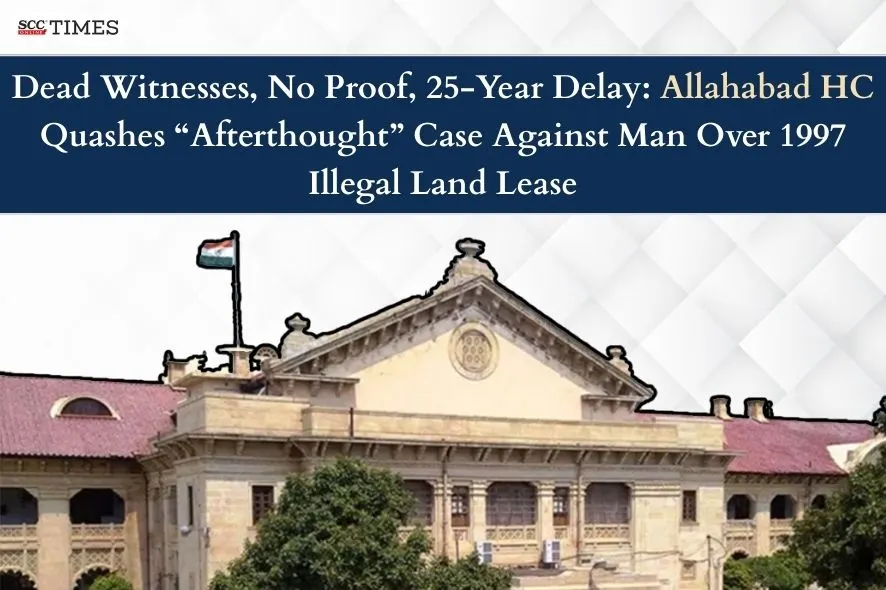
Allahabad High Court: In a criminal appeal filed by an accused in a 1997 illegal agricultural leasing case, the Single Judge Bench of Shekhar Kumar Yadav, J., allowed the appeal, holding that the appellant was not named in the FIR, no specific role or overt act was attributed to him, the dispute is predominantly civil and revenue in nature, the proceedings were initiated after an unexplained and inordinate delay of more than two decades, the provisions of the SC ST Act were invoked without satisfying the mandatory statutory ingredients, and the State did not take any action to cancel the alleged forged leases.
Background
In 1997, about 282 persons were granted leases of agricultural land by the competent authority, which were subsequently approved. Later on, complaints were received alleging that some allottees were ineligible and that the land so allotted was transferred to private persons by execution of sale deeds through manipulation of revenue records and forged documents.
The present FIR was filed by the Revenue Inspector in 2022, alleging that there were irregularities in the allotment and subsequent transfer of agricultural land of Village Chitahara, Tehsil Dadri. The FIR further alleged that certain persons, acting in connivance with others, committed forgery in revenue entries, showed enhancement of land area, and transferred land in violation of statutory provisions, thereby causing wrongful loss to the State exchequer and wrongful gain to the beneficiaries. In some cases, the land meant for members of the Scheduled Caste community was alienated in contravention of law, resulting in the invocation of Section 3(1)(f) of the Scheduled Castes and the Scheduled Tribes (Prevention of Atrocities) Act, 1989 (“SC ST Act”), along with offences under Sections 420, 467, 468, 471, 384 and 120-B of the Penal Code, 1860 (“IPC”).
Thereafter, the accused herein was summoned at a subsequent stage by the Trial Court. Aggrieved, he filed the present appeal under Section 14-A(1) of the SC ST Act.
The accused herein contended that the allegations pertain to transactions involving the leased land of Village Chitahara dating back to 1997, which were subject to multiple judicial proceedings and ultimately validated by competent Revenue Courts. Furthermore, the charge sheet includes various prosecution witnesses, out of which five witnesses had died years before the investigation commenced, exposing the fabricated nature of the investigation. The accused herein further contended that he was not named in the FIR, and neither the FIR nor the charge sheet mentioned any individual act attributable to the accused herein to satisfy the basic ingredients of the alleged offences.
Analysis
At the outset, the Court stated that from a careful examination of the FIR, charge sheet, and accompanying material, it was evident that the allegations against the accused herein were general and omnibus. No specific role, overt act, or individual transaction has been attributed to the accused herein to constitute the ingredients of the offences alleged. Thus, the principles laid down in State of Haryana v. Bhajan Lal, 1992 Supp (1) SCC 335, were clearly attracted.
The Court further stated that the dispute arose out of land allotments made in 1997 and subsequent revenue proceedings. The allegations are primarily related to alleged irregularities in revenue records, which have already been the subject matter of civil and revenue adjudication. Thus, the Court held that continuation of criminal proceedings in such circumstances would amount to abuse of the process of law as per the law laid down in Anand Kumar Mohatta v. State (NCT of Delhi),(2019) 11 SCC 706.
The Court found that the essential ingredients of offences under Sections 420, 467, 468, 471, 384, and 120-B of the IPC were not made out against him. The Court stated that, “There is no material indicating dishonest intention at inception or preparation or use of forged documents by the accused herein.”
Regarding the invocation of the SC ST Act, the Court noted that the FIR and charge sheet did not disclose that the alleged acts were committed on the ground that the victim belongs to a Scheduled Caste or a Scheduled Tribe. The Court referred to the decision in Hitesh Verma v. State of Uttarakhand, (2020) 10 SCC 710, wherein it was held that a mere reference to the Scheduled Caste land or status of the informant is insufficient to attract the provisions of the SC ST Act.
Thus, the Court held that the impugned cognizance order dated 20-03-2023 was passed routinely and mechanically, without recording satisfaction regarding the existence of prima facie material against the accused herein. Such an approach was impermissible in view of the law laid down in Pepsi Foods Ltd. v. Special Judicial Magistrate, (1998) 5 SCC 749.
Furthermore, the Court noted the following facts:
-
Various original pattadars and villagers were granted the lands in 1997 by the competent authorities.
-
Witnesses did not attribute alleged coercion, threats, or inducement to the accused herein;
-
Several witnesses have categorically stated that they did not know the accused herein personally, nor have they said that any document was executed, forged, or registered at his instance;
-
No witness has alleged that the accused herein threatened, induced, or deceived them, or received any money from them in connection with the land transactions.
-
The statements of independent witnesses and the inquiry officer primarily narrated the history of revenue litigation, cancellation proceedings with regard to the lease, and administrative inquiries, but did not disclose any active role or criminal intent attributable to the accused herein. At best, the material reflected civil disputes.
-
None of the witnesses stated that any act was committed by the accused persons on the ground that the pattadar belonged to a Scheduled Caste, which was a sine qua non for the invocation of the SC ST Act.
Thus, the Court held that even the oral evidence collected during the investigation did not disclose the basic ingredients of the offences alleged against the accused herein and failed to establish any prima facie case.
The Court further noted that the accused herein was not named in the FIR. “Neither the FIR nor the charge-sheet explains as to how, when, or on what basis the name of the accused herein surfaced during investigation. There is no reference to any incriminating document, transaction, recovery, or statement of any witness showing the role of the accused herein in the alleged offences. The prosecution has also failed to disclose the source of information or link evidence connecting the accused herein with the alleged conspiracy.”
The Court held that in the absence of any material explaining the genesis of the accused’s implication, the mere inclusion of his name in the charge-sheet appeared to be mechanical and unsupported by evidence, which could not be sustained in law. Criminal prosecution cannot rest on assumptions or conjectures, particularly when the FIR itself is silent about the accused herein.
Regarding the procedural irregularities, the Court stated that the record disclosed that the investigation suffered from grave and fatal irregularities as the charge sheet included various witnesses, out of which five witnesses were dead. This fact conclusively established that the investigation was faulty, unfair, and biased, and continuing the case would amount to an abuse of the judicial process and result in a miscarriage of justice.
“The inclusion of deceased persons as prosecution witnesses, without any explanation, goes to the root of the matter and reflects non-application of mind during investigation, thereby rendering the investigation unreliable and legally unsustainable.”
On the aspect of co-accused persons, the Court noted that several named and unnamed co-accused persons, arising out of the same FIR and charge-sheet, have already been granted relief by Coordinate Benches. The Coordinate Benches had observed that the dispute was predominantly civil and revenue in nature, no specific role was assigned to the accused persons therein, and the provisions of the SC ST Act were, prima facie, not attracted. They also held that the allegations pertained to old land allotments and revenue entries, the FIR contained general and omnibus allegations, essential ingredients of the alleged IPC provisions were not made out, and that continuation of criminal proceedings would amount to abuse of the process of law.
Furthermore, the Court stated that the role attributed to the accused herein was neither distinguishable nor graver than the role assigned to those co-accused who have already been granted relief. No material had been pointed out to demonstrate any distinguishing feature or additional incriminating circumstance against the present accused herein to deny him similar treatment.
Regarding the delay in filing the FIR, the Court stated that not only was it registered in 2022, approximately 24-25 years after the allotments, but even considering the claim that irregularities were discovered in 2016, the FIR was lodged after 7 years without any plausible or convincing explanation. Furthermore, despite the passage of more than two decades, the State had not been able to point out any civil suit, revenue proceeding, or statutory action initiated for the cancellation of the sale deeds.
The Court held that if the pattas/sale deeds were illegal, fraudulent, or obtained by misrepresentation, the natural and lawful course available to the State was to seek their cancellation before the competent revenue or civil forum. However, no material was placed on record to show that any such proceedings were ever initiated or pursued to their logical conclusion.
The Court remarked that, “The absence of any action for cancellation of deeds for such a prolonged period clearly indicates that the dispute is essentially civil and revenue in nature, and that the criminal machinery has been set in motion afterthought and as a substitute for appropriate civil remedies, which is impermissible in law. Criminal prosecution cannot be used to circumvent or replace statutory remedies available under revenue law.”
Accordingly, the Court allowed the appeal holding that the accused herein was not named in the FIR, no specific role or overt act was attributed to him, the dispute is predominantly civil and revenue in nature, the proceedings were initiated after an unexplained and inordinate delay of more than two decades, the provisions of the SC ST Act were invoked without satisfying the mandatory statutory ingredients, and the State did not take any action to cancel the alleged forged leases.
[Maloo v. State of U.P., 2025 SCC OnLine All 8098, decided on 19-12-2025]
Advocates who appeared in this case:
For the appellant: Senior Counsel Sageer Ahmad, Navnath Pandey, Sukrampal
For the respondent: Additional Government Advocate
Buy Penal Code, 1860 HERE