
Disclaimer: This has been reported after the availability of the order of the Court and not on media reports so as to give an accurate report to our readers.
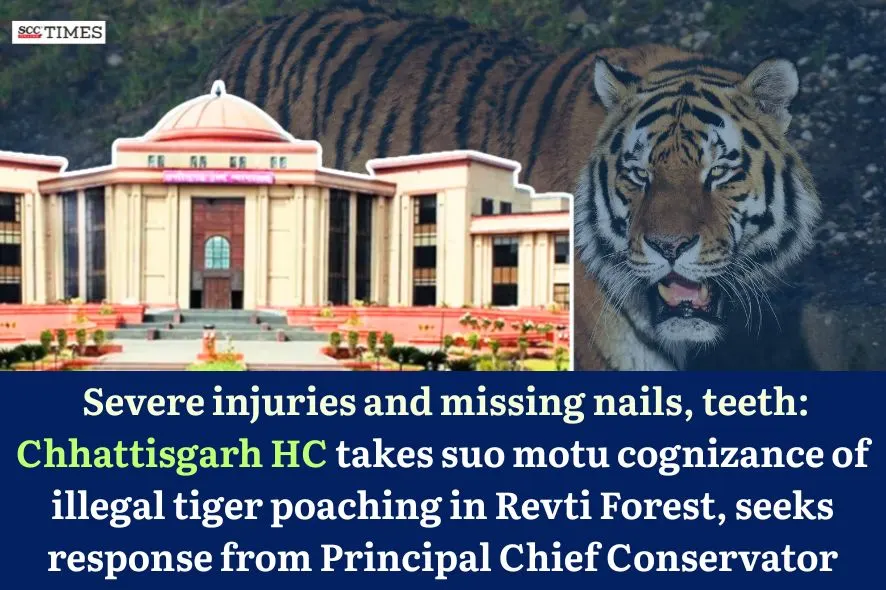
Chhattisgarh High Court: In a suo motu writ petition registered regarding the discovery of the carcass of a tiger who had been allegedly poached, the Division Bench of Ramesh Sinha, CJ., and Bibhu Datta Guru, J., took cognizance of similar incidents of animal poaching, especially poaching of a tiger in Revti Forest, and directed the Principal Chief Conservator of Forest-cum-Wild Life Warden, Chhattisgarh (“Principal Chief Conservator”), to file an affidavit disclosing the concrete and effective steps taken and proposed to be taken by the State Government and its instrumentalities to prevent further incidents of poaching by electrocution and to curb the illegal practice of erecting electric fencing or laying live electric wires.
Background
On 11-11-2024, the Court took cognizance based on a news report published in Times City, The Times of India, regarding the discovery of a tiger carcass in the same spot of the unreserved Guru Ghasidas Park where the previous tiger poaching occurred.
While the matter was ongoing, on 16-12-2025, the Court took cognizance of another news report published in Hairbhoomi, which stated that another tiger’s carcass was discovered in the Revti forest of the Forest Range, Ghui, under the Surajpur Forest Division. The dead tiger’s body bore severe injury marks and missing teeth and nails, suggesting it was poached.
Villagers who visited the Revti Forest found the tiger’s carcass and informed forest officials about the incident. When forest officials and veterinarians assessed the situation, they discovered that the tiger had likely died 3-4 days prior, given the swollen and decomposing state of the carcass. A sharp weapon was also found nearby, which was suspected to have been used to remove the nails and teeth of the tiger. Based on the available evidence, the officials, prima facie, suspected that the tiger was hunted.
The Court also took note of the death of an elderly tigress, who was ailing for the past several years at the Kanan Pendari Zoo, Bilaspur. At Khairagarh, an adult leopard was brutally killed in the forest village of Banbod, and poachers took its claws, nails, and jaw teeth. After the villagers saw the leopard’s carcass, they informed the Forest Department. After inspection, some suspects were detained and questioned. The scene was sealed and guarded by security forces. Additionally, dog squads were included in the investigation, and suspicious activity in surrounding villages was being monitored.
Noting the serious nature of such incidents, the Court directed the Principal Chief Conservator to file a personal affidavit in this regard.
Accordingly, the Principal Chief Conservator filed an affidavit explaining the actions taken by the Forest and Wildlife Department, which were as follows:
-
The area where the carcass was found was cordoned off for proper investigation.
-
A requisition had been made for assigning a dog squad for investigation.
-
A postmortem committee was to be constituted in accordance with the standard operating procedure adopted for wildlife, particularly tigers.
-
An investigation committee was constituted to investigate the death of the tiger.
-
The Assistant Inspector General, National Tiger Conservation Authority, Regional Office, Nagpur, was informed about the incident.
-
A show cause notice was issued to the Forest Guard concerned and to the Range Assistant, responsible for Ghui Forest Range, to explain the circumstances under which the tiger died. The Beat Officer concerned was also suspended.
-
A total of six people were being interrogated, and the main accused had been arrested.
-
Regarding the adult leopard that was brutally killed in Village Banbod, 7 persons were arrested and sent to 15 days’ judicial custody. From the accused persons, some pieces of teeth and all the 4 claws of the leopard were recovered. From the house of one of the accused, a sharp weapon was discovered, and he admitted to chopping off the claws using that weapon.
-
The State Government Department of Forest and Environment constituted a committee to monitor and ensure the safety and conservation of the wildlife, i.e., tigers and other animals, which are in constant danger of poaching.
-
The State government was undertaking six steps to ensure a scientific, data-driven framework that enhances surveillance, improves long-term decision-making, conservation goals, and strengthens systems to save wildlife.
-
Steps were being taken to create awareness among the local villagers and warn them about the seriousness of Forest offences involving the killing of wildlife to deter them from involving themselves in illegal poaching.
-
Sniffer dogs were placed in 7 different protected areas in Chhattisgarh for the investigation of wildlife offences.
-
The Principal Chief Conservator issued detailed instructions to all the field functionaries of the Forest Department regarding the preventive measures to be ensured to curb poaching and wildlife offences.
Analysis
Upon perusal of the aforesaid affidavit, the Court noted that evidently, prompt action had been taken by the State authorities and that the delinquent/poachers had been apprehended, with the claws, teeth, skin, and other body parts of the tiger and leopard having been duly recovered. However, the Court remarked that the disturbing aspect of these unfortunate incidents was the modus operandi adopted by the poachers, namely, the use of electric current for hunting wildlife.
“Such a method is not only fatal to animals but poses a grave and imminent danger to human life as well, as any unsuspecting person may come into contact with the live electric traps laid for illegal poaching.”
The Court stated that in WPPIL No. 84/2025, which pertained to the deaths of two children, one due to electrocution at an Anganwadi Centre and the other on account of electrocution caused by wired fencing in an agricultural field, the Court had directed the Chief Secretary to file a personal affidavit detailing the steps taken by the State to curb such untoward incidents. Pursuant thereto, the Chief Secretary filed his affidavit, which stated that a memorandum dated had been issued containing detailed instructions to officers and technical staff for minimizing incidents arising out of electrocution, including directions to conduct regular safety parades at all electricity distribution centres. The said affidavit, however, was confined primarily to the instructions issued to the personnel of the Electricity Distribution Company and the measures contemplated at the level of power supply and technical safety protocols.
Noting the aforesaid, the Court remarked that while such steps were undoubtedly necessary, they did not comprehensively address the grave issue of wildlife poaching using electric current, which involves multiple stakeholders and requires coordinated preventive and enforcement measures beyond the domain of the electricity authorities alone.
Considering the aforesaid and the recurring incidents of poaching by electrocution, the Court directed the Principal Chief Conservator to file a personal affidavit disclosing the concrete and effective steps taken and proposed to be taken by the State Government and its instrumentalities to prevent further incidents of poaching by electrocution and to curb the illegal practice of erecting electric fencing or laying live electric wires. The affidavit shall also indicate the mechanism put in place, or proposed to be put in place, for
-
the inter-departmental coordination between the Forest Department, the Electricity Distribution Company, the Police Department, and the district administration,
-
the identification of vulnerable areas,
-
the strengthening of patrolling and surveillance, and
-
the fixation of responsibility upon the concerned officers for ensuring strict compliance with the law.
The Court stated that such disclosure was necessary to ensure that effective, sustained, and preventive measures were adopted to safeguard wildlife and human life from the hazards posed by illegal electric traps laid for poaching.
The matter was listed for 21-01-2026.
[In the Matter of Suo Moto Public Interest Litigation v. State of Chhattisgarh, 2025 SCC OnLine Chh 12868, decided on 19-12-2025]
Advocates who appeared in this case:
For the respondent: Deputy Advocate General Praveen Das and Central Government Counsel Annapurna Tiwari